
Students from 23 countries travel to the North Pole aboard the nuclear-powered icebreaker "50 Years of Victory"
 Scan to share
The seventh "Knowledge Icebreaker" science and education expedition departed from Murmansk toward the North Pole, organized by Rosatom to coincide with the Year of National Unity in Russia. At the solemn departure ceremony, Captain Ruslan Sasov of the nuclear-powered icebreaker "50 Years of Victory" gave the order to set sail, with the vessel following the route Murmansk—North Pole—Franz Josef Land—Murmansk.
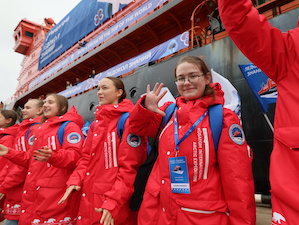
The expedition team includes primary and secondary school students and vocational school students from eight federal districts of Russia, as well as their peers from 22 countries around the world. Those selected include winners of Russian and international open competitions, participants in the "Rosatom Youth" engineering and technology movement, winners of the All-Russian "Big Change" contest, and laureates of other federal and international science competitions and olympiads, as well as a Moscow schoolgirl, Ekaterina Markova, who scored a perfect 500 points on the Unified State Exam. A key innovation this season is the "Master" track for future highly skilled technicians, which for the first time opens the door to the Arctic for students of vocational and technical colleges.
Rosatom Director General Alexey Likhachev stated: "The Arctic is a land of strength where the most ambitious ideas are born and realized. The 'Knowledge Icebreaker' carries exactly such young people to the North Pole. We are proud that our country's unique nuclear-powered icebreaker fleet provides them with this opportunity. Students from 23 countries will see technology on board that they cannot find anywhere else. We hope that the energy of gathered young minds will drive scientific progress and help protect our common home—the Earth."
Alexander Bugaev, First Deputy Minister of Education of Russia, noted that projects like this give children the chance to go beyond the classroom, express themselves, and experience the appeal of science and engineering. Science fiction writer Sergei Lukyanenko said he would discuss with students the topic of "how creative ideas are transformed into real-world technologies" and would lead them in creating popular science literature during the expedition.
The seventh season's selection was the largest in the history of the event: students from all 89 regions of Russia and 22 countries competed for places on the icebreaker. More than 73,000 teenagers aged 14 to 16 registered for the Russian selection, with a record competition ratio of 3045:1. The final round took the form of a "Science Showdown," featuring debates on quantum computing, nuclear medicine, energy aviation, and the development of the Moon and the Arctic.
Once on board, students will take part in lectures, discussions, master classes, and career counseling arranged by the Rosatom Corporate Academy. Special guests include science fiction writer Lukyanenko, the Bashkortostan band Ay Yola, and bloggers Yan Dilan and Vika Zhang. Lukyanenko will host a science fiction writing workshop, and the northernmost premiere of the animated film "Kikoriki: Across the Universe" will take place at the North Pole.
The nuclear-powered icebreaker fleet is one of Russia's key competitive advantages—no other country possesses such vessels. The fleet currently includes eight nuclear-powered icebreakers: the lead ship of Project 22220, "Arktika," along with its serial sister ships "Sibir," "Ural," and "Yakutia," as well as "Yamal," "50 Years of Victory," "Taymyr," and "Vaygach."
Disclaimer: Information republished from partner media, institutions or other websites is provided for reference and communication purposes only. It does not imply endorsement of its views or verification of its accuracy. Please contact us if any content infringes rights or requires correction.