
UC Santa Barbara and Lawrence Livermore National Laboratory Collaborate to Accelerate Fusion Plasma Simulations with AI
 Scan to share
The University of California, Santa Barbara (UCSB) and Lawrence Livermore National Laboratory (LLNL) are launching a new collaboration to bring artificial intelligence into extreme plasma simulations, accelerating critical computations in nuclear fusion and high-energy-density physics research.
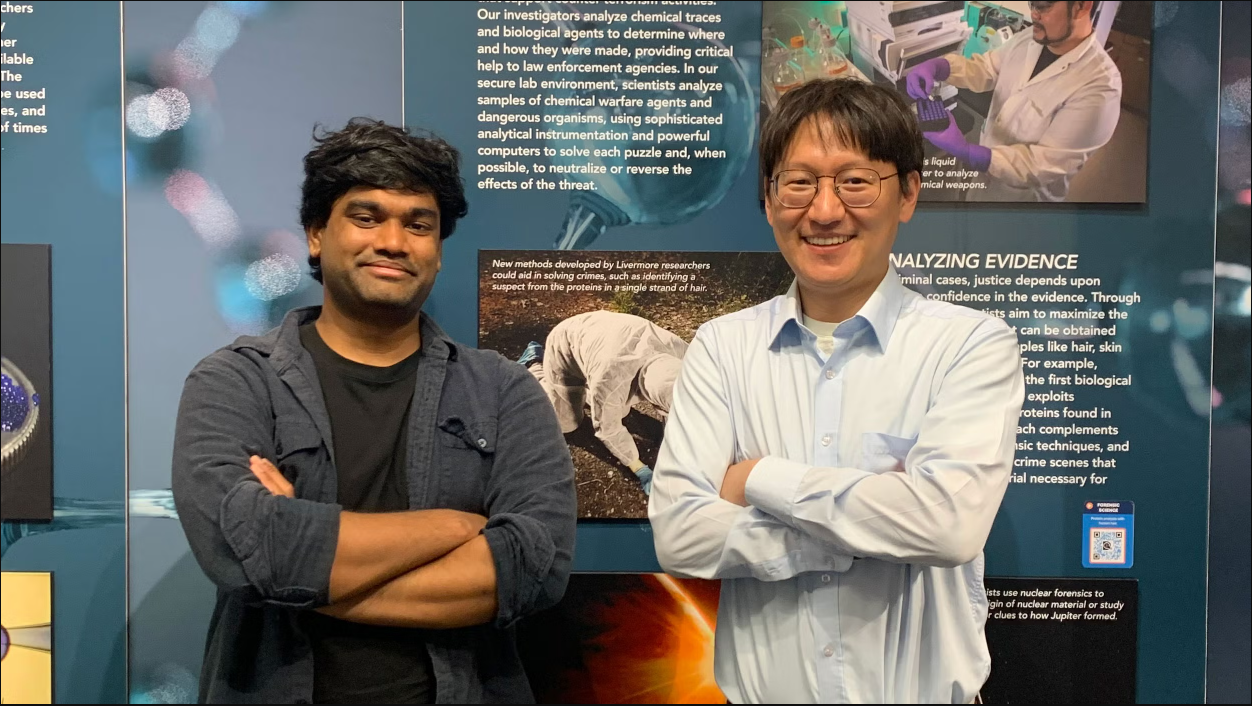
Neel Sankaran (left), a doctoral student of UCSB Professor Haewon Jeong, poses with LLNL scientist Min Sang Cho (right).
The project is led by Haewon Jeong, assistant professor in the Department of Electrical and Computer Engineering at UC Santa Barbara. Selected from 29 proposals submitted to the LLNL Academic Collaboration Team, it is one of five projects chosen to receive $536,000 per year from LLNL over three years. Jeong's team will work with LLNL scientists, including co-principal investigator Min Sang Cho. The two parties plan to build AI-driven surrogate models that can dramatically reduce the time required for large-scale plasma simulations.
Jeong noted that physics simulations are often computationally expensive. Surrogate models, especially AI-based ones, can approximate simulation results by learning from data, reducing reliance on directly solving partial differential equations and completing related tasks at lower computational cost.
The project, titled "Machine Learning for Non-Local Thermodynamic Equilibrium Kinetics," integrates machine learning, plasma physics, and high-performance computing, with a focus on non-local thermodynamic equilibrium (non-LTE) plasmas. Such plasmas exist in extreme states of matter where traditional simplifying assumptions may break down, making accurate simulation highly challenging.
In laser fusion research, ultra-intense lasers irradiate thin solid targets, ionizing the material and creating high-energy plasmas that release X-rays. These X-rays can be used to compress fusion fuel to the extreme conditions required for ignition. Jeong said that accurately simulating the relevant atomic states is crucial for understanding energy absorption, radiation generation, and how to drive fusion more efficiently.
These computations are difficult because plasmas contain numerous atomic and particle interactions that occur simultaneously across time and spatial scales. Existing simulation codes can describe the relevant physical processes with high accuracy but typically require substantial computational resources and long runtimes. To address this, the project will combine machine learning methods such as neural compression, generative modeling, and time-series forecasting to extract key patterns from complex systems.
Cho stated that laser fusion is considered one of the important scientific pathways for future clean energy research. LLNL achieved fusion ignition in 2022, but advancing fusion toward practical energy production requires a deeper understanding of how radiation and energy are transported in fusion plasmas, particularly under complex non-local thermodynamic equilibrium conditions, where these mechanisms affect energy flow and overall system performance.
He pointed out that these computations are time-consuming and often become bottlenecks in large-scale design studies and integrated simulations. If computation speeds can be significantly improved, researchers will be able to explore a broader range of plasma parameter space and more effectively analyze the physics of radiation and energy transport in fusion systems.
Neil Sankaran, a first-year doctoral student in Jeong's group participating in the project, said the team is using machine learning to simplify extremely complex plasma systems while preserving their essential physical characteristics. He noted that directly simulating every microscopic interaction is not realistic; the goal is to capture the patterns that truly matter for system behavior without computing every detail individually.
This collaboration also highlights the complementary roles of universities and national laboratories in interdisciplinary scientific research. UC Santa Barbara has research strengths in artificial intelligence and computational modeling, while LLNL has long-standing expertise in plasma physics, laser fusion, and high-energy-density physics. The two sides hope to combine their strengths to develop AI surrogate models that can be embedded into existing scientific workflows.
Jeong said that LLNL already possesses laser-driven plasma physics simulation codes used for nuclear fusion and extreme plasma environment research. If the new AI surrogate models can be integrated into these workflows and become tools that researchers use and trust in their daily work, that would represent substantial success for the project. She also expressed hope that the team can advance AI surrogate models from experimental research concepts to a reliable component of scientific computing.
Disclaimer: Information republished from partner media, institutions or other websites is provided for reference and communication purposes only. It does not imply endorsement of its views or verification of its accuracy. Please contact us if any content infringes rights or requires correction.