
DUNE Integrates Artificial Intelligence into Neutrino Experiment to Enhance Particle Detection and Data Processing Capabilities
 Scan to share
The team at the U.S. Fermi National Accelerator Laboratory is advancing the Deep Underground Neutrino Experiment (DUNE) by integrating artificial intelligence and machine learning tools into experiment design, detector operations, and data analysis workflows, aiming to improve neutrino interaction identification, event classification, and detector management capabilities.
Located at the Long-Baseline Neutrino Facility, DUNE has begun installing structural components for its large neutrino detector modules. The experiment consists of a near detector and a far detector: the near detector is situated at Fermilab, while the far detector is located approximately one mile underground at the Sanford Underground Research Facility in South Dakota. Both detectors will employ liquid argon time projection chamber technology to record the rare interactions between neutrinos and argon atoms.
Neutrinos interact with matter extremely weakly, making their detection highly challenging. The liquid argon time projection chambers used in DUNE can generate high-resolution images, providing critical data for studying neutrino properties, but they also present complex signal reconstruction challenges. To address this, the DUNE collaboration is developing artificial intelligence algorithms to identify whether neutrino interactions have occurred within the detector, trace particle tracks to pinpoint interaction locations, and infer the energy and direction of neutrinos upon entering the detector.
Fermilab has previously used deep neural networks to identify particle interactions in neutrino experiments such as NOvA and MicroBooNE. The DUNE collaboration states that these artificial intelligence tools can improve processing speeds by several orders of magnitude compared to traditional methods, helping to enhance signal processing, event classification, and particle identification, thereby increasing experimental sensitivity.
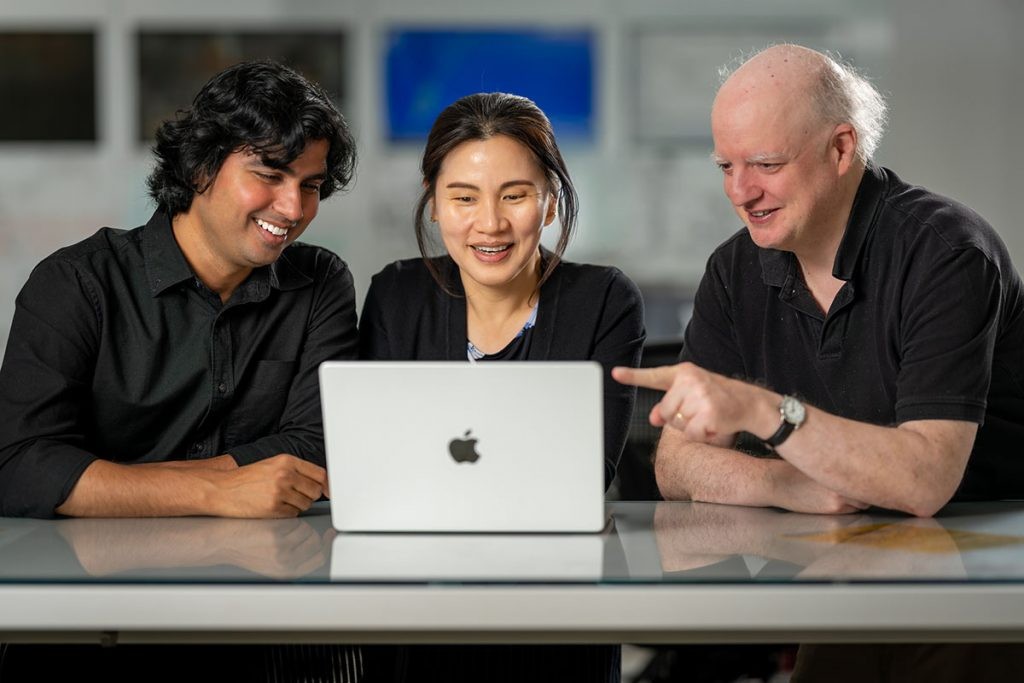
The Deep Underground Neutrino Experiment (DUNE) is pioneering the integration of artificial intelligence tools into the experiment to enhance the capabilities of DUNE scientists and accelerate scientific discovery. From left to right: Vishvas Pandey, Seon-Hee Seo, and Thomas Junk. Image credit: JJ Starr, Fermilab
Beyond routine neutrino signal reconstruction, DUNE is also training artificial intelligence "trigger" systems to rapidly screen large volumes of interaction events, retaining data of physical research value. One key task is identifying neutrino signals produced by supernova explosions within the Milky Way. Since neutrinos can arrive hours before optical signals reach Earth, such early warnings could help researchers pinpoint supernova locations more quickly, buying time for subsequent astronomical observations.
Artificial intelligence is also being applied to detector operations management. The DUNE detector consists of thousands of components that require continuous monitoring after installation and commissioning. The collaboration is investigating the use of large language models to rapidly retrieve operational logs and successful repair cases, providing operators with troubleshooting references; it is also exploring further automation of detector operations through machine learning and predictive capabilities to anticipate anomalies before they occur.
The DUNE collaboration is also strengthening partnerships with U.S. Department of Energy national laboratories and collaborating institutions to refine artificial intelligence infrastructure and establish workflows for processing petabyte-scale experimental data in the future. The project team notes that DUNE trains a large number of students and researchers each year, and the in-depth application of artificial intelligence tools will become an important component in cultivating the next generation of neutrino research talent.
Disclaimer: Information republished from partner media, institutions or other websites is provided for reference and communication purposes only. It does not imply endorsement of its views or verification of its accuracy. Please contact us if any content infringes rights or requires correction.