
StarRing Fusion Completes RMB 880 Million Series A++ Financing to Advance Fusion Device and Key Technology Engineering
 Scan to share
StarRing Fusion recently announced the completion of a new Series A++ financing round, raising RMB 880 million. This round was jointly invested by Shenzhen Capital Group, Shendan Venture Capital, ABC Capital, BOCOM Investment, GGV Capital, Yongxin Ark, Keke Capital, Advantage Capital, and other institutions, with existing shareholder Shanghai Science and Technology Innovation Group's intellectual property fund and other institutions continuing to follow on.
The company stated that the proceeds from this round, together with the previous Series A and A+ financing, will be used for the construction of the Shanghai Jiading experimental base, the construction and operation of the NTST negative-triangularity spherical tokamak, the design and construction of the CTRFR-1 "StarRing One," and the continued engineering advancement of key technologies including fusion-grade high-temperature superconducting magnets and AI-based plasma control.
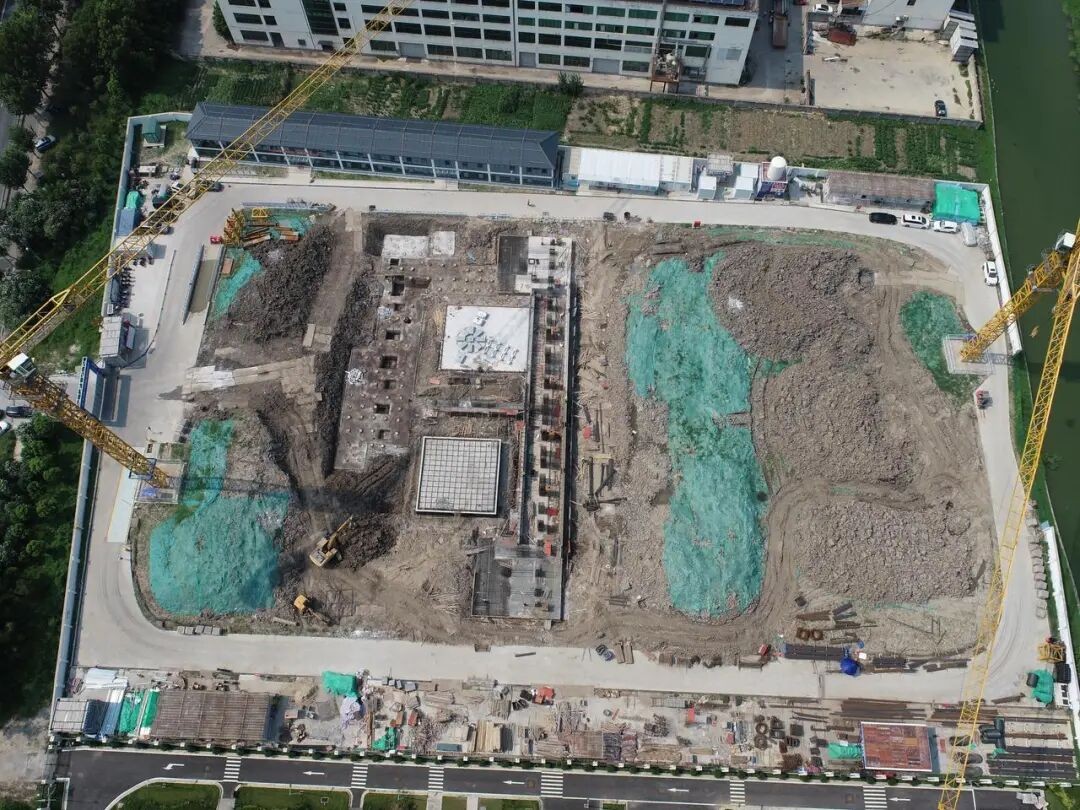
Since the completion of the Series A+ financing, StarRing Fusion's work has shifted from breakthroughs at key milestones to the coordinated advancement of device platforms, key components, supporting systems, and product delivery. The Shanghai Jiading experimental base broke ground in April 2026 and has completed pile foundation works, with construction of core areas such as the device hall currently underway. According to plan, the base will gradually become ready for device installation and equipment mobilization in the second half of 2026, and will undertake the company's subsequent device operation and engineering verification tasks.
The overall construction of NTST has entered the substantive advancement stage. Around the construction of this device, StarRing Fusion is advancing the construction of the device body, key components, and supporting systems. The manufacturing and processing of core components including the vacuum vessel, cryostat, structural components, and magnets, as well as the development and delivery of cooling, power supply, diagnostics, information, and safety systems, are all proceeding according to plan. Coil winding, coil box fabrication, raw material mobilization, and supply chain coordination are also advancing in parallel. Once the device hall conditions are ready, NTST will enter the installation and commissioning phase for subsequent engineering verification and physics research.
In the area of high-temperature superconducting magnets, StarRing Fusion's self-developed full-size high-temperature superconducting toroidal field magnet has completed a 20 K cryogenic excitation test and was successfully energized to 4.5 kA. The magnet measures approximately 4 meters in height and 2 meters in width, with dimensions consistent with future fusion device requirements rather than being a scaled-down model. The company stated that the magnet is designed for spherical tokamak fusion reactor applications, with an engineering current density exceeding 40 A/mm² including the coil box and a winding current density of 375 A/mm². Multiple test results have demonstrated stable performance. Full-size high-temperature superconducting ohmic field magnets, current leads, and other core components are also continuing cryogenic testing and validation.
In the power supply system area, the NTST device magnet power supplies adopt StarRing Fusion's self-developed universal pulsed power supply solution. The solution is based on a modular design and can be expanded through series-parallel configurations to meet the driving requirements of PF, CS, and TF magnets. Currently, the power supply system has transitioned from prototype development to the engineering delivery stage and has commenced batch production. The team has completed batch production process validation covering PCBA, full-unit assembly, and testing procedures, and has introduced self-designed automated test fixtures to improve module testing efficiency and product consistency. The NTST-TF power supply system has completed full-system assembly and entered the testing phase, with phased test results showing that all functions meet design specifications.
StarRing Fusion is also advancing the application of AI technology in fusion R&D and experimental analysis. The company's self-developed TokaPilot intelligent agent has been deployed in diagnostic signal processing, experimental analysis, anomaly detection, and data annotation, gradually forming a collaborative R&D model of "domain experts + intelligent agents." Around fusion experimental scenarios, the company is building an intelligent agent toolchain to promote the integration of experimental data, analysis programs, and physics models.
To meet fusion device construction needs, StarRing Electronics has established core electronic and electrical product lines including pulsed power supplies, signal conditioning equipment, and signal acquisition and sensing equipment, with some products already delivered to universities, research institutes, and high-end equipment applications. StarRing Fusion stated that it will continue to invest in high-temperature superconducting magnets, AI-based plasma control, device system integration, and key product delivery along the repeated-connection spherical tokamak technology roadmap, advancing the engineering and commercialization of fusion energy.
Disclaimer: Information republished from partner media, institutions or other websites is provided for reference and communication purposes only. It does not imply endorsement of its views or verification of its accuracy. Please contact us if any content infringes rights or requires correction.