
Shenju Nuclear Energy Unveils "Jinwu-1" Spherical Torus Fusion-Fission Hybrid Reactor Design
 Scan to share
Shenju (Sichuan) Nuclear Energy Co., Ltd. has unveiled the first-generation device, the "Jinwu-1" design, which adopts the spherical torus fusion-fission hybrid reactor technology pathway, driving a subcritical nuclear energy system with a compact fusion neutron source to achieve functions such as energy amplification, fuel breeding, and transmutation of long-lived nuclides.
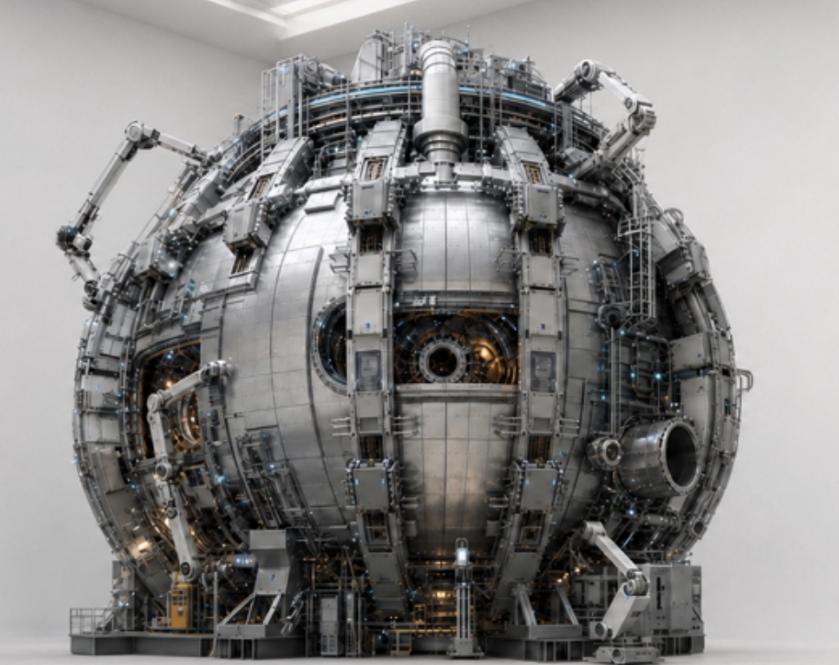
According to the design, Jinwu-1 uses a 50 MW-class fusion power as the conceptual design baseline, employing high-temperature superconducting magnets, a replaceable center column, and a modular subcritical nuclear energy zone. Its fusion core has a major radius of approximately 1.5 meters, with the goal of delivering approximately 40 MW of fusion neutron power at 14.1 MeV energy, serving as an industrial-grade neutron source.
In terms of system design, Jinwu-1 amplifies fusion neutron energy through a subcritical fission blanket. The project design proposes a nuclear thermal power multiplication factor of approximately 15, meaning 40 MW of fusion neutron power can drive approximately 600 MWth of nuclear thermal output; with the addition of fusion alpha particle deposition heat, the total plant nuclear thermal output reaches approximately 610 MWth. Based on a 35% to 40% thermal-to-electric conversion efficiency estimate, this corresponds to a gross electrical output of approximately 210 to 240 MWe.
The subcritical nuclear energy zone in this design adopts a zoned modular layout, designed around tritium breeding, nuclear fuel breeding, minor actinide transmutation, and long-lived fission product management. The lithium-containing breeding zone is intended to breed tritium through the lithium-6 neutron capture reaction, with a design tritium breeding ratio of no less than 1.15; the uranium-238 and thorium-232 zones can be used to convert and generate fissile nuclides such as plutonium-239 and uranium-233; meanwhile, the 14.1 MeV high-energy neutrons and fast neutron spectrum can be used to process long-lived minor actinides such as neptunium-237 and americium-241, with dedicated targets configurable for processing nuclides such as technetium-99 and iodine-129.
In terms of safety design, the Jinwu-1 nuclear energy zone maintains a subcritical state with an effective multiplication factor of less than 1, with fission power dependent on the external fusion neutron source for driving. According to the design, when the neutron source power decreases or terminates, the fission power will correspondingly decline. On this basis, the device will still be equipped with nuclear-grade engineering systems including independent shutdown, residual heat removal, radioactive material containment, tritium safety, and multiple barriers.
The project plan adopts a four-phase approach: "conceptual design — key validation — plasma verification — integrated demonstration." Phase one completes the unified design point, digital mockup, and core intellectual property layout for the 50 MW-class spherical torus hybrid reactor; phase two conducts prototype validation of high-temperature superconducting magnets, the center column, and high-heat-flux components; phase three constructs the fusion main machine and carries out stable, repeatable plasma operation validation; phase four completes the coupling of the subcritical nuclear energy zone with thermal-hydraulic and safety systems, achieving stable nuclear thermal and electrical output.
According to the project design, the total investment for the Jinwu-1 experimental reactor is approximately RMB 6.6 billion, with a planned land area of 130 mu (approximately 8.7 hectares) and a peak electrical load of approximately 160 MVA, with power generation validation targeted around 2030. Shenju Nuclear Energy stated that the project will leverage Sichuan's industrial resources in nuclear research, nuclear engineering design, and nuclear-grade equipment manufacturing to advance fusion engineering and validation of advanced nuclear energy systems.
Disclaimer: Information republished from partner media, institutions or other websites is provided for reference and communication purposes only. It does not imply endorsement of its views or verification of its accuracy. Please contact us if any content infringes rights or requires correction.