
The Energy Research Institute of Hefei Comprehensive National Science Center Achieves a Series of New Progress in Safety Assessment of Activated Corrosion Products under Magnetic Field Environments in Fusion Reactors
 Scan to share
The research team conducted systematic studies on the corrosion behavior of China's low-activation ferritic/martensitic steel CLF-1 in magnetic field environments: for the first time, its water corrosion behavior was systematically observed under the real magnetic field environment of the EAST tokamak, revealing that the Lorentz force alters the trajectories of ions in solution and the magnetic gradient force drives paramagnetic substances to migrate toward the sample surface, jointly changing the distribution morphology of corrosion products; in magnetic fields of 0–1 T, experiments with different surface roughness showed that higher roughness leads to more pronounced corrosion acceleration, suggesting that the roughness of pipe inner walls should be reduced in engineering applications; meanwhile, by separating the main corrosion product components and conducting migration experiments under different magnetic field strengths, the influence patterns of magnetic fields on the migration of corrosion products from low-activation steel were revealed for the first time, providing key experimental evidence for the safety assessment of activated corrosion products.
Currently, the research team is continuing to deepen its work in the field of activated corrosion products in fusion reactors, covering multiple directions including the construction of high-temperature and high-pressure experimental platforms under strong magnetic field environments, the development of simulation and safety assessment tools, and the research and development of prevention and control system prototypes. In the future, the team will further focus on the migration behavior of corrosion products in the actual magnetic field environments of fusion reactors, continuously advancing the development of activated corrosion product prevention and control technologies and the expansion of industrial applications, providing support for the safety assessment and application of fusion energy.
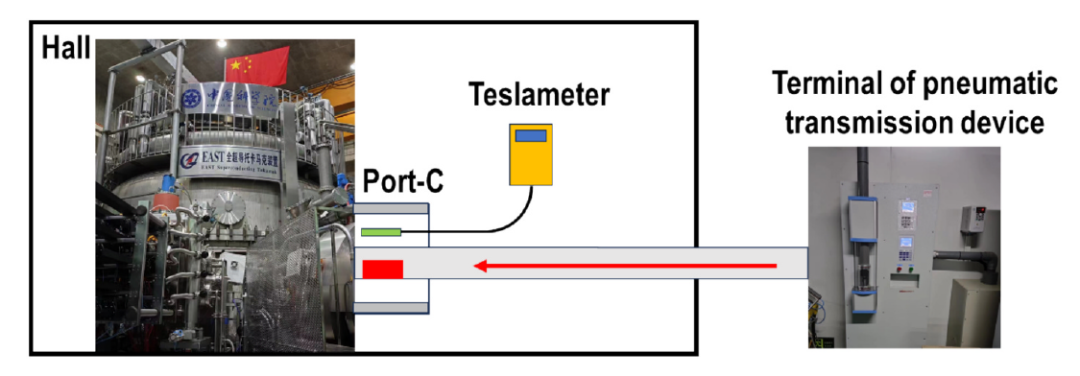
Figure 1 Corrosion experiment diagram under magnetic field in the EAST device
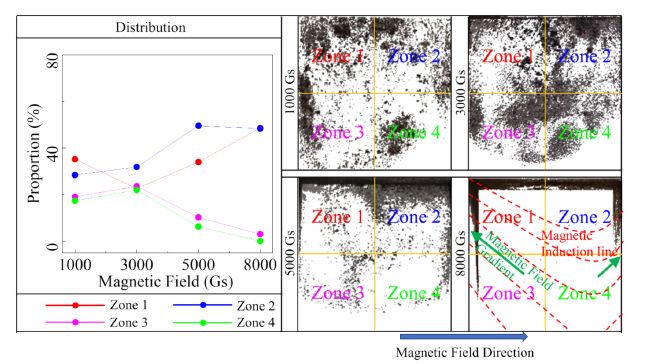
Figure 2 Top view of FeCr2O4 migration results under different magnetic fields and the proportions of each region
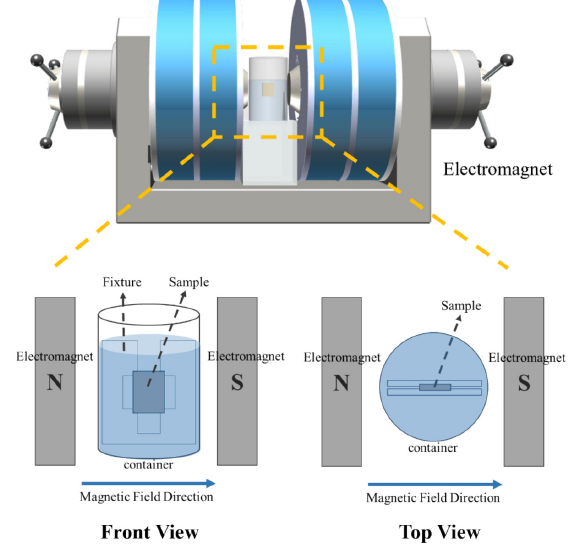
Figure 3 Diagram of the magnetic field electrochemical corrosion experimental setup
Disclaimer: Information republished from partner media, institutions or other websites is provided for reference and communication purposes only. It does not imply endorsement of its views or verification of its accuracy. Please contact us if any content infringes rights or requires correction.