
Machine learning framework predicts micro-displacements of DIII-D fusion device coils
 Scan to share
Researchers at the U.S. Department of Energy's (DOE) Thomas Jefferson National Accelerator Facility (Jefferson Lab) and collaborating teams have developed a machine learning framework that can predict subtle changes in critical fusion device hardware before the next experiment begins. The method targets the DIII-D National Fusion Facility in San Diego, and the findings have been published in the journal Machine Learning with Applications.
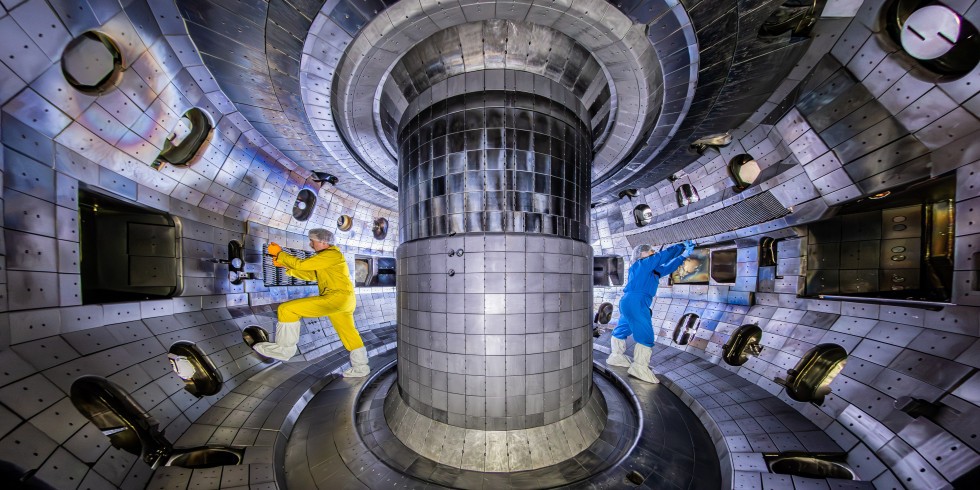
Interior of the DIII-D National Fusion Facility tokamak. (Image courtesy of General Atomics)
DIII-D is a tokamak device that uses strong magnetic fields to confine plasma hotter than the core of the Sun within a toroidal space. A ring of large toroidal field (TF) coils surrounds the device to generate the magnetic fields needed to confine the plasma. Although these coils are manufactured and secured to strict engineering tolerances, they can still undergo extremely slight displacements between different plasma discharges, or "pulses," as plasma stability varies. Though small, such changes can affect the physical conditions during experiments.
The DIII-D device performs a plasma discharge approximately every 10 minutes. The research team aims to predict coil movement within the brief interval between two experiments, enabling operators to adjust plasma parameters in a timely manner or schedule maintenance when needed, preventing minor issues from escalating.
"This technology we developed will help fusion researchers identify problems on the physical device before they actually occur," said Kishan Rajput, a data scientist at Jefferson Lab and lead author of the paper.
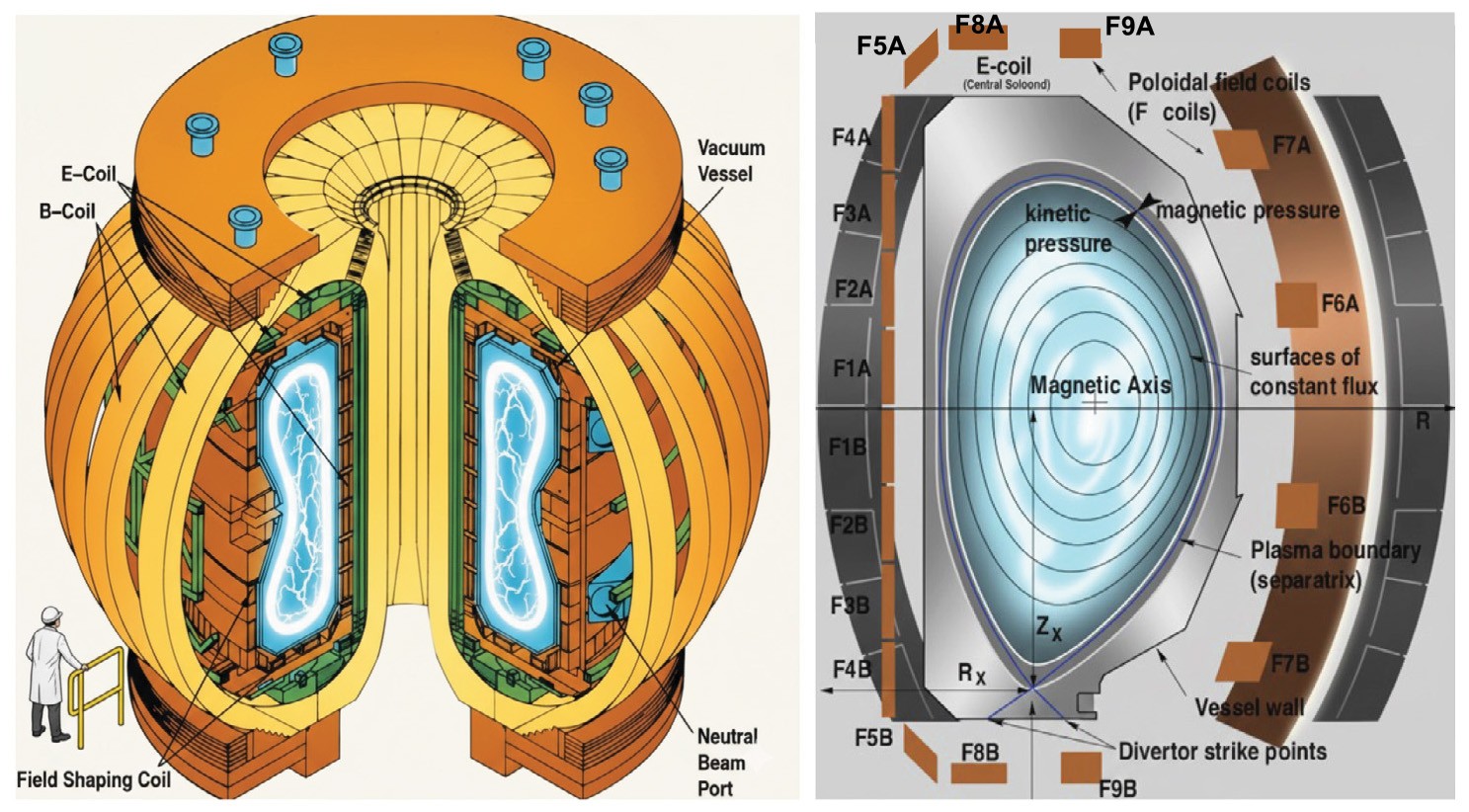
Artist's sketch and cross-section view of the DIII-D tokamak device. (Illustration courtesy of General Atomics)
To achieve this goal, the researchers constructed a digital twin model of the DIII-D toroidal field coil system. The model employs a deep neural network trained through online learning, allowing it to continuously update itself as new data arrives, rather than relying solely on existing historical data like traditional static models. Rajput noted that because plasma behavior continuously evolves, TF coil data exhibits significant drift between measurements; if the model does not update with new data, predictions are likely to lose reliability.
The research team further adopted an online ensemble model that combines multiple models trained on different historical time windows. Some models are better at capturing sudden changes, others are designed to identify slower, gradual changes, and still others cover timescales in between. The system also generates uncertainty estimates for each prediction and assigns greater weight to models with narrower error ranges and higher confidence when merging results.
Test results show that compared to traditional static machine learning models, the online learning approach reduces prediction error by 80%; with the introduction of uncertainty-guided ensemble methods, error is further reduced by approximately 10% relative to a single online model. These uncertainty estimates can also serve as decision-making references for DIII-D operators.
The research was conducted in collaboration between Jefferson Lab and General Atomics, the University of Houston, and Pacific Northwest National Laboratory. DIII-D is a DOE Office of Science user facility hosted by General Atomics and supported by the DOE Office of Fusion Energy Sciences.
Rajput stated that the next step is to continue testing the system using multi-year historical data to capture rarer events and improve uncertainty quantification capabilities. The research team also hopes to more clearly demonstrate how the model evolves with changes in device conditions, thereby enhancing the interpretability of AI tools in fusion diagnostics.
Currently, the framework is ready for deployment on the DIII-D device and can be adapted as needed for other fusion devices. The researchers believe that combining adaptive learning, uncertainty assessment, and experimental runtime constraints will help advance AI from a post-hoc analysis tool toward real-time decision support at fusion experiment sites.
Disclaimer: Information republished from partner media, institutions or other websites is provided for reference and communication purposes only. It does not imply endorsement of its views or verification of its accuracy. Please contact us if any content infringes rights or requires correction.