
SHINE Advances Commercial Spent Fuel Recycling Facility Construction
 Scan to share
U.S. electricity demand is growing at a rate rarely seen in decades, and nuclear energy is considered one of the key options to meet the incremental demand. Meanwhile, the current “open cycle” nuclear fuel model still treats spent fuel primarily as single-use waste, failing to fully utilize most of the energy potential that remains within it.
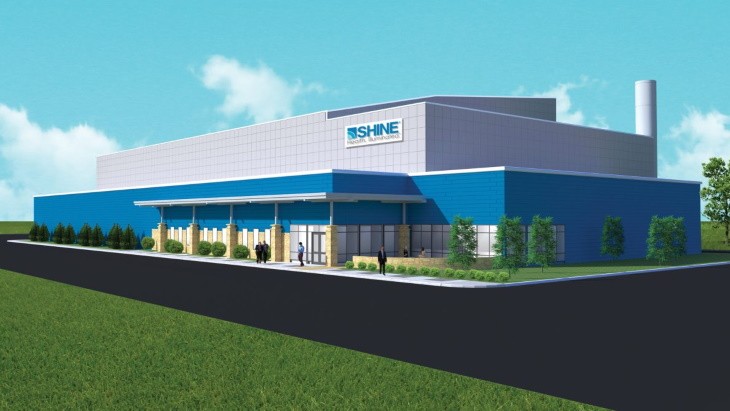
SHINE Technologies is developing spent fuel recycling technologies and plans to build a facility with spent fuel recycling capabilities. The company stated that multiple collaborations funded by the U.S. Department of Energy's Advanced Research Projects Agency-Energy (ARPA-E) CURIE program are advancing the work from validated laboratory-scale chemical processes toward commercial-scale nuclear fuel recycling.
SHINE believes that the challenge of commercializing spent fuel recycling lies not only in chemical technology breakthroughs, but also in building a full suite of foundational capabilities including facility licensing, physical protection, nuclear material tracking, and economic viability. The collaborative projects cover process operations, material monitoring, and regulatory review, aiming to deliver implementable solutions for the first commercial spent fuel recycling facilities.
In the areas of licensing and security, SHINE participates in a consortium led by the Electric Power Research Institute (EPRI) to jointly develop the “Model for Advanced Reprocessing and Recycling Implementation Evaluation” (MARIE). This optimization tool can be used to assess and support the construction of the first commercial spent fuel recycling facilities. SHINE will leverage its licensing experience from the Chrysalis project to provide support in areas such as safeguards by design, licensing costs, and isotope market potential.
SHINE also serves as a subcontractor on the “Monochrome Measurement for Enhanced Reliability” (MAYER) project led by GE Vernova, developing AI-driven sensors for real-time tracking and measurement of nuclear materials. The company believes that automating nuclear material accounting can reduce manual sampling, redundant instrumentation configurations, and inventory shutdowns, thereby lowering operational costs.
In the areas of recycling processes and waste management, SHINE is collaborating with Argonne National Laboratory and Case Western Reserve University to adapt Argonne's “Packed Centrifugal Extraction for Radionuclide Separation” (PaCERS) technology to its own process flows. This technology enables faster and more efficient recovery of minor actinides, converting materials that were once a disposal burden into manageable, stable byproducts.
These projects will support SHINE's proposed three-step recycling process REDUCE, which stands for “Recover Elements, Diminish Undesirables, Create Energy.” The company aims to establish a framework for commercial spent fuel recycling by optimizing licensing pathways, reducing chemical processing costs, and improving isotope extraction capabilities. If such facilities achieve scaled deployment, spent fuel could transition from waste awaiting disposal to a reusable resource, providing supplementary support for growing electricity demand.
Disclaimer: Information republished from partner media, institutions or other websites is provided for reference and communication purposes only. It does not imply endorsement of its views or verification of its accuracy. Please contact us if any content infringes rights or requires correction.