
Yonsei Cancer Hospital in South Korea Expands Heavy Ion Radiotherapy Indications, Three Systems Operating Simultaneously
 Scan to share
Yonsei Cancer Hospital in South Korea recently announced that it has further expanded the indications for heavy ion radiotherapy to include head and neck cancer, sarcoma, and recurrent rectal cancer. Since becoming the first hospital in South Korea to perform heavy ion radiotherapy for prostate cancer in 2023, the hospital has gradually expanded its treatment scope to cover pancreatic cancer, liver cancer, lung cancer, and other cancer types.
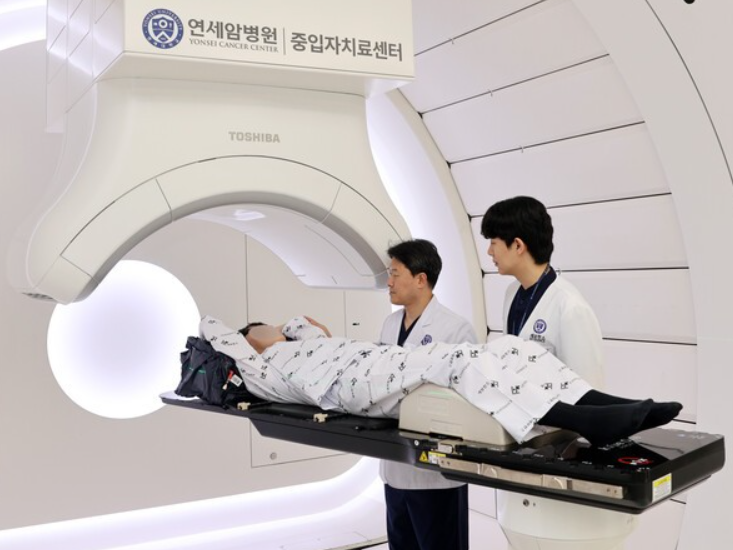
Medical staff, including Proton Therapy Center Director Kim Woong-sub (left), are preparing for proton therapy. (Photo provided by Yonsei University Medical Center)
Meanwhile, the hospital's second rotating heavy ion radiotherapy system has been fully commissioned. This brings the hospital to a configuration of one fixed-beam system and two rotating systems operating simultaneously. The hospital stated that it is the first medical institution in the world to operate three heavy ion radiotherapy systems at the same time, with the capacity to treat approximately 40 patients per day and an annual treatment volume of about 10,800 cases.
The newly added indications—head and neck cancer, sarcoma, and recurrent rectal cancer—are mostly diseases that are clinically difficult to treat. The head and neck region contains vital organs related to breathing, phonation, and swallowing, and is adjacent to the brain, spinal cord, optic nerves, and major blood vessels and nerves. Treatment must not only control the tumor but also preserve normal tissues and functions as much as possible. Sarcomas often occur in sites that are surgically challenging, such as the spine, pelvis, sacrum, and skull base, and may be adjacent to critical tissues including the spinal cord, intestines, and nerves. Recurrent rectal cancer often faces limited retreatment options due to factors such as prior treatment history and the tolerance doses of normal pelvic tissues.
Heavy ion radiotherapy leverages the Bragg peak property to deliver a high dose concentrated in the tumor region while reducing irradiation to surrounding normal tissues. The rotating treatment system can deliver 360-degree irradiation around the patient, allowing physicians to design beam angles better tailored to each patient's individual condition based on tumor location, shape, and the distribution of surrounding normal organs. The hospital noted that head and neck cancer treatment is typically completed in 16 sessions of high-dose carbon ion irradiation over approximately four weeks.
Existing multi-center collaborative studies from Japan have reported that among select head and neck cancer patients unsuitable for surgery, the 5-year local control rates for adenoid cystic carcinoma, mucosal melanoma, and mucoepidermoid carcinoma are 68%, 84%, and 95%, respectively, with 5-year overall survival rates reaching 70% to 80%. For unresectable osteosarcoma, related studies have shown a 5-year local control rate of 74% and a 5-year overall survival rate of 73% after heavy ion radiotherapy; for soft tissue sarcoma, the 5-year local control rate ranges from 65% to 69%.
In terms of recurrent rectal cancer, Japanese multi-center studies have shown that among patients unsuitable for surgery who received heavy ion radiotherapy, the 3-year local control rate was 93%, the 5-year local control rate was 88%, and the 3-year overall survival rate was 73%. A joint study conducted by Yonsei Cancer Hospital and the Hospital of the National Institutes for Quantum Science and Technology (QST) in Japan also demonstrated that for patients with recurrent rectal cancer who had previously received radiotherapy, heavy ion radiotherapy showed advantages over re-irradiation with X-rays in reducing local recurrence rates, mortality, and long-term complications.
The head of the Heavy Ion Radiotherapy Center at Yonsei Cancer Hospital stated that for refractory tumors where major organs are densely packed, surgery is difficult, or response to existing therapies is limited, the key to treatment lies in improving tumor control while minimizing damage to normal tissues. With the second rotating system now in operation, the hospital will further expand its capacity for individualized heavy ion therapy. The hospital representative noted that heavy ion radiotherapy requires appropriate timing of treatment and will be combined with standard treatment modalities such as surgery, anticancer drug therapy, and conventional radiotherapy, depending on the patient's condition and the stage of disease progression.
Disclaimer: Information republished from partner media, institutions or other websites is provided for reference and communication purposes only. It does not imply endorsement of its views or verification of its accuracy. Please contact us if any content infringes rights or requires correction.