
South Korea's Gijang County and KHNP Discuss Communication Issues with Residents near Kori Nuclear Power Plant
 Scan to share
Gijang County, Busan, South Korea, said on August 25 that it held talks with Korea Hydro & Nuclear Power (KHNP) that day on pending issues related to the Kori Nuclear Power Plant, focusing on resident communication, allocation of co-prosperity support funds, dry cask storage facilities for spent fuel, and the small modular reactor project.
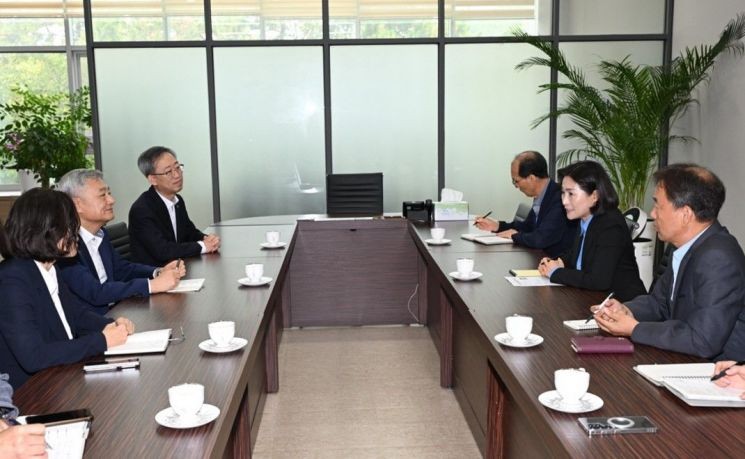
According to Gijang County, KHNP President Kim Hoe-cheon visited the Gijang County government that day and met with County Governor Woo Sung-bin. Since taking office on March 18, Kim Hoe-cheon has been visiting nuclear power plant sites to understand local concerns, and this visit to Gijang County, the site of the Kori Nuclear Power Plant, is part of that ongoing communication effort.
During the talks, Gijang County raised the issue that the allocation of co-prosperity support funds related to the continued operation of Kori Units 2, 3, and 4 has already sparked concerns and divisions among local residents. Woo Sung-bin stated that growing doubts over the consultation procedures and allocation criteria are deepening conflicts among residents, and that KHNP should take a more proactive role in proposing fair and reasonable solutions to reduce residents' sense of disappointment and confrontation around the plant.
Regarding the construction of dry cask storage facilities for spent fuel, Gijang County demanded that substantive consultations with the local government be conducted before advancing relevant procedures, and that accompanying measures be developed to promote the region's shared development. Gijang County also proposed that, in accordance with the Special Act on High-Level Radioactive Waste Management, a consultation mechanism comprising the High-Level Radioactive Waste Management Committee, local governments, and relevant disposal agencies be established, and that concrete co-prosperity plans be presented before seeking residents' opinions.
Gijang County also emphasized that, for the first-unit project of the innovative small modular reactor (i-SMR) that KHNP is promoting, any related memorandum of understanding should be signed on the premise of sufficient communication and resident understanding. Woo Sung-bin stated that before undertaking administrative cooperation, residents' concerns over the safety of the small modular reactor must be addressed as a priority; as the project implementer, KHNP should directly provide objective and transparent information and hold safety briefing sessions for residents in advance.
Kim Hoe-cheon stated that he would carefully listen to the opinions of residents near the nuclear power plant site, pay attention to the local issues arising from the allocation of co-prosperity support funds needed for the continued operation of Kori Units 2, 3, and 4, and seek a smooth resolution. He also said that KHNP would maintain close consultation with Gijang County in advance on matters such as resident briefing sessions.
Woo Sung-bin stated that Gijang County would prioritize residents' interests and community harmony to prevent residents near the nuclear power plant from feeling excluded. He urged KHNP, as a key party in resolving regional conflicts, to communicate more actively with residents and to turn the issues discussed that day into actionable solutions.
Disclaimer: Information republished from partner media, institutions or other websites is provided for reference and communication purposes only. It does not imply endorsement of its views or verification of its accuracy. Please contact us if any content infringes rights or requires correction.