
Lancaster University in the UK receives EPSRC funding to study antimatter production in intense laser pulses
 Scan to share
The research focuses on matter-antimatter production processes under intense laser pulse conditions. Similar interactions are believed to exist in extreme cosmic environments, such as near pulsars and black hole accretion disks. Previously, such interactions had only been measured at large particle accelerator facilities such as Stanford University and the European Organization for Nuclear Research (CERN), but the electric and magnetic field strengths used in those experiments were far weaker than the strong-field conditions achievable with current high-power lasers.
The physics underlying this research is closely related to Einstein's mass-energy equivalence equation E=mc². This equation is commonly used to explain the conversion of mass into energy in nuclear fusion and nuclear fission, whereas in intense laser experiments, researchers aim to harness this relationship in reverse: by focusing sufficiently intense laser light onto high-energy gamma rays, energy can be converted into mass, thereby producing matter-antimatter pairs from the light field.
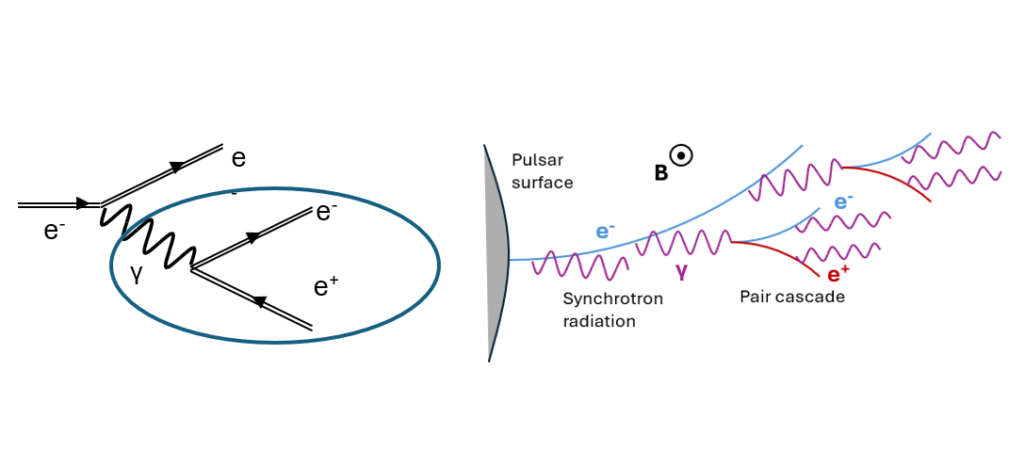
In the nonlinear Breit-Wheeler process, the interaction of multiple photons can produce electron-positron pairs. As the beam intensities of the world's most powerful lasers continue to increase, laser fields have reached levels where hundreds of photons can be compressed within the radius of a single electron. Under such conditions, photon interactions enter the so-called "non-perturbative" regime, which can no longer be described by single-collision models.
Arran stated that high-power lasers are revealing new physics, and that directly measuring "how light creates matter" is of great significance. Due to the extremely strong electromagnetic fields, the research team will treat this process as a quantum tunneling phenomenon, in which "virtual" electron-positron pairs in the vacuum are converted into measurable real electrons and positrons under the influence of the strong field. The researchers believe this may correspond to processes occurring in the most extreme environments in the universe, and the EPSRC funding will provide the conditions for measuring these processes in Earth-based laboratories.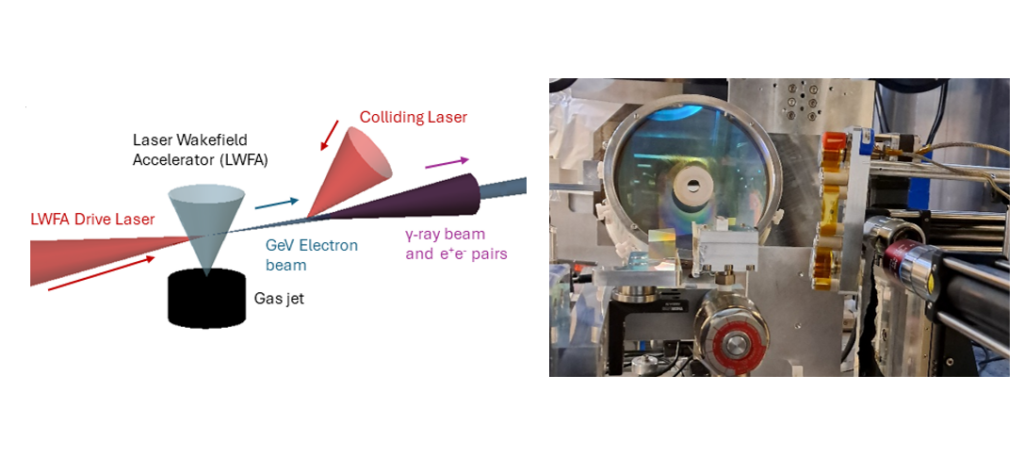
Schematic diagram of the matter-antimatter production experiment, illustrating how two laser beams are used to generate gamma rays and electron-positron pairs. The right panel shows the actual experiment, viewed from the perspective of the drive laser.
According to the research plan, the team will conduct experiments using two laser beams: one beam will be used to accelerate high-energy electrons via laser wakefield acceleration in a plasma; the other beam will be focused to a scale far smaller than the width of a human hair to achieve the highest possible intensity. By colliding the electron beam with the second laser pulse, the experiment is expected to produce high-energy gamma rays as well as electron-positron pairs.
The research team will measure electron beam, gamma ray, and positron signals to further understand the quantum tunneling process under strong-field conditions, and to provide experimental evidence for studying physical mechanisms in extreme cosmic environments. Regarding the relevant experimental design, particularly key challenges such as temporal control and beam alignment in high-power laser experiments, the research findings of Arran and his collaborators have been published in the New Journal of Physics.
Disclaimer: Information republished from partner media, institutions or other websites is provided for reference and communication purposes only. It does not imply endorsement of its views or verification of its accuracy. Please contact us if any content infringes rights or requires correction.