
South Korea's KSTAR to Conduct Long-Pulse Fusion Research in Tungsten Environment with European Institutions
 Scan to share
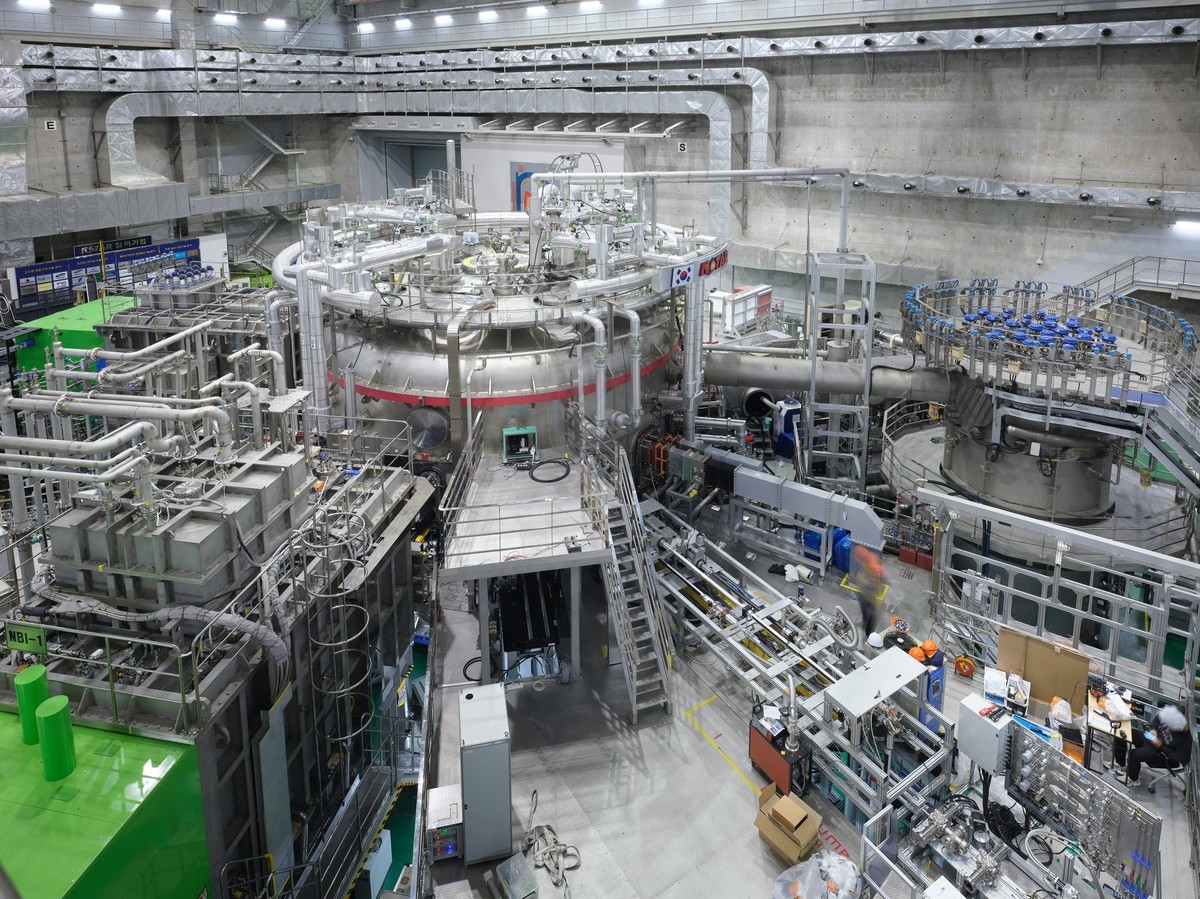
Partner institutions include the French Alternative Energies and Atomic Energy Commission (CEA), the Italian National Agency for New Technologies, Energy and Sustainable Economic Development (ENEA), the Max Planck Institute for Plasma Physics (IPP) in Germany, and the VTT Technical Research Centre of Finland (VTT). The institutions will conduct joint experiments and data analysis on key technologies required for long-pulse operation of future fusion reactors.
Achieving fusion power generation requires stably maintaining ultra-high-temperature plasma over extended periods. Tungsten materials exhibit strong high-temperature resistance and are commonly used to manufacture in-vessel components that come into direct contact with plasma. However, if tungsten impurities enter the plasma during operation, plasma performance may degrade. Therefore, controlling impurities and stably sustaining plasma operation in a tungsten environment is a critical issue that must be resolved for the engineering realization of fusion reactors.
This collaboration will combine KSTAR's accumulated experience in long-pulse, high-performance plasma operation with the technical expertise of European institutions in operating tungsten-environment devices and conducting related analysis. CEA operates the WEST tokamak in a tungsten environment, and IPP operates the ASDEX Upgrade (AUG) device. The relevant experience will provide reference for KSTAR's future upgrades and experiments.
Under the plan, researchers will conduct joint experiments, data analysis, and modeling on KSTAR, focusing on tungsten impurity control, reduction of thermal loads on in-vessel components, plasma instability control, mitigation of disruption effects, and diagnostic assessment of tungsten component conditions.
KSTAR plans to undergo an upgrade in the second half of 2026, replacing in-vessel components that come into direct contact with plasma with tungsten materials. Upon completion of the upgrade, KSTAR will be able to validate long-pulse plasma technologies in an operating environment closer to that of future fusion reactors. Joint experiments and data analysis are expected to be concentrated between 2026 and 2027, and the implementation agreement will remain valid for five years from the date of signing.
Disclaimer: Information republished from partner media, institutions or other websites is provided for reference and communication purposes only. It does not imply endorsement of its views or verification of its accuracy. Please contact us if any content infringes rights or requires correction.