
U.S. Electron-Ion Collider ePIC Detector Completes First Batch of Lead Tungstate Crystal Procurement and Acceptance
 Scan to share
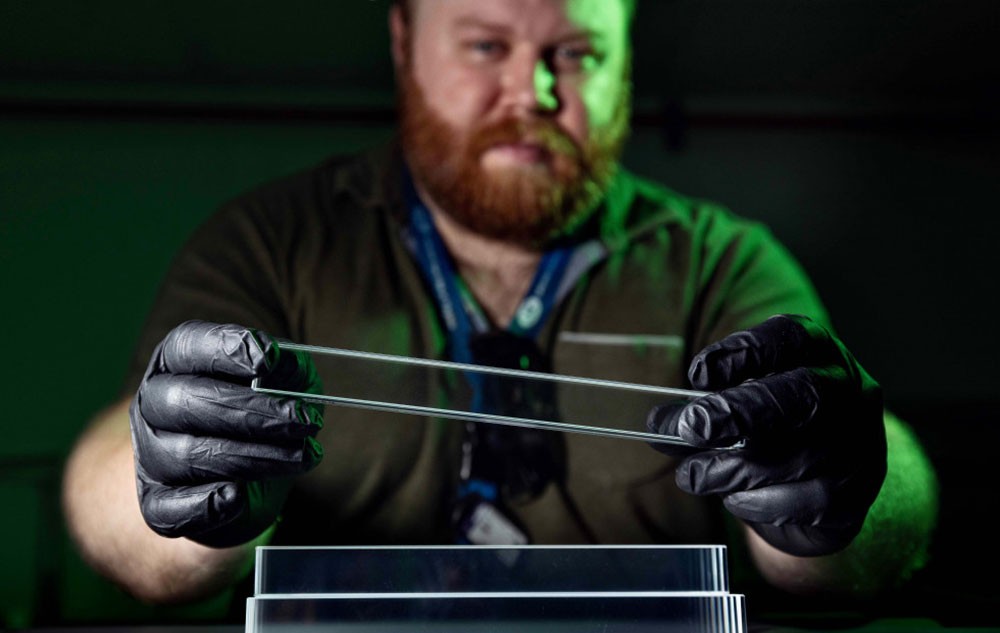
The U.S. Electron-Ion Collider (EIC) project recently achieved its first long-lead procurement milestone: 1,069 custom lead tungstate crystals for the new ePIC detector have been delivered, tested, and accepted. These crystals will be used in the Electron Endcap Electromagnetic Calorimeter (EEEMCAL) to help precisely measure the energy of scattered electrons during collisions.
The EIC is being built by the U.S. Department of Energy's Brookhaven National Laboratory, in collaboration with the Thomas Jefferson National Accelerator Facility. The facility will circulate electron and ion beams in opposite directions, colliding them inside the ePIC detector. The ePIC detector records information about particles produced in the collisions, providing experimental data for studying the fundamental building blocks of visible matter.
According to the project team, the core mission of the EEEMCAL is to measure scattered electrons, information that is critical for a wide range of nuclear physics measurements at the EIC. Given the detector's requirements for compactness, high precision, fast response, and radiation tolerance, lead tungstate crystals were ultimately selected as the key detection material. The full EEEMCAL is expected to require approximately 3,000 custom crystals, and given the long manufacturing lead time, the procurement was designated as a long-lead item.
In April 2024, following the U.S. Department of Energy's approval of Critical Decision 3A (CD-3A), crystal procurement entered the execution phase. The first-phase order was awarded to the U.S. subsidiary of Crytur, a Czech producer of synthetic crystals for science and advanced technology, with each phase planned to deliver approximately 1,000 crystals, accounting for about one-third of the detector's total requirement. After the first batch arrived, the project team established procedures for measurement, cleaning, quality inspection, and acceptance, with subsequent monthly deliveries of approximately 100 to 120 crystals. To date, the first-phase contract has been completed, with all 1,069 crystals passing acceptance and no rejections due to quality non-conformance.
Next, the project will proceed with the second-phase procurement contract and conduct broader testing on delivered crystals, including monitoring of key performance parameters such as light yield. Meanwhile, mechanical design of detector units and frame fabrication preparations are also underway. The project team stated that the EEEMCAL will provide high-precision scattered electron detection capabilities for EIC studies of nuclear physics questions, including the internal structure of protons and the structure of π and K mesons.
Disclaimer: Information republished from partner media, institutions or other websites is provided for reference and communication purposes only. It does not imply endorsement of its views or verification of its accuracy. Please contact us if any content infringes rights or requires correction.