
German Team Achieves Ultrafast Shaping of Extreme Ultraviolet Pulses Using High-Density Helium Gas
 Scan to share
On August 20, 2026, the international team led by researchers from the Max Planck Institute for Nuclear Physics (MPIK) in Heidelberg announced that they have utilized atomic gas as a rapidly switchable time-varying lens to control the beam shape and spectrum of intense high-frequency laser pulses. This achievement is expected to provide a new pathway for the fine control of extreme ultraviolet (XUV) and X-ray pulses, and may serve research directions such as improved spectroscopic methods, control of chemical reactions, and quantum computing.
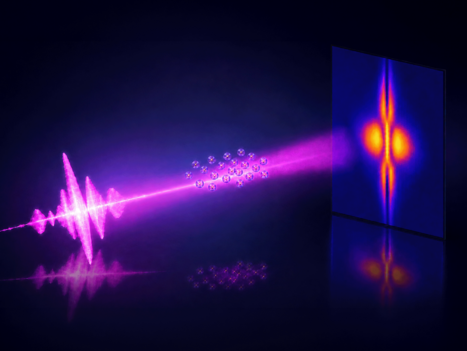
Extreme ultraviolet light can provide important tools for studying atomic-scale processes. With the development of free-electron lasers, researchers have been able to generate ultrashort, high-intensity XUV light pulses, but how to focus, deflect, or spectrally shape them as with visible light remains a challenge. Traditional glass lenses, mirrors, or prisms often exhibit strong absorption of high-energy extreme ultraviolet photons, making them difficult to use as stable and efficient optical elements.
The research team employed high-density helium atomic gas as the control medium. When intense XUV laser pulses pass through this optically dense medium, they rapidly excite and de-excite atomic energy levels, forming a quantum dynamical process known as Rabi oscillations. Due to the difference in intensity between the center and edges of the laser beam, the refractive index of the gaseous medium also varies with spatial position, particularly pronounced near the atomic resonance frequency. The researchers believe that this intensity-dependent light-matter interaction enables the atomic gas to exhibit refractive functions similar to lenses or prisms.
The experiments were conducted at the FLASH free-electron laser at DESY in Hamburg. The researchers focused intense extreme ultraviolet laser pulses into a gas cell containing helium atoms, with the central photon energy of the pulses at 21.2 eV, corresponding to the 1s-2p electronic transition energy of helium atoms. The experiments showed that at lower laser intensities, light was absorbed by the gas cell in the atomic resonance region, but the spatial shape remained largely unchanged; at higher laser intensities and higher gas pressures, the beam deviated from its original propagation direction and became particularly pronounced at two frequencies slightly below and slightly above the atomic resonance energy, forming a characteristic double-peak spectral structure.
The researchers stated that this method is equivalent to constructing a time-varying lens that operates on extremely short timescales, capable of directionally shaping the beam and its spectral components. This not only contributes to the development of new optical elements suitable for high-frequency light, but also helps researchers further understand the interaction and propagation processes of intense radiation with resonant media. In the future, this technique may be used for spatial and spectral control of coherent extreme ultraviolet and X-ray pulses.
Disclaimer: Information republished from partner media, institutions or other websites is provided for reference and communication purposes only. It does not imply endorsement of its views or verification of its accuracy. Please contact us if any content infringes rights or requires correction.