
Search Results
Keyword:free-electron laser
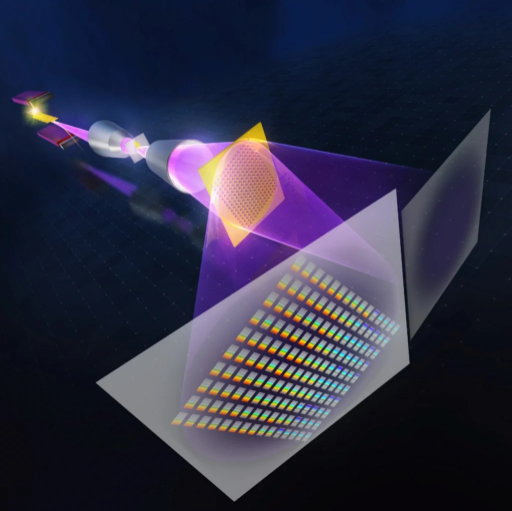
Japanese Team Achieves Femtosecond Soft X-ray Hyperspectral Microscopy, Simultaneously Acquiring Spatial and Energy Information with Single Pulse
On August 21, the Japan Science and Technology Agency, RIKEN, and the University of Tokyo announced that a research team comprising Assistant Professor Yoko Takeo and Associate Professor Takashi Kimura from the Institute for Solid State Physics at the University of Tokyo, Assistant Professor Satoru Egawa from the Research Center for Advanced Science and Technology at the University of Tokyo, and Team Leader Makina Yabashi from the RIKEN SPring-8 Center, among others, successfully developed and implemented a femtosecond soft X-ray hyperspectral microscope. The findings were published on August 20 in the U.S. scientific journal *Optica*. This technology utilizes a single soft X-ray pulse from an X-ray free-electron laser (XFEL) to simultaneously acquire soft X-ray spectra transmitted through different positions of a sample, enabling...
2026-08-31
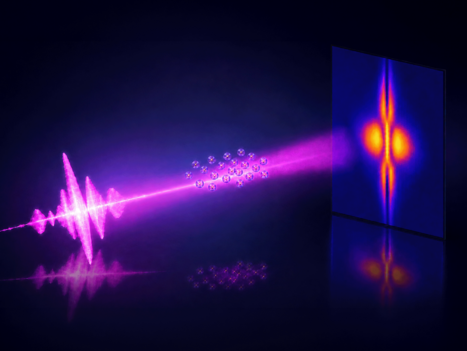
German Team Achieves Ultrafast Shaping of Extreme Ultraviolet Pulses Using High-Density Helium Gas
August 20, 2026, the international team led by researchers from the Max Planck Institute for Nuclear Physics (MPIK) in Heidelberg announced that they have utilized atomic gas as a rapidly switchable time-varying lens to control the beam shape and spectrum of intense high-frequency laser pulses. This achievement is expected to provide a new pathway for the fine control of extreme ultraviolet (XUV) and X-ray pulses, and may serve research directions such as improved spectroscopic methods, control of chemical reactions, and quantum computing. Extreme ultraviolet light can provide important tools for studying atomic-scale processes. With the development of free-electron lasers, researchers have been able to generate ultrashort, high-intensity XUV light pulses, but how to manipulate them like...
2026-08-31
SwissFEL Achieves Ultralow-Temperature X-ray Observation of Quantum States
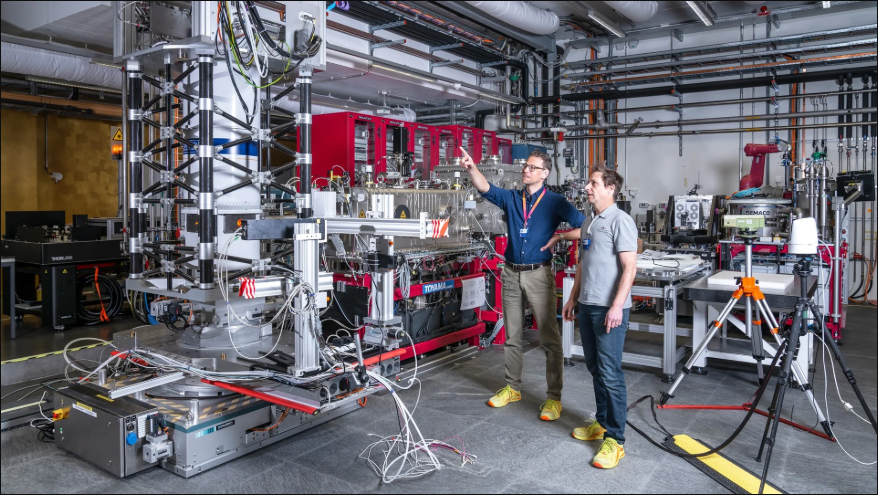
Researchers at the Paul Scherrer Institute (PSI) in Switzerland recently reported that the Cristallina experimental station of the Swiss Free-Electron Laser (SwissFEL) can now observe quantum states that only emerge at extremely low temperatures using X-ray scattering at temperatures close to absolute zero. Simon Gerber (left) and Bill Pedrini (right) at the Cristallina experimental station of SwissFEL. With the help of a custom-built cryostat connected to the beamline (far left), quantum states can now be studied at extremely low temperatures. Paul Scherrer Institute PSI/Markus FischerAccording to the team, they recently achieved a low temperature of 35 millikelvin in experiments...
2026-08-17