
U.S. Develops Hybrid Process Combining Electroforming and 3D Printing for Critical Component Manufacturing in Advanced Nuclear Reactors
 Scan to share
On August 24, local time, the U.S. Department of Energy's Oak Ridge National Laboratory (ORNL) announced that its scientists are collaborating with AJ Tuck Company (AJ Tuck) to develop a hybrid manufacturing process that combines 3D printing and electroforming to produce complex, leak-tight hot isostatic pressing canisters for powder metallurgy hot isostatic pressing processes. The process targets the manufacturing of critical metal components for advanced nuclear reactors and other energy and defense applications, with the goal of shortening production workflows and reducing reliance on traditional large-scale forging and casting supply chains.
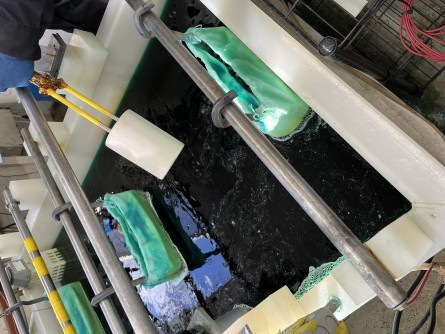
A hot isostatic pressing canister is a type of sealed container used to compact metal powders into high-performance metal components under high temperature and high pressure. Traditional hot isostatic pressing canisters typically require multiple machining, welding, and assembly steps, making the fabrication of complex structures highly challenging. The new process uses polymer additive manufacturing to create a mandrel, followed by electroforming to deposit a metal shell onto the mandrel surface, forming a metal container that precisely replicates complex geometries.
According to the introduction, the process first uses 3D printing to create a polymer mandrel that defines the final component shape; the mandrel is then placed in an electrolytic bath, where an electric current causes nickel to deposit on the surface, forming a uniform metal shell approximately 2 to 3 millimeters thick; the mandrel is subsequently removed to obtain a hollow structure, which is then filled with metal powder and sealed, and finally subjected to hot isostatic pressing to form a solid metal component.
Vanshika Singh, a research assistant scientist at Oak Ridge National Laboratory, stated that the project demonstrates that electroforming technology can successfully produce leak-tight hot isostatic pressing canisters for advanced nuclear energy applications, helping to streamline the domestic manufacturing of related components in the United States and alleviate supply chain pressures facing advanced nuclear energy systems.
With the growing demand for advanced small modular reactors, the manufacturing capability for complex, high-performance metal components has drawn increasing attention. According to available data, nuclear energy accounts for approximately 20% of U.S. electricity supply, but the country's domestic large-scale forging capacity is limited, constraining the manufacturing of large components such as reactor pressure vessels, valves, and turbine systems. Oak Ridge National Laboratory believes that this hybrid process can be used for the manufacturing of large, high-precision metal components, particularly suited for advanced nuclear reactor and energy infrastructure applications.
Amy Jackson, a mechanical engineer at Oak Ridge National Laboratory, stated that electroforming can rapidly and precisely produce fine structures while avoiding certain challenges inherent in traditional manufacturing methods. Since the process is primarily governed by the thickness of the metal deposition layer rather than the size limitations of individual parts, it holds the potential to scale up production and manufacture multiple components at once.
In the first phase of the project, the team successfully produced five leak-tight cylindrical hot isostatic pressing canisters using the electroforming process, each measuring 6 inches in height and 4 inches in diameter. The researchers also developed an integrated port design, eliminating the separate welded process tube—a common potential failure point in hot isostatic pressing workflows—thereby enhancing process reliability. Project images show that the team used the leak-tight hot isostatic pressing canisters produced in the first phase to manufacture a solid nickel component weighing 15.7 pounds.
Currently, the project has entered its second phase, with the research team planning to apply the process to components with more complex geometries, including impellers used to drive fluids in pumps and turbine systems, or valves related to nuclear energy systems. Related invention disclosures and provisional patent applications have been submitted.
Disclaimer: Information republished from partner media, institutions or other websites is provided for reference and communication purposes only. It does not imply endorsement of its views or verification of its accuracy. Please contact us if any content infringes rights or requires correction.