
Weilan Stellar Completes China's First Stellarator Magnet Cryogenic Comprehensive Test Platform in Three Months, First Round of Magnet Testing Launched
 Scan to share
Weilan Stellar recently completed the construction of China's first stellarator magnet cryogenic comprehensive test platform, and the first round of magnet testing has been launched. Qiu Lilong, a review expert for the cryogenic system, stated that from independent design and system integration to domestically sourced supporting equipment, Weilan Stellar took only three and a half months to integrate vacuum, cryogenics, power supply, measurement, and protection into a comprehensive test platform. The test platform fully demonstrates the team's outstanding capabilities in scientific research, engineering, and project management.
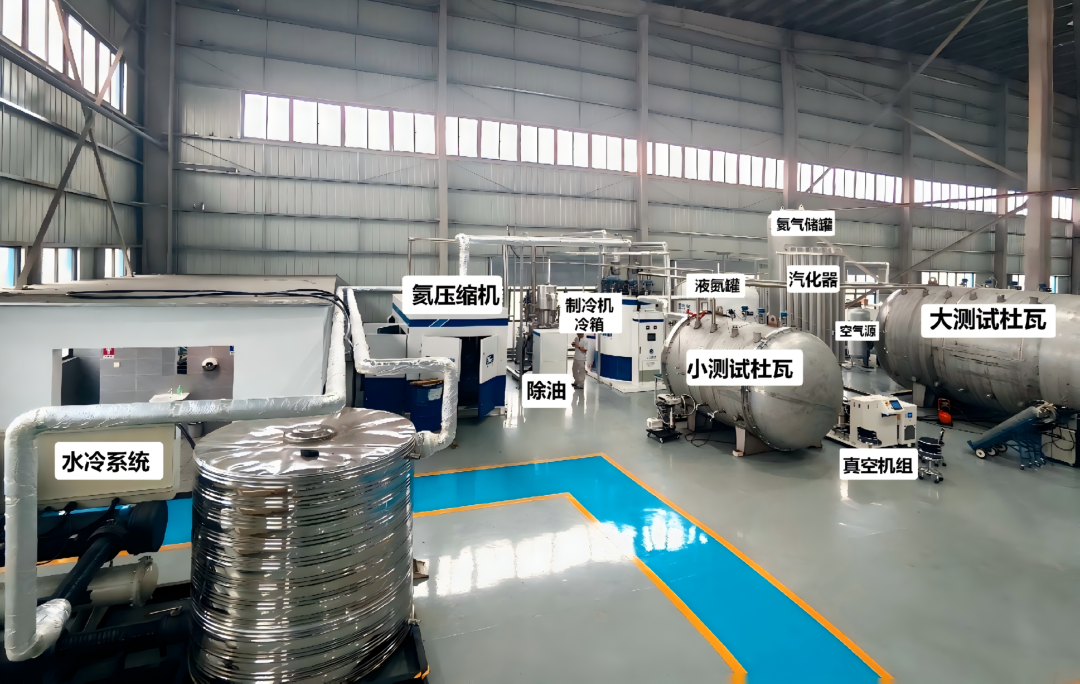
As the foundation for stable operation of a stellarator, the cryogenic system's vacuum level, sealing performance, and cooling capacity are all crucial. Unlike conventional paced R&D models, Weilan Stellar has always adhered to a pragmatic and proactive approach to tackling challenges, working overnight shifts and staggered schedules, troubleshooting hazards point by point and calibrating parameters item by item, laying a solid prerequisite foundation for each coil cryogenic test with strict process standards. At the frontier of the controllable nuclear fusion track, speed always stems from solid execution.
In a cryogenic environment, magnets need to undergo processes such as cooling, current energization, and electromagnetic cycling, and their current-carrying performance, temperature changes, and structural responses all need to be verified item by item through testing. After fabrication is completed, superconducting magnets must undergo a series of tests before entering the device integration phase. The 77 K liquid nitrogen test is mainly used for preliminary performance screening and process verification, while the cold helium circulation and conduction-cooled cryogenic tests conducted at temperatures close to actual operating conditions will further verify the magnet's true performance under cryogenic and high-current conditions, serving as an important gatekeeping step before magnet delivery.
The magnet cryogenic comprehensive test platform built by Weilan Stellar is designed for a temperature range of 10 K to 20 K, featuring two dewars—one large and one small—along with supporting helium cryogenic, magnet power supply, performance measurement, and operational protection systems. The platform can cover key processes from magnet cooling and current energization to background magnetic field testing, enabling the team to systematically verify magnet performance under conditions close to actual operating conditions. Once completed, the platform will provide support for batch coil testing of the company's first high-temperature superconducting stellarator, making the connection between magnet manufacturing, cryogenic testing, and whole-machine assembly more seamless.
Facing magnets of different sizes, structures, and test batches, the platform accommodates both the establishment of cryogenic environments and flexible configuration of test conditions. The large dewar has a diameter of 3 meters and a length of 4.2 meters, capable of simultaneously meeting the cryogenic testing needs of large-size magnets and small coils; the small dewar has a diameter of 2.2 meters and a length of 3.2 meters, suitable for modular coils of different specifications. The two dewars can operate independently or conduct tests simultaneously, allowing the team to flexibly arrange test tasks according to magnet type and manufacturing batch.
To maintain a stable state in the 10 K to 20 K temperature range, the system must both reduce external heat ingress and promptly remove heat generated when the magnet is energized. The interior of the dewar adopts a combined structure of vacuum, multilayer insulation, liquid nitrogen cold shield, and cryogenic helium cooling: the vacuum environment reduces gas heat transfer, multilayer insulation and liquid nitrogen cold shield reduce radiative heat leakage from the outside to the cryogenic region, and the 10 K to 20 K helium pipes provide cooling capacity for magnet cooling. The platform uses a helium refrigeration system with 500 W cooling capacity as the cold source, paired with a helium compressor station, oil removal and purification, cold box, liquid nitrogen system, and helium storage and purification system to complete helium compression, purification, expansion refrigeration, and recycling. During magnet testing, the absolute pressure at the helium circuit inlet can be adjusted between 2 and 10 bar to accommodate different magnet cooling conditions.
After the cryogenic environment is established, the platform still needs to complete magnet power supply, state measurement, and operational protection to form complete test conditions. During testing, the platform monitors cooling rate, temperature gradient, and local temperature rise through silicon diodes and Cernox thermometers, captures tiny voltages across coils and joints with nanovoltmeters, and uses Hall sensors, strain gauges, and pressure and flow sensors to simultaneously record magnetic field, structural response, and cold helium supply status. These complex signals are ultimately collected through data acquisition cards into a single measurement and control system for real-time display, storage, and correlation analysis, with alarm and quench protection functions intervening promptly when abnormal voltages or local temperature rises occur.
Compared with cryogenic platforms in the same industry that take years for design and commissioning, Weilan Stellar completed platform construction in only three and a half months, achieving a leapfrog breakthrough. Behind this speed is the team's spirit of proactively applying pressure, tackling challenges ahead of schedule, and strictly adhering to milestone deadlines, as well as the team's unified grasp of the overall plan, system interfaces, and implementation process. From initiating cryogenic concept design in June, to completing overall system design in late June, to advancing procurement in July, completing installation and integration in August, and completing platform construction in September, the team rapidly coordinated among equipment design, manufacturing, delivery, and on-site integration, driving multi-disciplinary systems to integrate on schedule.
Aiming at the goal of building the world's first high-temperature superconducting stellarator, the team holds the bottom line with professionalism and advances implementation through solid execution. Currently, the first round of platform testing has been carried out around cooling performance, joint resistance, target current operation, and electromagnetic cycling. Under complex system coordination and stringent testing requirements, the team insists on controlling key links with professionalism, continuously accumulating verifiable data and engineering experience, and building a more solid foundational capability for whole-machine stellarator construction through every test and feedback cycle.
Disclaimer: Information republished from partner media, institutions or other websites is provided for reference and communication purposes only. It does not imply endorsement of its views or verification of its accuracy. Please contact us if any content infringes rights or requires correction.