
ITER Tritium Plant Completes Final Design, Fully Transitions to Equipment Manufacturing, Installation, and Commissioning
 Scan to share
At the Saint-Paul-lès-Durance site in France, the International Thermonuclear Experimental Reactor (ITER) Organization officially convened the Third Tritium Plant Summit. More than 70 core experts from the ITER Organization, Fusion for Energy (F4E), Japan's Domestic Agency (QST), Korea's Domestic Agency (KFE), and the US Domestic Agency (US ITER), as well as global engineering contractors and equipment manufacturers, gathered together. This summit released a decisive engineering signal: all subsystems under the ITER Tritium Plant have officially reached Final Design Status, marking that this core nuclear facility has completely departed from years of conceptual and system design phases and fully entered the decisive engineering delivery phase of large-scale equipment manufacturing, on-site installation, and subsystem integrated commissioning.
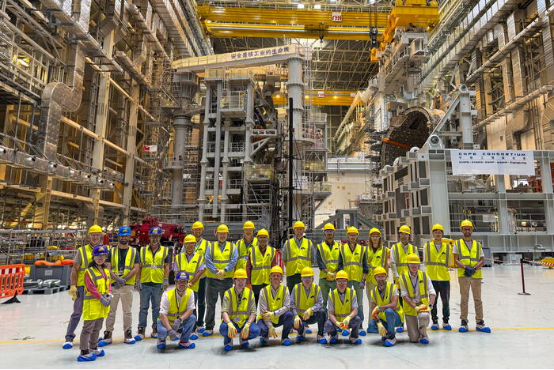
The Tritium Plant is the "fuel hub" and lifeline supporting ITER's achievement of deuterium-tritium (D-T) fusion ignition and long-pulse burning, and its technological maturity directly determines the success or failure of the fusion device's closed fuel cycle. This facility undertakes the full-chain closed-loop functions of receiving, safe storage, precise proportional supply, gas purification and separation, cyclic recovery, and reuse of tritium isotopes across the entire plant. It is also responsible for the deep processing of radioactive media such as Tokamak exhaust and tritiated heavy water/light water, and establishes an extremely stringent tritium defense-in-depth safe confinement barrier. The entire system will in the future be densely arranged within the seven-story ITER-dedicated Tritium Building, constituting the tritium-handling nuclear chemical complex with the highest process complexity and the most stringent safety protection level in the history of controlled nuclear fusion by humankind.
With the comprehensive closure of the final design review, multinational procurement contracts and engineering equipment trial manufacturing are advancing on multiple fronts:
Europe (F4E): Full efforts are being made to advance the engineering implementation of the Isotope Separation System (ISS) and the Water Detritiation System (WDS). The former separates hydrogen isotopes (protium, deuterium, tritium) based on processes such as cryogenic distillation, while the latter is responsible for efficiently extracting tritium from process water and reinjecting it into the closed fuel cycle;
Korea (KFE): The general manufacturing contract for the Storage and Delivery System (SDS) has been formally signed and locked in. This system employs special metal hydride tritium storage beds to achieve milligram-level high-precision feeding;
United States (US ITER): The global procurement and trial manufacturing of dedicated safety glovebox clusters and long-lead-time critical process equipment for the Tokamak Exhaust Processing (TEP) system are being accelerated;
Japan (QST): The detailed engineering construction drawing design for the central emergency and routine processing units of the Tokamak Complex Detritiation System (TC-DS) has been fully initiated.
According to ITER's updated overall project schedule, the complete sets of core equipment for the above-mentioned key subsystems are planned to be successively delivered to the French site starting from 2028, with large-scale modular introduction and installation to be initiated. In addition, this summit specifically listed "equipment standardization" and "stringent nuclear-grade environmental qualification" (Equipment Qualification) as core topics. For common key components such as special metal bellows valves, micro-flowmeters, and high-sensitivity online radiation monitoring instruments operating under high-pressure, high-vacuum, extremely low-temperature, and high-purity tritium environments, in-depth exchanges were conducted on qualification and testing experience. All participating parties reached a high degree of consensus, aiming to establish internationally unified tritium-related nuclear safety and equipment qualification standards, to minimize redundant technical verification among member states, and to improve the efficiency of multinational supply chain coordination, thereby comprehensively mitigating technical barriers and schedule risks in the subsequent manufacturing, pipeline assembly, and cold/hot commissioning phases.
Disclaimer: Information republished from partner media, institutions or other websites is provided for reference and communication purposes only. It does not imply endorsement of its views or verification of its accuracy. Please contact us if any content infringes rights or requires correction.