
The Fully Superconducting Tokamak EAST Marks 20 Years of Operation: From a 3-Second First Cry to Thousand-Second Steady State, China's "Artificial Sun" Opens a Leap Toward Fusion Engineering
 Scan to share
On September 28, 2006, the Experimental Advanced Superconducting Tokamak (EAST), independently designed and developed by the Institute of Plasma Physics (ASIPP) under the Hefei Institutes of Physical Science of the Chinese Academy of Sciences, successfully achieved its first plasma discharge on Hefei Science Island, with a current of 200 kA and a duration of nearly 3 seconds. This historic moment marked the official completion and operation of the world's first fully superconducting non-circular cross-section nuclear fusion experimental device, propelling China into the club of fully superconducting tokamak technology ahead of others. Over the past two decades, this “artificial sun” has completed more than 160,000 physical discharge experiments, witnessing China's magnetic confinement controlled nuclear fusion research journey from early stage following, to running in parallel, and even to partially leading.
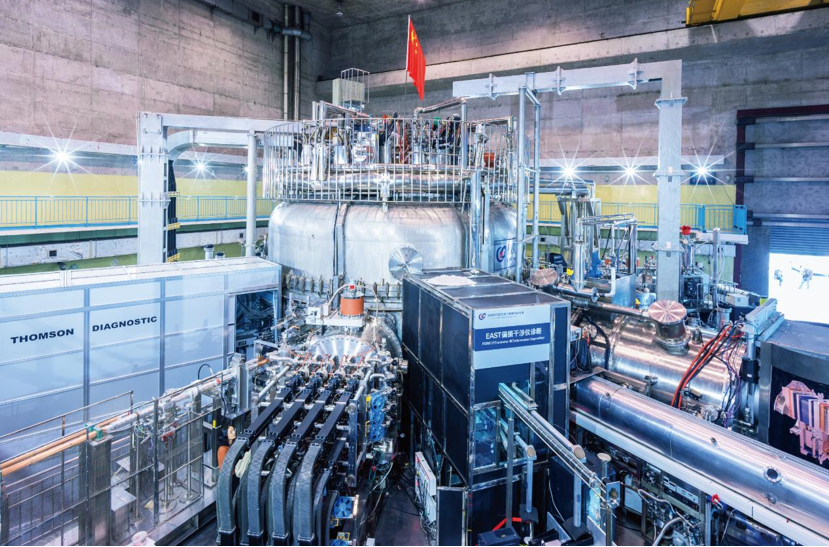
Looking back at the development trajectory of magnetic confinement nuclear fusion in China, in the mid-1970s, the Chinese Academy of Sciences laid out tokamak research in Hefei; in the 1990s, the research team self-reliantly upgraded equipment introduced from abroad, successively building the HT-6B and HT-6M conventional magnet tokamaks, as well as China's first circular cross-section superconducting tokamak, "Hefei Super Ring" (HT-7). On this basis, the research team represented by Wan Yuanxi, academician of the Chinese Academy of Engineering, broke international precedent and courageously shouldered the engineering burden of "all magnet coils using superconducting materials," overcoming core technologies including superconducting magnets, ultra-high vacuum, cryogenic refrigeration, and high-power heating, and achieving fully independent development of the complete set of key equipment.
As a top-tier large-scale scientific project integrated from more than 20 complex subsystems and nearly one million components, EAST has continuously rewritten the operating records of human magnetic confinement fusion parameters over the past two decades: from 3 seconds in 2006, to 30 seconds of long-pulse H-mode in 2012, to breaking through 60 seconds in 2016, reaching 101 seconds in 2017, and achieving 403 seconds of steady-state H-mode in 2023; on January 20, 2025, in its 150,425th experiment, EAST set a world record of 1,066 seconds of steady-state long-pulse operation at an electron temperature of 100 million degrees Celsius, achieving for the first time internationally a high-fidelity verification on an experimental device of the core physics boundary for long-duration, high-parameter stable burning in future fusion reactors.
After twenty years of physics experiments and engineering iterations, EAST has accumulated more than 200 core technologies and over 2,000 invention patents, not only exceeding expectations in achieving its established scientific goals, but also continuously providing irreplaceable data support and "Chinese solutions" for key physics experiments and component testing of the International Thermonuclear Experimental Reactor (ITER). At present, the fusion innovation cluster on Science Island has comprehensively built a tiered and sequential R&D matrix: the Comprehensive Research Facility for Fusion Technology (CRAFT) is fully tackling engineering tests for ten-thousand-ton-class superconducting magnets, divertors, and vacuum vessels; the main assembly of the Burning Plasma Experimental Superconducting Tokamak (BEST) is being intensively advanced, aiming to be completed by 2027 and demonstrate net fusion energy gain output. At twenty years old, EAST continues to exert its strength as a main scientific research platform, laying a solid technological foundation for humanity to ultimately light the first fusion lamp.
Disclaimer: Information republished from partner media, institutions or other websites is provided for reference and communication purposes only. It does not imply endorsement of its views or verification of its accuracy. Please contact us if any content infringes rights or requires correction.