
Search Results
Keyword:HAP

German Team Achieves Ultrafast Shaping of Extreme Ultraviolet Pulses Using High-Density Helium Gas
August 20, 2026, the international team led by researchers from the Max Planck Institute for Nuclear Physics (MPIK) in Heidelberg announced that they have utilized atomic gas as a rapidly switchable time-varying lens to control the beam shape and spectrum of intense high-frequency laser pulses. This achievement is expected to provide a new pathway for the fine control of extreme ultraviolet (XUV) and X-ray pulses, and may serve research directions such as improved spectroscopic methods, control of chemical reactions, and quantum computing. Extreme ultraviolet light can provide important tools for studying atomic-scale processes. With the development of free-electron lasers, researchers have been able to generate ultrashort, high-intensity XUV light pulses, but how to manipulate them like...
2026-08-31

Large Hadron Collider experiments reveal neon nucleus may be bowling-pin shaped
A recent experimental result from the Large Hadron Collider at CERN suggests that the internal structure of the neon-20 nucleus may not be approximately spherical as commonly depicted in traditional textbooks, but rather closer to a "bowling pin" shape. This finding provides new experimental clues for studying deformation of light atomic nuclei and collective behavior in high-energy nuclear collisions. Atomic nuclei are composed of protons and neutrons, determining the elemental identity of atoms and carrying most of their mass. Although nuclei are often simplistically depicted as spherical, nuclear physics research has shown that some nuclei exhibit pronounced non-spherical deformation, such as the pear-shaped nuclei mentioned in previous studies. Accurately understanding these shapes helps physicists...
2026-08-21

USTC Team Participates in STAR Experiment, Discovering Possible "Y"-Shaped Gluon Junction Inside Nucleons
The University of Science and Technology of China, together with Kent State University and Brookhaven National Laboratory, played a leading role in the STAR international collaboration. Through precise measurements of net baryon number and net charge in high-energy nucleus-nucleus collision experiments, they discovered an exotic structure inside nucleons that may overturn fundamental understanding of nucleon internal structure. In the early morning of August 14, the results were published online in the journal Science under the title "Tracking the baryon number with nuclear collisions." Nucleons are the fundamental particles that make up the material world, carrying more than 99% of the mass of the visible matter in the universe. Understanding the internal structure of nucleons is of paramount importance for understanding the fundamental constituents and fundamental interactions of the material world.
2026-08-14
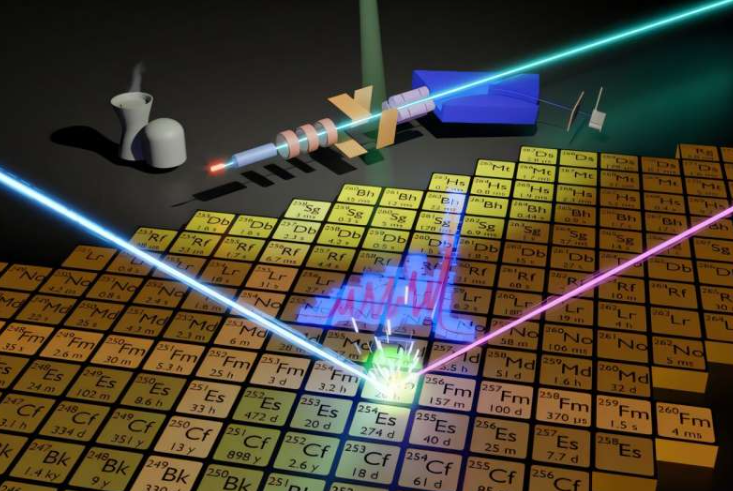
Laser spectroscopy reveals for the first time the precise nuclear shape of fermium-255, offering new clues in the search for superheavy elements
An international research team has, for the first time, precisely determined the nuclear structure of the actinide fermium-255, confirming that its nucleus exhibits a pronounced prolate deformation, similar to a rugby ball. The study, published in *Physical Review Letters*, was conducted in collaboration with 18 institutions, including Johannes Gutenberg University Mainz in Germany, the Helmholtz Institute Mainz, and the University of Gothenburg in Sweden. The findings not only correct several unreasonable nuclear property values in previous standard data tables but also provide crucial experimental validation for modern nuclear theory models. Fermium is a synthetic heavy element that does not exist in nature. Fermium-255 contains 100 protons and 155 neutrons, making its experimental production extremely challenging. The research team...
2026-08-08

GAO Report Urges DOE-EM to Learn from Canada, UK, France, and Belgium in Reshaping Nuclear Waste Cleanup Strategy
The U.S. Government Accountability Office (GAO) noted in a new report that countries such as Canada, France, and the United Kingdom have taken proactive measures in recent years to accelerate nuclear waste cleanup. The report recommends that the U.S. Department of Energy's Office of Environmental Management (DOE-EM) engage in strategic exchanges with these countries to identify and evaluate alternative approaches that could reduce risks, lower costs, or expedite cleanup activities. Currently, DOE-EM estimates its cleanup mission could cost between $641 billion and $840 billion and may not be completed until 2100. The report found that while DOE-EM has some level of exchange with other countries on nuclear cleanup, such exchanges are not strategic and lack proactive learning...
2026-08-04