
Search Results
Keyword:KSTAR
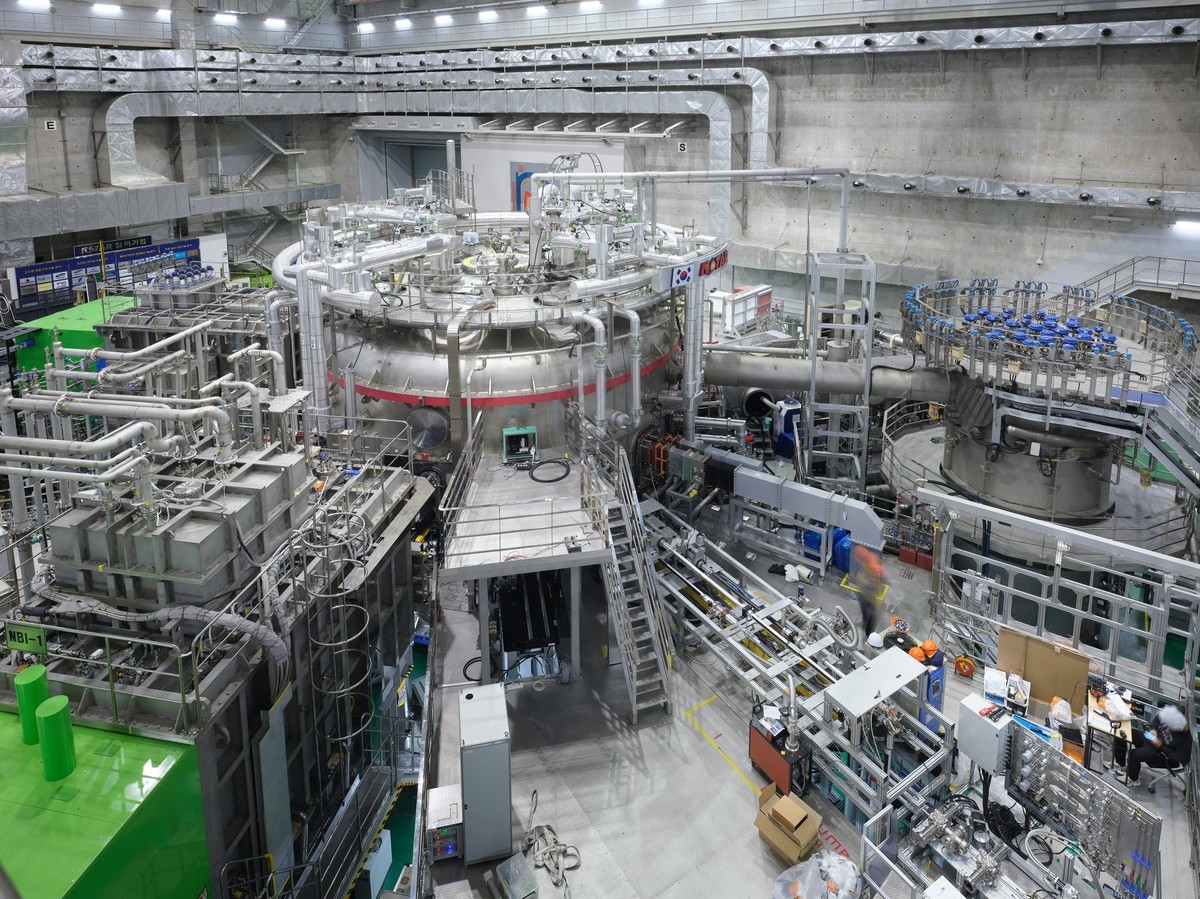
South Korea's KSTAR to Conduct Long-Pulse Fusion Research in Tungsten Environment with European Institutions
The Korea Institute of Fusion Energy (KFE) announced on August 27 that it has signed implementation agreements with multiple fusion research institutions in France, Italy, Germany, and Finland to conduct joint research on long-duration plasma operation in a tungsten environment using the Korea Superconducting Tokamak Advanced Research (KSTAR) device. Partner institutions include the French Alternative Energies and Atomic Energy Commission (CEA), the Italian National Agency for New Technologies, Energy and Sustainable Economic Development (ENEA), the Max Planck Institute for Plasma Physics (IPP) in Germany, and the VTT Technical Research Centre of Finland (VTT). The institutions will focus on key technologies required for long-pulse operation of future fusion reactors...
2026-08-27

South Korea plans to build an innovative self-developed fusion reactor by 2035
Yang Hyeong-ryeol, head of the fusion sector of the K-Moonshot project at the Korea Institute of Fusion Energy (KFE), recently stated that South Korea plans to complete the construction of an independently developed innovative fusion reactor by 2035 and strives to complete power generation demonstration by 2039. He said that nuclear fusion is an extremely challenging technical endeavor, but once a breakthrough is achieved, it will have broad driving effects on the energy, industrial, and technological systems. Yang Hyeong-ryeol, project director of South Korea's Moonshot program, said nuclear fusion is often called an artificial sun because it generates energy by simulating the energy production process inside the sun. Against the backdrop of rapid expansion of AI applications, rising electricity demand, and increasing global pressure for carbon reduction, the commercialization of fusion energy is attracting growing attention from more countries and enterprises. The South Korean government has listed nuclear fusion, along with small modular reactors and renewable energy, as key future technology directions, and hopes to advance the commercialization of fusion energy through public-private partnerships.
2026-08-20