
CERN measures niobium-94 neutron capture for the first time, shedding new light on the mystery of molybdenum abundance in ancient stardust
 Scan to share
The n_TOF collaboration at CERN recently reported that researchers have for the first time measured the probability of neutron capture by niobium-94. The results, published in Physical Review Letters, provide new experimental evidence for explaining the anomalous abundance of molybdenum-94 in presolar grains.
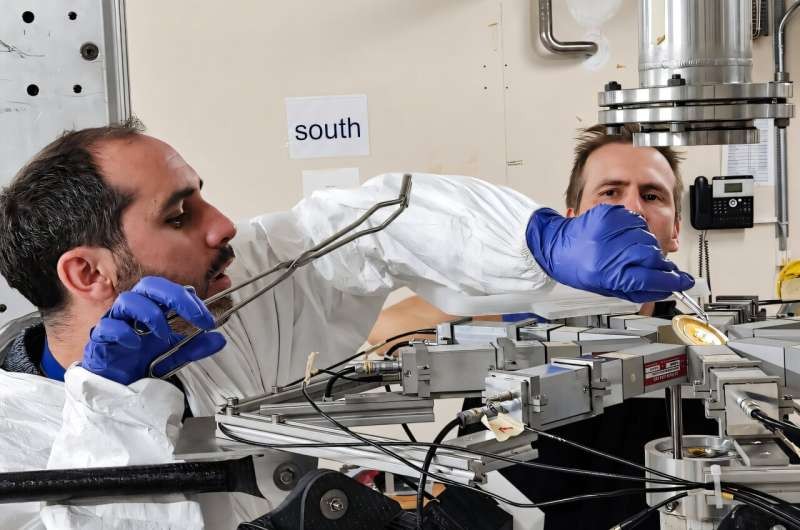
The EAR2 facility in the n_TOF experiment at CERN produces intense neutron beams, opening new possibilities for nuclear research. Credit: CERN
Niobium-94 is a niobium isotope containing 41 protons and 53 neutrons, occupying a critical juncture in the nuclear reaction chain that produces heavy elements in dying stars. Researchers focus on it because niobium-94 is very close to molybdenum-94, differing by just one fewer proton and one more neutron. Under the high-temperature, high-pressure conditions inside stars, niobium-94 may either transform into molybdenum-94 through beta decay or form niobium-95 through neutron capture. The competition between these two reaction pathways directly affects scientists' understanding of the origin of molybdenum-94.
For a long time, scientists have observed that the abundance of molybdenum-94 in presolar grains exceeds theoretical model predictions. Presolar grains are ancient stardust that survived the formation of the Sun, with some of them reaching Earth aboard primitive meteorites. By studying these grains, researchers can trace the nuclear composition information from the formation of heavy elements in the early Milky Way. However, the probability of niobium-94 capturing neutrons had never been directly measured before, and related models could only rely on theoretical estimates.
To carry out this experiment, multiple research institutions participated in the preparation and characterization of the rare isotope samples. The Helmholtz-Zentrum Dresden-Rossendorf prepared stable and pure niobium-93 samples, the Institut Laue-Langevin converted a small fraction of them into niobium-94, and the Paul Scherrer Institute subsequently performed detailed characterization of the samples. The research team then irradiated the samples with an intense neutron source at the EAR2 experimental station of the CERN n_TOF facility to simulate the neutron capture process of niobium-94 in stellar environments.
The experiment spokesperson stated that the high instantaneous neutron flux at the EAR2 experimental station was crucial for capturing the weak neutron capture signals from the niobium-94 samples. The measurement results show that the experimental values are relatively close to some previous theoretical estimates, implying that the long-standing discrepancy between models and stardust observations does not primarily stem from the estimated neutron capture probability of niobium-94, but is more likely related to limitations in early stellar models.
The researchers noted that when the new experimental results are incorporated into more advanced stellar models, the model uncertainties are significantly reduced, and the models can reproduce the molybdenum-94 abundance observed in ancient stardust. This progress is considered an important step toward understanding the nucleosynthetic origin of molybdenum-94.
However, the issue is not yet fully resolved. Another key branch in the evolution path of niobium-94—beta decay—still relies mainly on theoretical estimates. The research team stated that more precise experimental measurements of this nuclear process will be needed in the future to further clarify the origin of molybdenum-94 and deepen the understanding of the mechanisms by which stars produce heavy elements.
Disclaimer: Information republished from partner media, institutions or other websites is provided for reference and communication purposes only. It does not imply endorsement of its views or verification of its accuracy. Please contact us if any content infringes rights or requires correction.