
Search Results
Keyword:cosmic rays
"Wukong" Detects "Super-Iron" Elements in Cosmic Rays, Achieving First High-Precision Cosmic Ray Nickel Energy Spectrum in the TeV Range
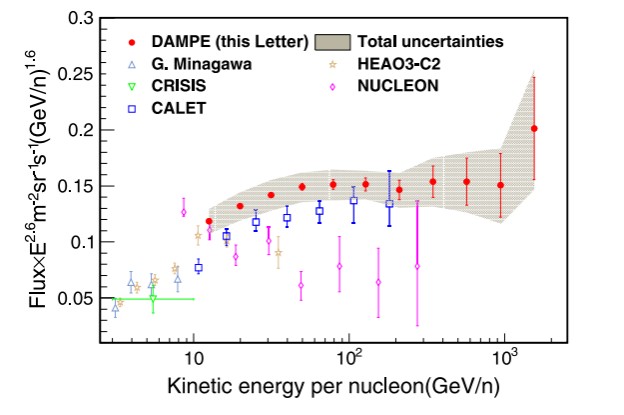
Recently, the DAMPE scientific team led by Academician Chang Jin of the University of Science and Technology of China made significant progress in direct observations of high-energy cosmic rays. Based on DAMPE on-orbit observation data, the scientific team obtained the differential flux spectrum of nickel nuclei from 10 GeV/n to 2 TeV/n. The results were published in the international academic journal *Physical Review Letters* under the title "Measurement of the Cosmic Ray Nickel Energy Spectrum from 10 GeV/n to 2 TeV/n with the DAMPE Space Mission." The origin of super-iron elements in cosmic rays has long been a challenge for the scientific community. It is generally believed that cosmic ray elements are primarily produced in nuclear fusion processes within stars, but since iron nuclei have the highest binding energy per nucleon, stellar fusion reactions typically struggle to proceed beyond elements near iron. Heavier elements than iron are generally attributed to different nucleosynthesis processes such as neutron capture. Because the abundance of super-iron elements is typically at least an order of magnitude lower than that of iron, measurements of super-iron elements in cosmic rays remain extremely scarce. Most experiments have only provided relative abundances of different elements; a few experiments have measured the differential flux spectrum of cosmic ray nickel, but with energy upper limits of only a few hundred GeV/n.
2026-09-07

Cosmic Rays "Probe" Soil Moisture from Above: Colorado State University Innovates Soil Moisture Monitoring Technology
Researchers at Colorado State University are utilizing a mobile cosmic-ray neutron rover to explore a novel soil moisture monitoring method. This technology is expected to provide data support for hydrological research, particularly in assessing the impacts of wildfires on landscapes. The rover is reportedly capable of estimating soil moisture over large areas by measuring changes resulting from the interaction of cosmic rays from outer space with hydrogen atoms in the soil. Unlike traditional sensors that only capture near-surface data at a limited number of points, or the coarse resolution of satellite remote sensing, this technology offers a mesoscale dataset that falls between the two, enabling more accurate mapping of moisture distribution...
2026-08-04