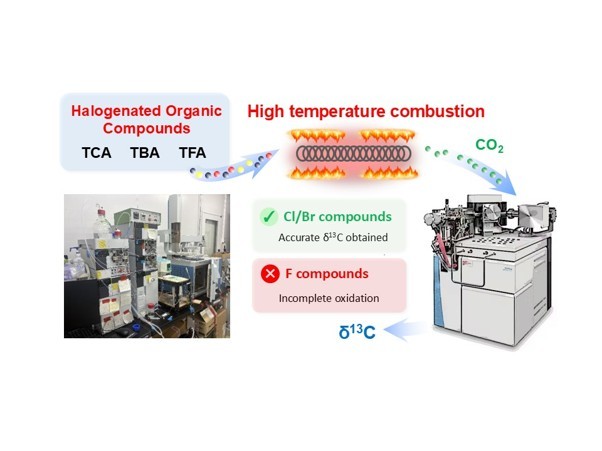
Japanese Team Develops High-Temperature, High-Pressure Isotope Ratio Analysis Method for Tracing Halogenated Pollutants
Researchers from Shibaura Institute of Technology (SIT) and the National Institute of Advanced Industrial Science and Technology (AIST) in Japan have collaboratively developed a customized high-temperature, high-pressure combustion interface for liquid chromatography-isotope ratio mass spectrometry (LC-IRMS), enabling carbon stable isotope ratio (δ¹³C) analysis of various halogenated organic compounds. The research findings were published online on August 2, 2026, and will appear in Volume 1421 of Analytica Chimica Acta, scheduled for release on November 1, 2026. Source of the new high-temperature, high-pressure LC-IRMS system: Professor Hiroto Kawashima, SIT, Japan. Halogenated organic compounds are widely present in disinfection byproducts, pesticides, refrigerants, and industrial chemicals, some of which exhibit persistence, bioaccumulation, and toxicity. Traditional environmental monitoring primarily relies on concentration measurements, which makes it difficult to directly provide information on pollutant sources and environmental transformation processes. δ¹³C analysis can offer clues for studying chemical sources, production processes, and environmental fate, but organic pollutants containing strong carbon—chlorine or carbon—fluorine bonds are difficult to fully oxidize under conventional LC-IRMS combustion conditions, limiting the application of this technique.
2026-09-02