
German SIBAF Project Receives €9.7 Million to Support Fusion Materials Research
 Scan to share
On August 20, 2026, with funding from the German Federal Ministry of Research, Technology and Space (BMFTR), the SIBAF project will launch the construction of an accelerator infrastructure for fusion materials research. The project, whose full name is "Superconducting Ion Accelerator as a Foundational Technology for Fusion Research," will receive €9.7 million over three years, of which €8.1 million is allocated to the GSI Helmholtz Centre for Heavy Ion Research (GSI) and its Facility for Antiproton and Ion Research (FAIR), currently under construction. Goethe University Frankfurt will also participate in the project.
SIBAF is part of the funding program "Fusion Foundational Technologies — Toward the Fusion Power Plant." The project aims to establish an accelerator-based research platform for faster screening and qualification of advanced materials required for future fusion power plants. Since key components of fusion reactors must operate for extended periods under high temperatures and intense neutron irradiation, materials development and qualification are regarded as a critical step in the engineering deployment of fusion energy.
At present, neutron irradiation experiments remain an irreplaceable tool for fusion materials research, but such experiments are costly and facility resources are limited. Heavy-ion irradiation can serve as an important complement, accelerating the formation of irradiation damage under controlled conditions while reducing sample activation levels for easier subsequent analysis.
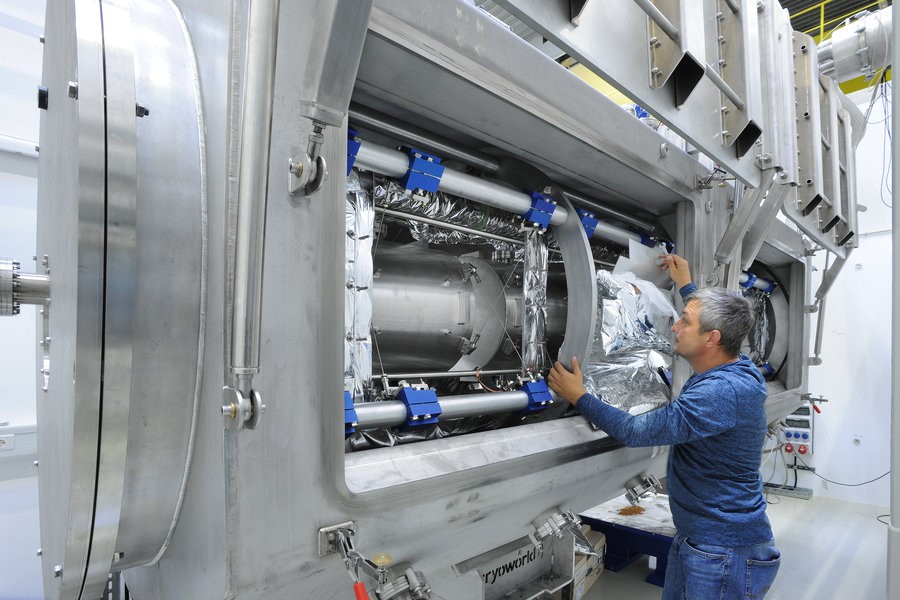
As planned, SIBAF will build on the superconducting continuous-wave accelerator — the Helmholtz Linear Accelerator (HELIAC) — which is being partially constructed at the GSI/FAIR campus. The project will utilize the first cryomodule of HELIAC and the existing High Charge State Injector (HLI) at GSI/FAIR to construct a dedicated irradiation facility equipped with temperature-controlled sample environments and automated sample handling systems. According to the project team, this facility will combine superconducting accelerator technology with materials irradiation and characterization capabilities, improving the speed, reproducibility, and energy efficiency of fusion candidate materials qualification.
SIBAF is coordinated by Maksym Miski-Oglu, head of the CW Linac Research Group at GSI/FAIR. He stated that the project will translate the long-standing expertise in superconducting linac technology into practical applications, providing support for materials development for future fusion power plants.
Maria Eugenia Toimil-Molares, head of Materials Research at GSI, stated that the new irradiation facility based on HELIAC will complement the existing ion-beam materials research infrastructure at GSI/FAIR, providing conditions for studying radiation effects and developing materials suitable for extreme irradiation environments. Continuous-wave heavy-ion irradiation enables faster and more controllable damage accumulation, which is of practical significance for qualifying advanced fusion reactor materials.
Thomas Nilsson, Scientific Director of GSI and FAIR, stated that this funding reflects GSI/FAIR's capabilities in accelerator technology and materials research, will advance materials development and qualification for fusion applications, and will provide a platform for training the next generation of experts in accelerator and fusion technologies. The project consortium also acknowledged Winfried Barth for his contributions to the conception, preparation, and initial submission of the SIBAF project proposal.
Disclaimer: Information republished from partner media, institutions or other websites is provided for reference and communication purposes only. It does not imply endorsement of its views or verification of its accuracy. Please contact us if any content infringes rights or requires correction.