
CNNC achieves end-to-end process integration for the production of the medical isotope Terbium-161.
 Scan to share
Recently, the China Institute of Atomic Energy (CIAE) under the China National Nuclear Corporation (CNNC) successfully established the entire production process for the emerging medical isotope Terbium-161 (161Tb), producing a 100-millicurie, high-purity sample. Testing revealed a nuclidic purity of 99.9% and a radiochemical purity of 99%, with impurity concentrations (such as iron, copper, and zinc) at the ppb level (10⁻¹¹ to 10⁻⁷). This achievement marks CNNC's mastery of nuclidic purity control technology for medical Terbium-161; the separation and purification process set new domestic records for recovery and impurity removal rates, laying a solid foundation for the domestic production of high-purity Terbium-161.
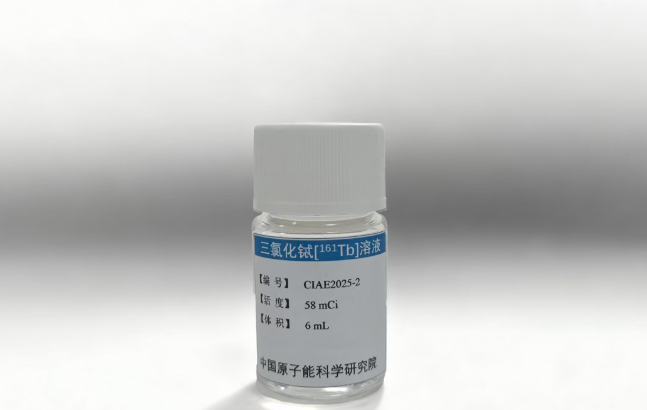
Terbium-161 is a next-generation medical radioisotope designed for "theranostics" (combining diagnosis and therapy). It serves a dual purpose: effectively destroying solid tumors by emitting beta rays, while simultaneously releasing significant amounts of Auger electrons and internal conversion electrons to precisely damage cancer cell DNA—making it particularly effective at eliminating micrometastases. Terbium-161 delivers a higher radiation dose to tumors while causing less damage to healthy organs and tissues. It holds great clinical value and application potential in the radiotherapy of small tumors, offering new hope for patients with conditions such as neuroendocrine tumors and prostate cancer.
Medical-grade Terbium-161 demands extremely high standards for nuclidic and radiochemical purity. The primary challenge in production lies in separating Terbium-161 from its precursor material (Gadolinium-160), radioactive impurities, and metal ion impurities like iron and copper. While extraction methods for Terbium-161 have been established internationally, existing separation and purification processes often suffer from low recovery rates and inefficient impurity removal.
To address this challenge, the Radiochemistry Institute of the CIAE targeted the cutting-edge radionuclide market. Adopting the advanced Integrated Product Development (IPD) management model and utilizing stable isotopes such as gadolinium, terbium, and dysprosium, the team independently established a comprehensive process chain covering Gadolinium-160 target preparation, irradiation, and separation-purification. The team successfully conducted irradiation experiments on both natural and highly enriched gadolinium targets and carried out multiple hot tests for separation and purification. They have fully established the production process for Terbium-161 and verified that key performance indicators—such as chemical recovery rates and impurity removal rates—meet design specifications.
Moving forward, the China Institute of Atomic Energy (CIAE) will further refine and standardize the nuclide production process, actively advance the development of large-scale production technologies and the translation of research outcomes, and contribute to the high-quality, sustainable development of my country's nuclear medicine industry.
Disclaimer: Information republished from partner media, institutions or other websites is provided for reference and communication purposes only. It does not imply endorsement of its views or verification of its accuracy. Please contact us if any content infringes rights or requires correction.