
Hefei establishes a new joint laboratory for fusion reactor material irradiation and evaluation, driving the coordinated development of the nuclear fusion industry.
 Scan to share
Recently, the Joint Laboratory for Fusion Reactor Material Irradiation and Evaluation—co-established by the Institute of Plasma Physics (Hefei Institutes of Physical Science, Chinese Academy of Sciences) and the Institute of High Energy Physics (Chinese Academy of Sciences)—was inaugurated in Hefei. Addressing the needs for fusion reactor material irradiation and evaluation, the laboratory aims to further augment Hefei's research resources in neutron irradiation of fusion materials, strengthen foundational research capabilities, and provide professional technical support to enterprises across the fusion industry chain.
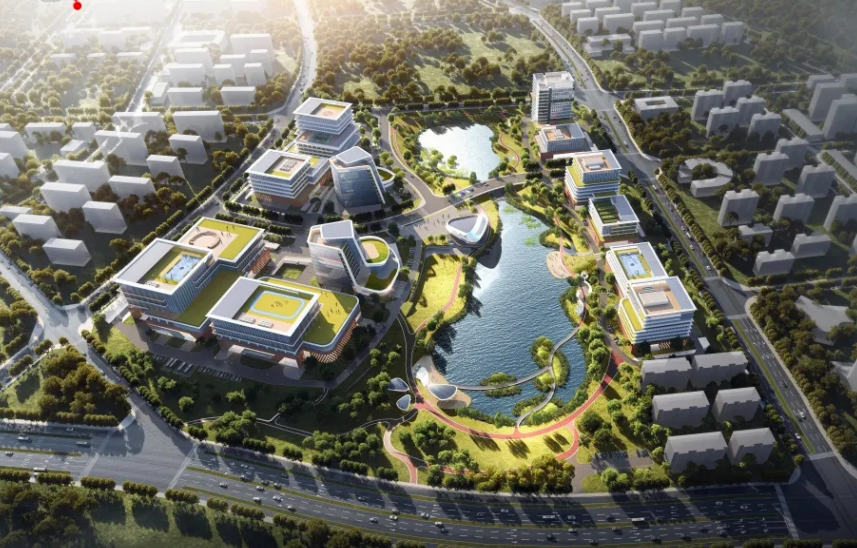
Rendering of the Luyang Future Innovation Valley Industrial Park
Concurrently, the Xiyuan Fusion Scenario Laboratory in Hefei was designated as a municipal-level "scenario laboratory," adding a new platform for innovation to the city's fusion industry. Jointly established by Fusion New Energy (Anhui) Co., Ltd., the Energy Research Institute of the Hefei Comprehensive National Science Center, and other entities, the laboratory focuses on using scenario-based innovation to bridge research resources with industrial needs, thereby facilitating the integration of cutting-edge fusion technologies with market applications.
Reportedly, the Xiyuan Fusion Scenario Laboratory has already released 26 collaboration opportunities—covering systems such as heating, water cooling, vacuum, and fuel cycles—to small and medium-sized enterprises, aiming to drive the practical implementation of technologies and foster industrial synergy.
Currently, Hefei's Luyang District is accelerating the layout of its fusion industry by leveraging major scientific facilities such as the Experimental Advanced Superconducting Tokamak (EAST) and the Compact Fusion Energy Experimental Device (BEST), while developing carrier platforms like the Future Innovation Valley Industrial Park and the Huanggang Science and Technology Industrial Park. Focusing on the magnetic confinement tokamak technology pathway, the district is fostering an innovation ecosystem for the fusion industry that seamlessly connects basic research, the transformation of scientific achievements, and industrial clustering.
An official from the Luyang District Science and Technology Bureau stated that the district has attracted 67 innovation platforms in recent years—including the Hong Kong Polytechnic University (Hefei) Technology Innovation Research Institute, the State Key Laboratory of Rare Earth Permanent Magnet Materials, and the CAS Medical Valley—forming a nascent cluster of innovation platforms spanning sectors such as high-end instrumentation, fusion energy, new materials, and life and health.
Disclaimer: Information republished from partner media, institutions or other websites is provided for reference and communication purposes only. It does not imply endorsement of its views or verification of its accuracy. Please contact us if any content infringes rights or requires correction.