
Department of Plasma Physics and Fusion Engineering at the University of Science and Technology of China Proposes New Three-Dimensional Magnetic Field Configuration for Stellarators
 Scan to share
Stellarators confine high-temperature plasma using three-dimensional magnetic fields generated by external coils, enabling steady-state operation without relying on plasma current and avoiding instabilities such as disruptions, making them the fastest-growing technological route globally. However, if the three-dimensional magnetic field is not carefully optimized, trapped particles can experience significant radial drift, leading to a substantial increase in neoclassical transport losses. To suppress this drift, the magnetic field must satisfy the "omnigenity" condition, meaning that the time-averaged radial drift of all trapped particle orbits is zero.
The most widely applied class of omnigenous magnetic fields is poloidal omnigenity (PO), and such configurations are also commonly referred to as quasi-isodynamic (QI) configurations, which offer the advantage of zero bootstrap current at low collision frequencies and serve as the theoretical cornerstone of the world's largest operating stellarator, Wendelstein 7-X (W7-X), as well as most fusion reactor concepts. However, PO requires magnetic field contours to close strictly in the poloidal direction, which inherently conflicts with the toroidal geometry of stellarators, often resulting in excessive mirror ratios or elongated cross-sections on the high-field side, complex coil designs, and poor economic efficiency in terms of aspect ratio, forcing fusion reactor designs to face multiple trade-offs.
The advanced stellarator research team at the University of Science and Technology of China has innovatively proposed the OOPS unified mapping framework (arXiv:2502.09350), which for the first time incorporates multiple classes of hidden symmetry configurations, including quasi-symmetry and omnigenity, into a unified mathematical description, and further developed the "squeeze" mapping technique: while maintaining strict poloidal omnigenity (PO) on the weak-field side, the magnetic field contours on the strong-field side are locally closed, forming a new configuration with approximate piecewise omnigenity (pwO). This new three-dimensional magnetic field configuration (PO-pwO) can broaden the design space without sacrificing confinement performance.
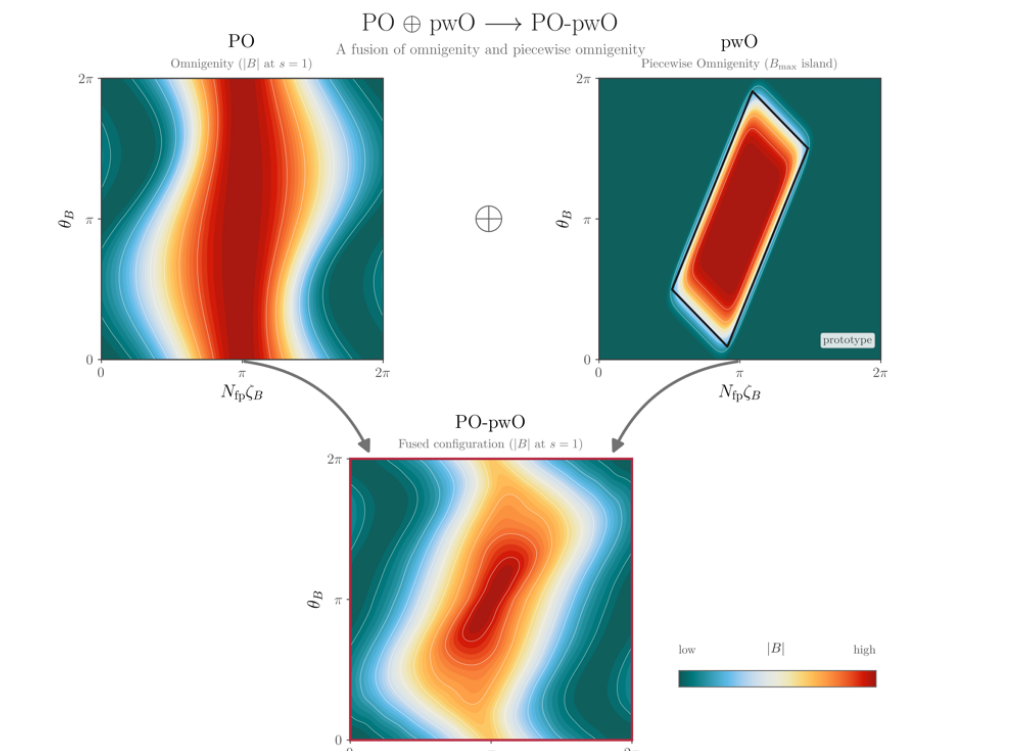
Figure 1: Magnetic field strength distributions of poloidal omnigenity (PO), piecewise omnigenity (pwO), and hybrid omnigenity (PO-pwO) configurations.
The research team has optimized and obtained a series of PO-pwO configuration designs with excellent confinement performance. Figure 2 presents 9 PO-pwO configurations with magnetic field period numbers ranging from 2 to 5 and aspect ratios ranging from 4 to 10. These new configurations exhibit superior neoclassical transport characteristics compared to W7-X; at typical fusion reactor dimensions, the alpha particle loss rates are all below 4% (the W7-X loss rate is approximately 20%). These PO-pwO designs can relax the stringent requirements on mirror ratio and aspect ratio while ensuring physical performance, providing new options for designing stellarator fusion reactors.
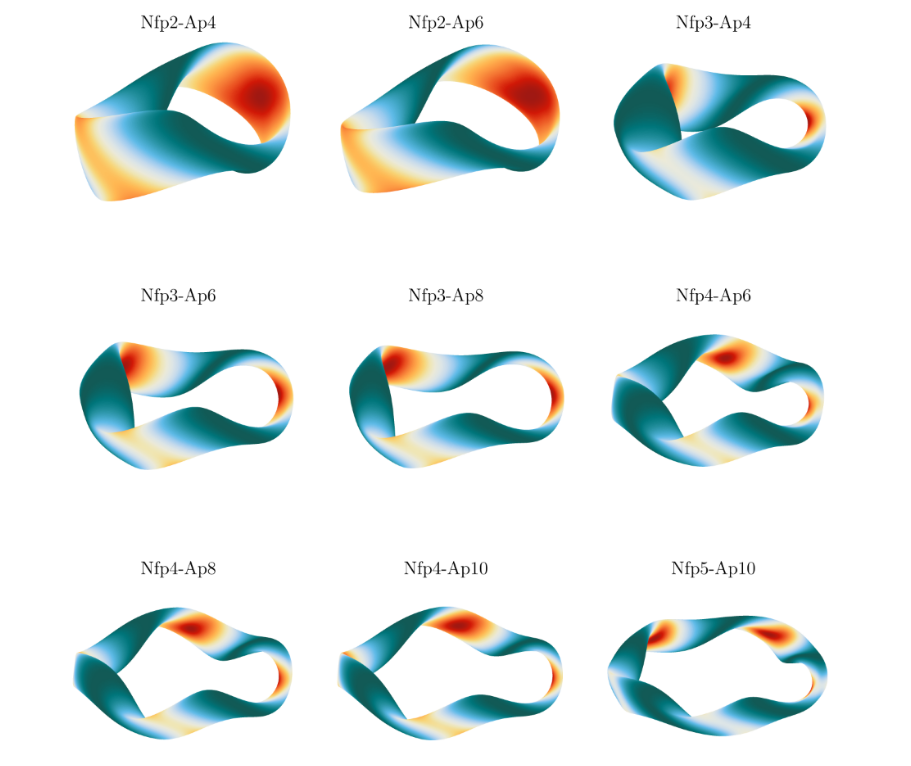
Figure 2: 9 optimized PO-pwO configurations with varying magnetic field period numbers and aspect ratios, with colors indicating magnetic field strength distributions.
The significance of this work extends beyond obtaining a batch of high-performance novel stellarator configurations. As an optimization framework that unifies the description and actively designs hidden symmetries, the OOPS method provides new theoretical language and computational tools for stellarator configuration exploration. By actively establishing connections among quasi-symmetry, omnigenity, and piecewise omnigenity, it expands the feasible design space for high-performance stellarators. In the future, this method is expected to be used to construct large-scale high-performance stellarator configuration databases, serving AI-assisted optimization, coil design, and fusion reactor concept studies, providing original tools for developing stellarator fusion reactors that combine physical advancement with engineering feasibility.
This research, titled "Optimization of stellarator configurations combining omnigenity and piecewise omnigenity," was published in the renowned journal Nuclear Fusion in the field of nuclear fusion. The first author of the paper is Liu Hengqian, a doctoral student at USTC, with Professor Zhu Caoxiang as the corresponding author. Collaborators include Associate Researcher Wei Guodong and Researcher José Luis Velasco from the CIEMAT institute in Spain. This research was jointly funded by the Strategic Priority Research Program of the Chinese Academy of Sciences, the National Natural Science Foundation of China, and the Spanish Ministry of Science, Innovation and Universities.
ENDAbout the Department of Plasma Physics and Fusion Engineering: Since its establishment in 2020, the Department of Plasma Physics and Fusion Engineering at the University of Science and Technology of China (Department No. 52) has become the first department-level institution in China dedicated to teaching and research in plasma physics and fusion engineering, with its predecessor being the Plasma Physics Teaching and Research Group established in 1974. Currently, Department 52 offers two undergraduate programs in Applied Physics and Engineering Physics, and recruits graduate students in three specialties: Physics (Plasma Physics), Nuclear Science and Technology (Nuclear Energy Engineering), and Energy and Power.
Disclaimer: Information republished from partner media, institutions or other websites is provided for reference and communication purposes only. It does not imply endorsement of its views or verification of its accuracy. Please contact us if any content infringes rights or requires correction.