
Basic research cracks an application challenge that has persisted for nearly half a century: quantitative prediction of neutron irradiation swelling via ion irradiation
 Scan to share
Whether advanced nuclear energy systems can operate safely over the long term depends on the ability of structural materials to resist neutron irradiation damage. Neutrons create numerous atomic-scale defects in materials, which gradually aggregate into nanoscale cavities, ultimately causing material swelling, dimensional instability, and performance degradation. However, obtaining high-dose neutron irradiation data often requires years or even more than a decade, with high costs and post-irradiation sample radioactivity; in contrast, ion irradiation can simulate years of accumulated damage within days and is therefore widely adopted (approximately 95% of irradiation experimental data in existing literature come from ion irradiation). But the dose rate of ion irradiation is typically 3—4 orders of magnitude higher than that of neutron irradiation, making direct conversion between the two results difficult. Recently, the research team of Wang Chenxu and Wang Yugang from the Institute of Heavy Ion Physics, School of Physics, and the State Key Laboratory of Nuclear Physics and Nuclear Technology at Peking University, in collaboration with researchers from the University of Tennessee and other institutions, established a quantitative relationship between material swelling and irradiation dose and dose rate at fixed temperatures based on cluster dynamics simulations, theoretical derivations, and ion irradiation experiments, achieving prediction of neutron irradiation swelling using rapid ion irradiation and providing a new tool for rapid screening and lifetime evaluation of nuclear materials.
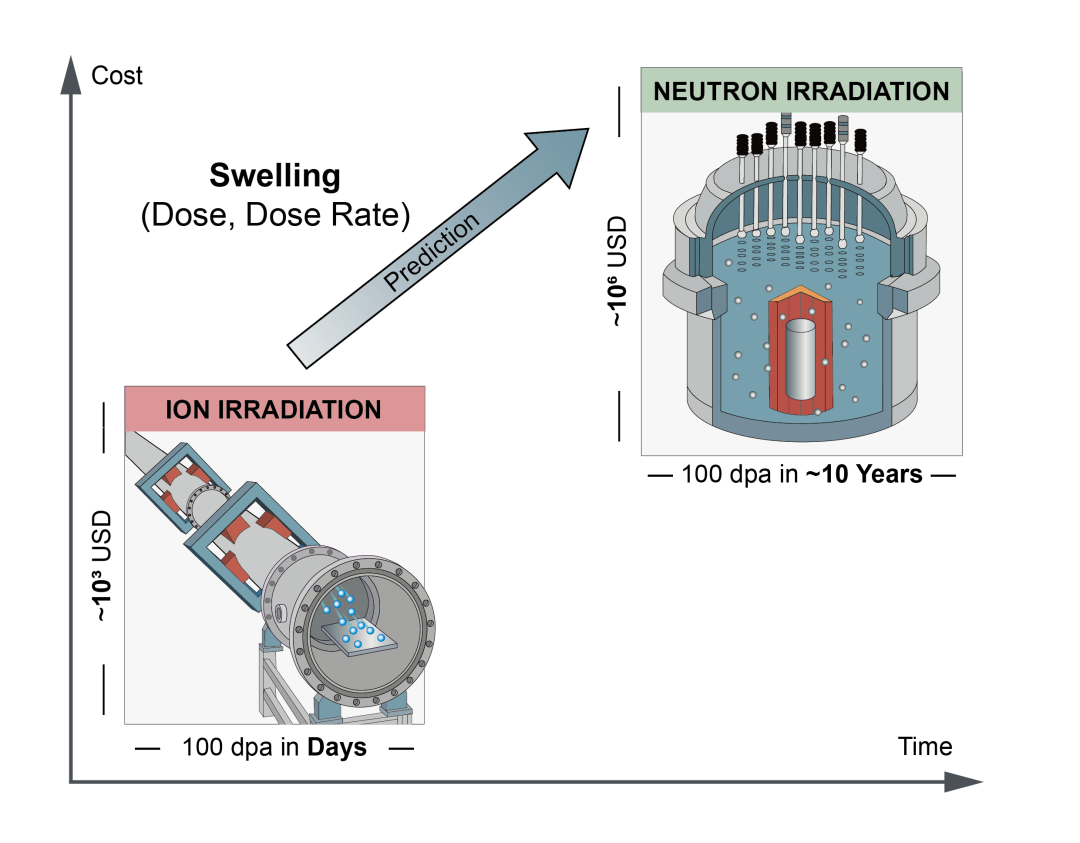
Figure 1 Ion irradiation can obtain high-dose data within days, whereas neutron irradiation often requires years; this study establishes a quantitative prediction pathway between the two.
Irradiation dose can be understood as the "total rainfall" of a rain event, while dose rate corresponds to "rainfall intensity." With the same total rainfall, ten days of drizzle versus one day of concentrated downpour have different effects on the ground. The same applies to materials: a high dose rate causes more defects to coexist simultaneously, altering the competitive processes of defect recombination, aggregation, and migration, and the same dose does not necessarily produce the same degree of swelling. In 1978, Mansur proposed the temperature-shift equivalence method, which compensates for dose rate differences by raising the ion irradiation temperature, but no theoretical breakthrough has been achieved in the 48 years since, and this method is mainly applicable to relatively low doses, making reliable prediction difficult at high doses. Therefore, how to bridge the dose rate gap and establish a quantitative ion—neutron equivalence model is the key to reliable evaluation of irradiation resistance of nuclear materials and a research challenge that has persisted for nearly half a century in the field of nuclear materials.
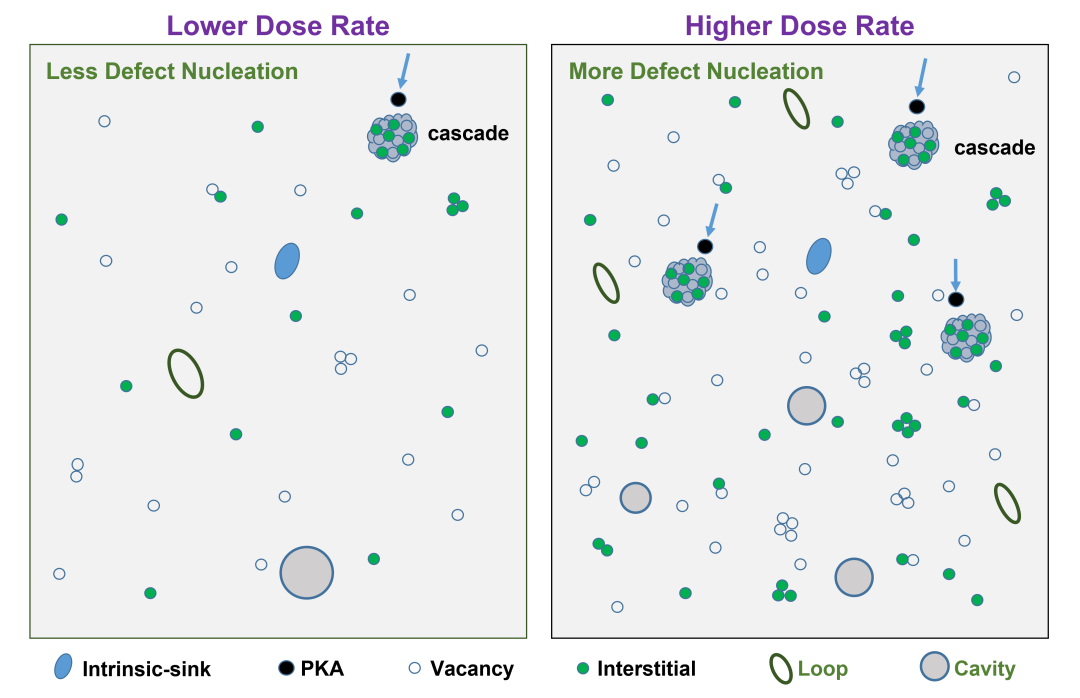
Figure 2 Schematic of the dose rate effect: a high dose rate causes more defects to coexist simultaneously and promotes the nucleation of defects such as cavities and dislocation loops.
Starting from the physical processes of cavity formation and growth, the research team innovatively proposed a different research pathway: instead of attempting to offset dose rate differences by adjusting temperature, they directly established a quantitative relationship between cavity swelling and irradiation dose and dose rate at fixed temperatures, based on the material's own irradiation response. This physical framework can describe the nonlinear swelling behavior of different materials from incubation, rapid growth, to high-dose stages, and has been validated by extensive experimental data from multiple material classes including austenitic stainless steels and ferritic/martensitic steels. Further ion irradiation experiments demonstrated that model parameters determined solely from ion data at different doses and dose rates at the same temperature can successfully predict fast reactor neutron irradiation results.
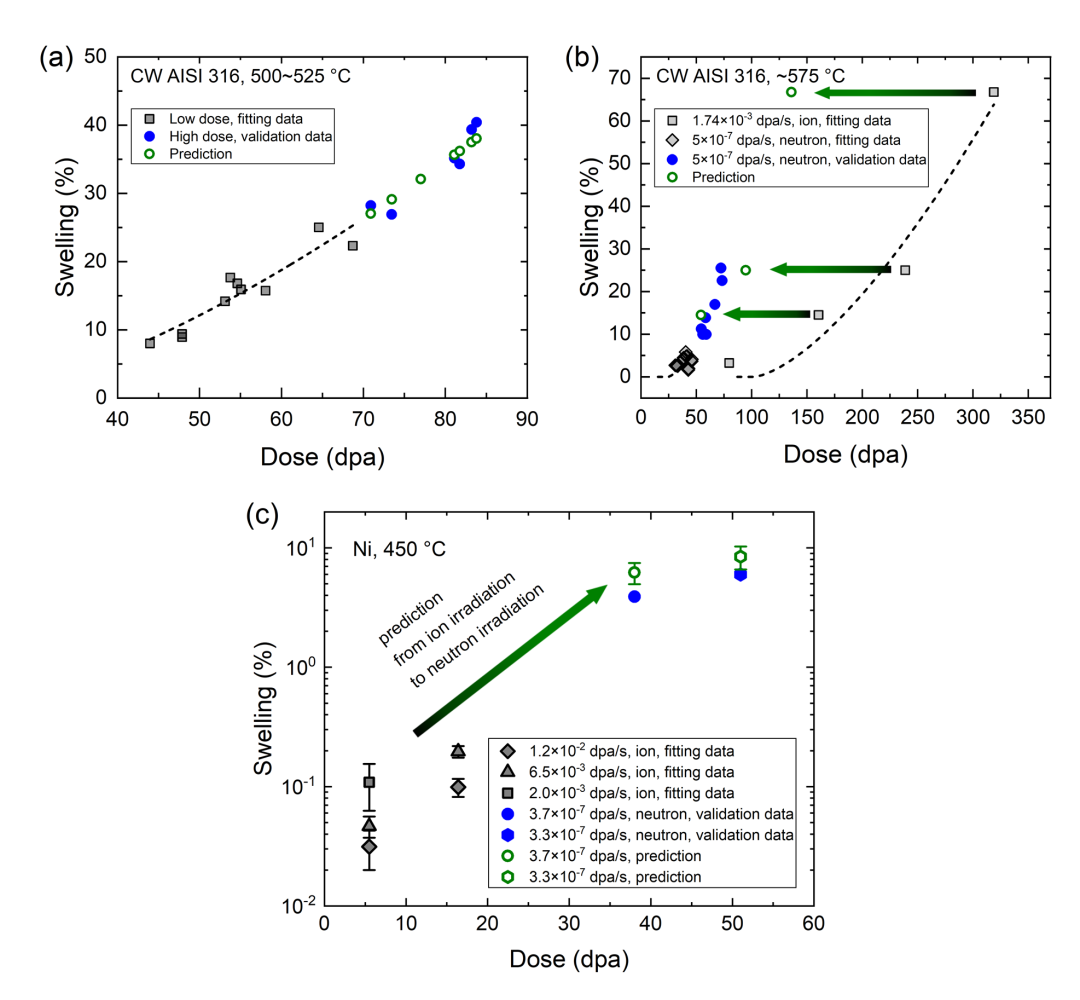
Figure 3 Validation results of the model in high-dose extrapolation, equivalent dose conversion, and ion—neutron swelling prediction.
The key breakthrough of this work lies in simultaneously addressing two critical issues in irradiation swelling prediction: on one hand, it can predict high-dose neutron irradiation from low-dose neutron irradiation data; on the other hand, it can predict low-dose-rate neutron irradiation, which differs by several orders of magnitude, from high-dose-rate ion irradiation swelling. Furthermore, because this method successfully separates material parameters from irradiation parameters, it can be applied to complex alloys, providing a quantitative tool for rapid screening, long-term performance evaluation, and safety design of nuclear structural materials, and is particularly valuable for the development of future fusion reactor materials that lack fusion neutron conditions.
This research, titled "Bridging Ion and Neutron Irradiation: A Predictive Framework for Swelling in Structural Alloys," was published in PRX Energy in July 2026. Chen Denghuang, a 2023-class doctoral student at the Institute of Heavy Ion Physics, School of Physics, Peking University, Ge Wei, a 2022 doctoral graduate, and Luo Fengping, a 2025 doctoral graduate, are co-first authors of the paper, with Wang Chenxu and Wang Yugang as co-corresponding authors. This research was supported by the National Natural Science Foundation of China and the National Magnetic Confinement Fusion Energy Development Research Project.
Disclaimer: Information republished from partner media, institutions or other websites is provided for reference and communication purposes only. It does not imply endorsement of its views or verification of its accuracy. Please contact us if any content infringes rights or requires correction.