
Microchip Launches Radiation-Tolerant Six-Output Programmable Clock Generator DSA504RT
 Scan to share
Microchip Technology Inc. of the United States has launched the DSA504RT radiation-tolerant six-output programmable clock generator, targeting spacecraft and other aerospace and defense high-reliability electronic systems, designed to simplify timing architectures in complex systems.
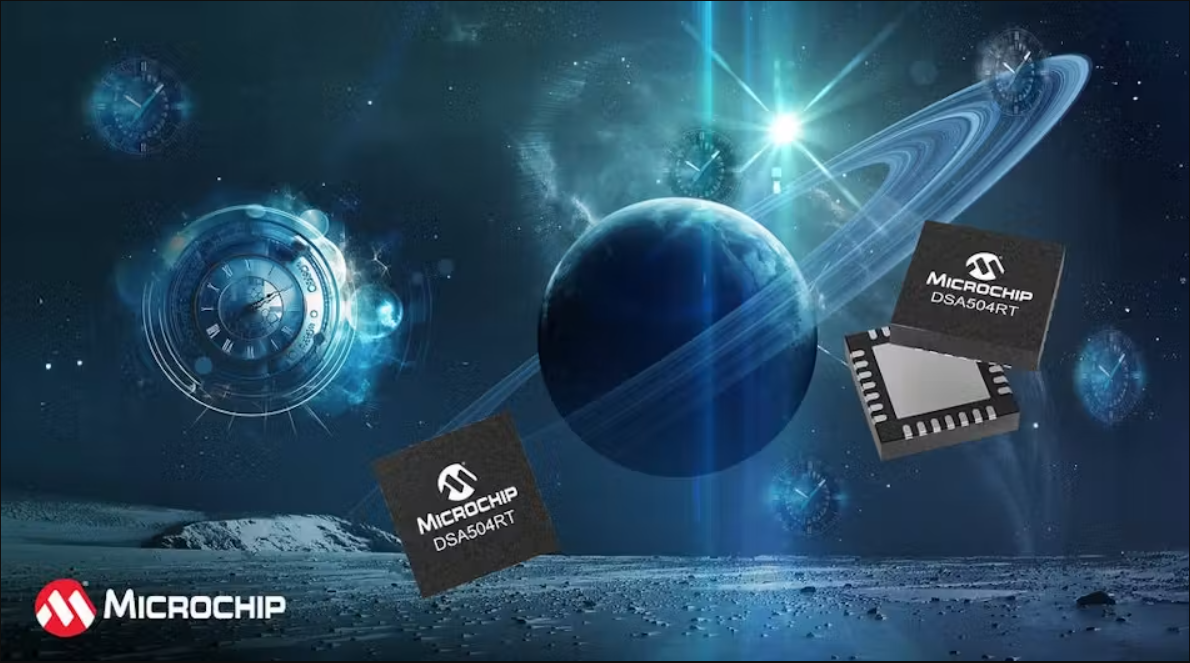
Spacecraft electronics typically require highly stable time references for missions such as navigation, communications, and scientific payloads, especially in environments where global navigation satellite system (GNSS) signals may be unavailable or subject to interference. Traditional solutions often rely on multiple oscillators, buffers, and timing devices to provide clock signals to different subsystems, resulting in increased component count, higher system mass, and greater circuit complexity.
The DSA504RT integrates clock generation and distribution functions into a single device, generating multiple phase-aligned frequencies from one external reference source. The device integrates an analog phase-locked loop (APLL), fractional and integer dividers, and configurable output buffers, providing up to six clock outputs. Each output can be independently configured as LVPECL, LVDS, or low-power HCSL differential drivers, or as a pair of single-ended CMOS outputs, thus supporting up to six differential outputs, twelve single-ended outputs, or a combination of output types.
In terms of performance, the DSA504RT achieves jitter performance as low as 200 femtoseconds over the 12 kHz to 20 MHz frequency range and supports outputs compliant with PCI Express Gen 1 through Gen 7 SRIS standards. Its programmable architecture enables engineers to replace multiple discrete oscillators, synthesizers, and buffers with a single device, reducing board footprint and simplifying clock distribution networks.
The device supports external differential or single-ended clock references, with a differential input range of 10 MHz to 250 MHz and an LVCMOS input range of 10 MHz to 200 MHz. Depending on the output type, its output frequency range spans from 0.35 MHz to 662 MHz.
The DSA504RT is designed for radiation environments, with a total ionizing dose rating of 50 krad(Si); at 125 degrees Celsius, no single-event latch-up occurs when the linear energy transfer threshold is below 78 MeV·cm²/mg. The device operates over a temperature range of -55 degrees Celsius to 125 degrees Celsius and supports a supply voltage of 1.71 V to 3.63 V.
In terms of packaging, the DSA504RT is available in a 32-pin CQFP32 hermetic ceramic flat pack and a 28-pin VQFN28 high-reliability plastic package. The device can be used in conjunction with radiation-tolerant and radiation-hardened FPGAs, microcontrollers, and other devices, making it suitable for spacecraft and other high-reliability electronic systems.
Disclaimer: Information republished from partner media, institutions or other websites is provided for reference and communication purposes only. It does not imply endorsement of its views or verification of its accuracy. Please contact us if any content infringes rights or requires correction.