
South Korea's Nuclear Energy Paper Output Ranks High but Quality Impact Remains Low
 Scan to share
According to the report "Academic Competitiveness Analysis in Five Core and Emerging Technology Fields of the United States" released by the National Research Foundation of Korea on the 12th, from 2016 to 2025, South Korea's paper output in fields such as semiconductors, artificial intelligence, nuclear energy, biotechnology, and quantum information has maintained a certain level of competitiveness overall. Among these, the number of papers in the semiconductor field ranked 4th globally, artificial intelligence and nuclear energy both ranked 7th, biotechnology ranked 8th, and quantum information ranked 14th.
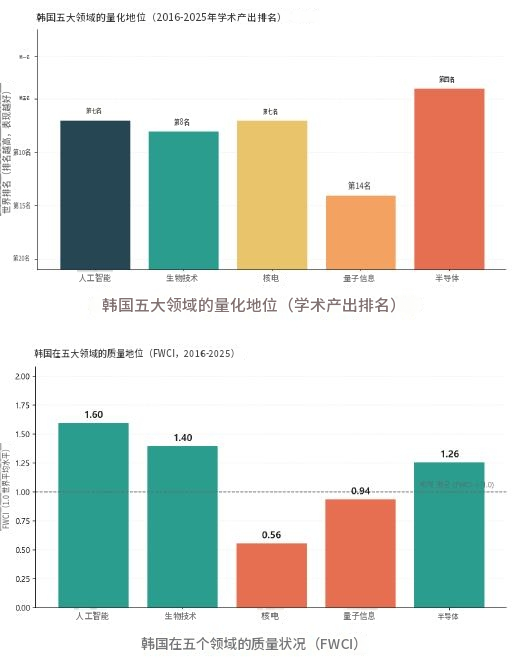
The quantitative and qualitative status of South Korea in the five major fields. Excerpted from the National Research Foundation of Korea report
The report is based on analysis of data from SciVal, the research performance analysis platform of Elsevier. In terms of the share of South Korean papers in the global total, the semiconductor field ranks the highest at 6.49%, followed by nuclear energy at 5.36%. Biotechnology, artificial intelligence, and quantum information account for 3.38%, 2.97%, and 2.43%, respectively.
In terms of the Field-Weighted Citation Impact (FWCI) indicator, which measures the quality impact of papers, artificial intelligence performs the most prominently with a score of 1.60, meaning its papers are cited 60% more than the global average in the same field. Biotechnology scores 1.40 and semiconductors 1.26, both above the world average of 1. In contrast, quantum information scores 0.94 and nuclear energy only 0.56, significantly below the global average.
In terms of FWCI ranking, South Korea's artificial intelligence field ranks 8th, the best performance among the five fields; biotechnology ranks 13th, semiconductors 14th, quantum information 15th, and nuclear energy 18th. The report concludes that among the five major fields, nuclear energy shows the largest gap between paper quantity competitiveness and quality impact.
In terms of growth rate, artificial intelligence is the fastest-expanding direction among South Korea's related fields. From 2016 to 2025, the average annual growth rate of South Korea's artificial intelligence papers was 21.5%, higher than the global average of 17%. The nuclear energy field saw an average annual growth rate of approximately 0.8%, lower than the global average of 3.1%, indicating relatively stagnant growth in this field. The report notes that the number of South Korean nuclear energy papers has shown a fluctuating decline since 952 papers in 2016, but a rebound of 16.7% occurred in 2024, partially reversing the previous downward trend.
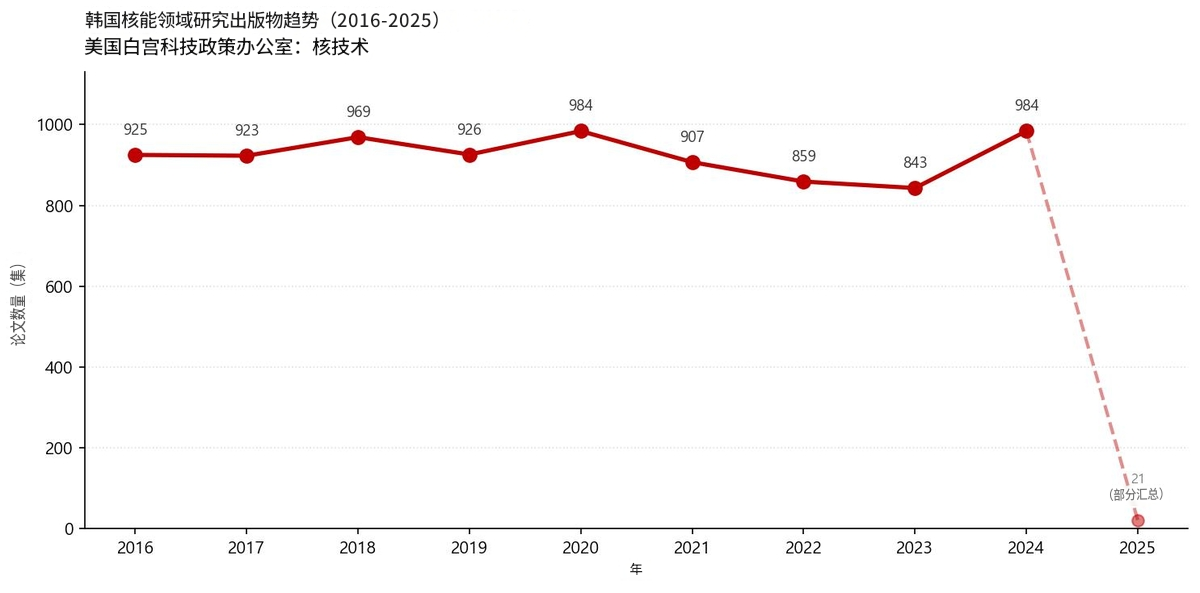
Trend of research publications in South Korea's nuclear energy field. Excerpted from the National Research Foundation of Korea report
In terms of research institution competitiveness, 9 South Korean institutions rank among the global top 100 in the semiconductor field, and 5 institutions rank among the top 100 in the nuclear energy field; 2 institutions rank among the top 100 in artificial intelligence, 1 in biotechnology, and no South Korean institution currently ranks among the global top 100 in quantum information.
The report recommends adopting differentiated support measures based on the research characteristics and development stages of different technology fields. Artificial intelligence and semiconductors require stable support to maintain existing quantitative and qualitative competitiveness; biotechnology should expand the output of world-class research results; and the nuclear energy field should leverage existing research infrastructure and scale advantages, focusing on enhancing research quality impact. For quantum information, although the current research scale is relatively small, strategic support should be provided given its active growth and international collaboration potential.
Disclaimer: Information republished from partner media, institutions or other websites is provided for reference and communication purposes only. It does not imply endorsement of its views or verification of its accuracy. Please contact us if any content infringes rights or requires correction.