
IAEA Trains Ukrainian Experts in Non-Destructive Testing Techniques to Assess Damaged Infrastructure
 Scan to share
The International Atomic Energy Agency (IAEA) recently conducted non-destructive testing (NDT) training for Ukrainian civil engineering experts through the "International Atomic Energy Agency Support and Assistance Mission to Kherson State" (ISAMKO), to support infrastructure safety assessment and recovery efforts following the destruction of the Kakhovka Dam.
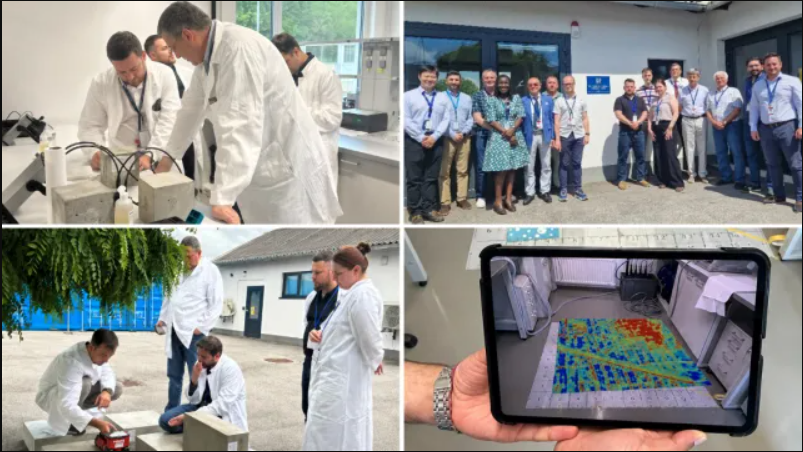
The training was held in July 2026 at the IAEA Non-Destructive Testing Service Center in Seibersdorf, Austria, over a five-day period, with nine Ukrainian experts participating. This was also the first training program held at the center since its inauguration in 2024. The course focused on the application of NDT techniques in civil engineering for infrastructure inspection, structural diagnostics, safety assessment, and asset integrity evaluation, helping participants master the technical methods required for post-disaster infrastructure assessment and repair planning.
On June 6, 2023, the Kakhovka Dam in Ukraine breached, triggering severe downstream flooding that caused extensive damage to civilian infrastructure, including residential buildings, public facilities, transportation networks, hydraulic structures, and industrial installations. The disaster affected approximately 80 settlements in Kherson State and disrupted drinking water supply for a large number of residents. Subsequently, the IAEA launched the ISAMKO project to provide equipment, supplies, and technical support to Ukraine, covering civil structure integrity assessment, drinking water safety, human and animal health, environmental monitoring, and food and agriculture.
Following large-scale disasters, determining the structural integrity and residual load-bearing capacity of damaged buildings and facilities is a critical basis for deciding whether they can continue to be used and how they should be repaired. Non-destructive testing techniques enable engineers to identify internal defects, material deterioration, corrosion, and structural weak points without further damaging the structure.
The course covered rebound hammer testing, ultrasonic pulse velocity testing, infrared thermography, rebar detection using rebar locators and ground-penetrating radar, post-disaster inspection methods, as well as case studies on structural diagnostics and infrastructure assessment. IAEA staff and invited NDT experts guided participants in hands-on practice with the relevant equipment.
Viktoriia Zozulinets, a participant from the Kyiv National University of Construction and Architecture, stated that the training not only provided new skills but also helped improve the accuracy of result interpretation, and that the knowledge gained will be applied to concrete structure research, civil engineering teaching, and building inspection work. Vitalii Tsykh from the Ivano-Frankivsk National Technical University of Oil and Gas noted that the training helped improve the efficiency of NDT work and contributed to cultivating the civil engineering structure professionals currently needed in Ukraine.
The IAEA stated that its long-term non-destructive testing program helps Member States enhance relevant capabilities through training, certification, technical guidance, and support for establishing NDT service centers. In recent years, the IAEA has deployed experts following multiple disasters to assist in safety assessments of buildings and civil engineering structures. In 2025, the Agency also published its first training syllabus guide on NDT in civil engineering and launched a five-year coordinated research project exploring the integration of artificial intelligence with advanced NDT techniques to provide real-time, data-driven technical support for infrastructure assessment.
Disclaimer: Information republished from partner media, institutions or other websites is provided for reference and communication purposes only. It does not imply endorsement of its views or verification of its accuracy. Please contact us if any content infringes rights or requires correction.