
Chinese Team Proposes "Toxic Blood Meal" Pre-Treatment Approach to Boost Sterile Insect Technique for Mosquitoes
 Scan to share
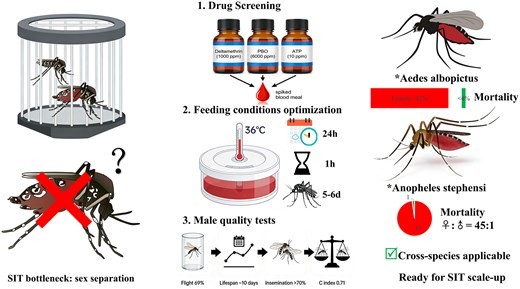
Chinese researchers have recently proposed a novel sex-sorting approach for the Sterile Insect Technique (SIT) in mosquitoes: adding a specific agent to the blood meal ingested by female mosquitoes, leveraging the biological difference that “female mosquitoes feed on blood while males do not,” to substantially reduce the number of females before release. The study was published in the June issue of the Journal of Medical Entomology.
The Sterile Insect Technique is a pest population control method centered on radiation-induced sterility. Its basic process involves mass-rearing male target insects in the laboratory, sterilizing them through radiation exposure to render them reproductively incapable, and then releasing them into the field, where they mate with wild females to produce non-viable eggs, thereby suppressing target population growth. This technique has been incorporated into integrated pest management systems and is regarded as a relatively environmentally friendly pest control approach.
However, the application of SIT to mosquitoes has long faced a critical obstacle: female mosquitoes must be removed as thoroughly as possible before release. Unlike pests such as fruit flies, female mosquitoes bite and can transmit vector-borne diseases, making them unsuitable for release alongside males. For Aedes mosquitoes, researchers can exploit size differences between male and female larvae or pupae for mechanical sorting; however, for Anopheles mosquitoes, the size and pupation time differences between males and females are minimal, making mechanical sorting impractical, and manual sorting efficiency is insufficient to support large-scale field releases.
Dr. Zhang Dongjing from Sun Yat-sen University stated that the team's approach leverages the most fundamental difference between male and female mosquitoes: females feed on blood, while males do not. In experiments, female mosquitoes died after consuming a blood meal laced with the agent, while males survived because they do not feed on blood. Although this method has not yet reduced the residual female ratio to the below-1% threshold required for direct release, it can serve as a highly efficient pre-treatment step that significantly reduces the burden of subsequent manual or fine-scale sorting.
The researchers screened and tested 11 chemical agents, first evaluating their effects on Aedes albopictus and then validating their efficacy against Anopheles stephensi. The study also compared the effects of different chemicals on mosquito blood-feeding behavior and examined factors such as temperature, blood-feeding frequency, blood-feeding duration, and mosquito age. For surviving males, the team further assessed flight capacity, longevity, mating ability, and competitiveness against wild males for females.
Experimental results showed that the most effective combinations included deltamethrin and piperonyl butoxide. Deltamethrin acts on the insect nervous system, while piperonyl butoxide inhibits the insect's detoxification of pyrethroid compounds, thereby enhancing toxicity. The researchers also added ATP to the mixture to stimulate blood-feeding behavior in females, increasing the likelihood of ingesting a lethal dose.
The research team stated that after removing the majority of females through the “toxic blood meal” approach, artificial intelligence and genetic techniques could be combined for higher-precision supplementary sorting, bringing batches closer to all-male composition. Zhang Dongjing believes that although this approach cannot yet independently meet the female control requirements for direct release in mosquito SIT, it has already demonstrated considerable practical application value as a pre-treatment step.
Disclaimer: Information republished from partner media, institutions or other websites is provided for reference and communication purposes only. It does not imply endorsement of its views or verification of its accuracy. Please contact us if any content infringes rights or requires correction.