
South Korea Sets 2035 Commercialization Target for Small Modular Reactors
 Scan to share
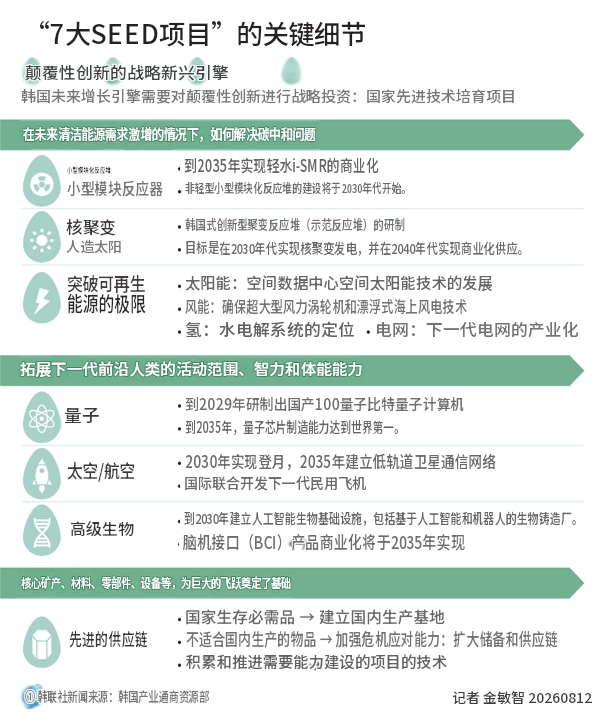
The Ministry of Science and ICT (MSIT) of South Korea announced on August 12 its "Seven Future Growth Engines SEED" promotion plan, designating small modular reactors, nuclear fusion, and next-generation renewable energy as key focus areas for the future clean energy sector. Among these, nuclear power-related content primarily centers on the commercialization of small modular reactors, research and development of non-light water reactor-type reactors, nuclear fuel supply security, and fusion demonstration power generation.
According to the plan, South Korea will advance the development of light water reactor-type small modular reactors, targeting commercialization in Gijang County, Busan by 2035. The innovative small modular reactor (i-SMR) will undergo detailed design through public-private cooperation starting next year, with large-scale test facilities, integrated operation, and digital twin technologies employed to accelerate preparations for demonstration construction.
For non-light water reactor-type small modular reactors, South Korea plans to commence construction in the 2030s. Related research, development, and commercialization will involve joint participation of public and private capital from the early stages of projects, with large-scale research, development, and commercialization efforts advanced through special purpose companies (SPCs).
The South Korean government also proposed accelerating the modernization of nuclear regulatory systems. By 2030, South Korea plans to establish a technology-neutral, performance-based licensing system for small and micro modular reactors of various uses and designs, while reducing regulatory uncertainty in project advancement through pre-application review systems and regulatory research groups. The government will also establish a cross-ministerial task force to review and improve regulations affecting the application of small modular reactors, promoting their use as power and heat sources in industrial parks, marine, defense, and aerospace applications.
In the nuclear fuel sector, South Korea proposed establishing cooperative relationships with countries including the United States to address uncertainties in enriched uranium supply. Additionally, South Korea plans to build a more self-reliant nuclear fuel security system, including directions such as spent nuclear fuel recycling.
Nuclear fusion is also a key focus of this clean energy plan. South Korea plans to shorten research and development cycles through the construction of an AI-based virtual fusion reactor, and to complete a Korean innovative fusion reactor by 2035 to conduct 100 MW-class demonstration power generation. South Korea will also build infrastructure in Naju for validating core components and equipment of fusion reactors, and plans to pursue demonstration and commercial reactor construction in parallel, targeting commercial power supply from 3 to 4 or more units by the 2040s.
Beyond nuclear energy, the plan also covers energy technologies such as high-efficiency perovskite tandem solar cells, ultra-large wind turbines, large-scale water electrolysis hydrogen production, high-voltage direct current transmission, and AI-based power grid models. However, one of its core pillars remains establishing a long-term industrialization pathway for advanced nuclear energy spanning research and development, regulation, and supply chain security.
Disclaimer: Information republished from partner media, institutions or other websites is provided for reference and communication purposes only. It does not imply endorsement of its views or verification of its accuracy. Please contact us if any content infringes rights or requires correction.