
Russia Plans to Build Small Nuclear Power Plant in Kyrgyzstan, Land-Based Icebreaker Reactor in Focus
 Scan to share
Rosatom's plan to promote the construction of a small nuclear power plant in Kyrgyzstan is centered around discussions on the RITM-200N reactor design. With a power output of approximately 55 MW, this reactor is the land-based version of the RITM-200 reactor used in Russia's new generation of nuclear-powered icebreakers. Several Russian nuclear-powered icebreakers currently operate on the same technological platform, which serves as the primary basis for Russia to demonstrate its maturity and reliability.
The project first entered public discussion in January 2022. At that time, Kyrgyzstan's energy authorities stated that if a nuclear power plant were to be built, its installed capacity should be no less than 300 MW, reflecting the country's practical concerns over power shortages and energy security. In November 2022, relevant Russian enterprises and Kyrgyzstan's Ministry of Energy signed a technical assignment for the preliminary feasibility study of the small nuclear power plant project at the "ATOMEXPO-2022" forum, with the document preparation period expected to take one to one and a half years.
According to the Russian side, the advantages of the small nuclear power plant are mainly reflected in its small footprint and adaptability to special regional conditions. According to Rosatom, a small nuclear power plant using this reactor occupies an area roughly equivalent to 8 football fields, significantly less than solar, wind, and hydroelectric facilities of comparable capacity. Its Generation III+ enhanced safety design and passive safety systems that do not rely on external power are also cited as key arguments for suitability in earthquake-prone regions. A small nuclear power plant based on a similar technological approach is currently under construction in Yakutia, Russia, with commissioning planned for 2028.
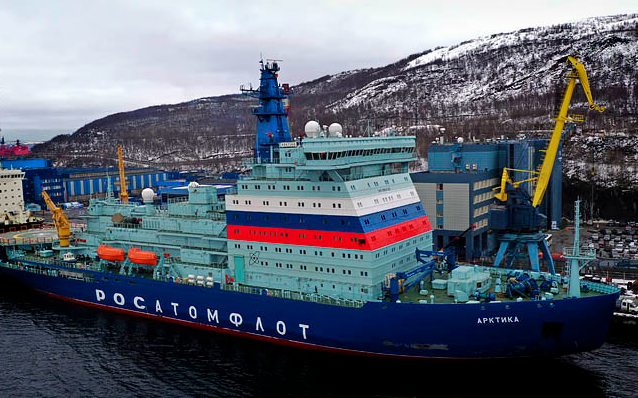
The materials place particular emphasis on the technological background of nuclear-powered icebreakers. Russia's icebreaker "Arktika" is equipped with two RITM-200 reactors and is the lead ship of Project 22220, capable of operating in thick ice conditions, with a refueling interval of approximately 7 years and a design service life of 40 years. In addition to the "Arktika," the "Sibir," "Ural," and "Yakutia" belong to the same series. Meanwhile, earlier icebreaker models such as the "Yamal," "50 Let Pobedy," as well as the "Taymyr" and "Vaygach," use different series of nuclear propulsion systems, demonstrating Russia's extensive operational experience in marine nuclear reactors.
If the project moves forward, Kyrgyzstan will become an important pilot site for Russia's overseas construction of small nuclear power plants. For the Kyrgyz side, the project may help alleviate power supply pressure and diversify the energy mix, but it will also raise issues related to installed capacity, economic viability, seismic safety, public acceptance, and long-term nuclear waste management. Whether the project can ultimately materialize will depend on the results of the feasibility study, bilateral financing arrangements, and the direction of Kyrgyzstan's domestic energy policy and public discourse.
Disclaimer: Information republished from partner media, institutions or other websites is provided for reference and communication purposes only. It does not imply endorsement of its views or verification of its accuracy. Please contact us if any content infringes rights or requires correction.