
ITER Tokamak Advances Assembly in France, Fusion Experiment Targets 150 Million Degree Celsius Plasma
 Scan to share
The ITER tokamak being assembled in southern France is one of the most closely watched large-scale experimental devices in global nuclear fusion research. The machine weighs approximately 23,000 tonnes in total and adopts a toroidal structure resembling a "donut," using strong magnetic fields to confine high-temperature plasma, with the goal of replicating on Earth the conditions for fusion reactions that occur inside stars. Its plasma volume is approximately 830 cubic meters, far exceeding previous tokamak devices, and it is therefore expected to validate the key physics and engineering technologies required for future commercial fusion reactors.
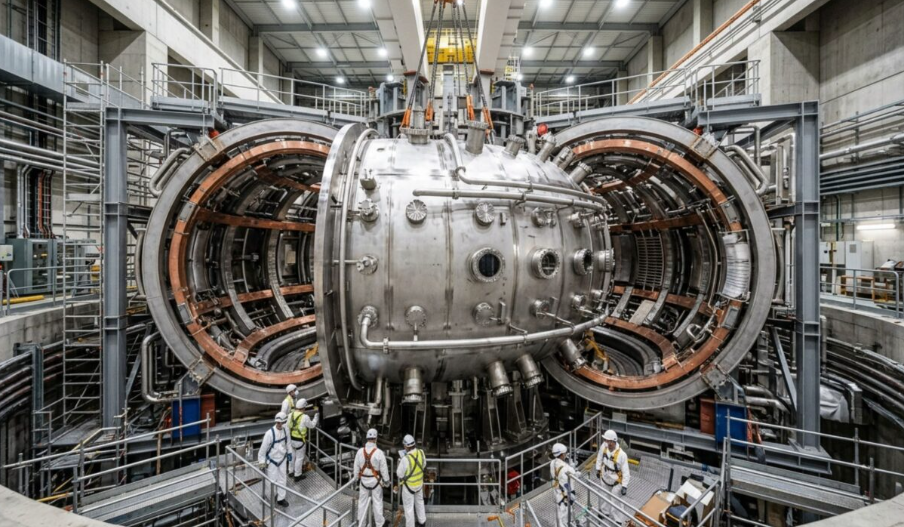
ITER adopts the toroidal tokamak structure because charged particles can move along toroidal paths under strong magnetic fields, thereby minimizing direct contact with the device's inner walls. The project plans to heat the plasma to approximately 150 million degrees Celsius, roughly ten times the temperature of the Sun's core. Since Earth cannot rely on the immense gravitational pressure found inside stars to sustain a fusion environment, researchers must create experimental conditions through higher temperatures, precise magnetic confinement, external heating systems, and a vacuum environment.
Such high temperatures do not mean the entire machine will reach 150 million degrees Celsius. The core challenge of ITER lies in keeping the high-temperature plasma "suspended" by magnetic fields within the toroidal vacuum vessel, while using components such as divertors to manage escaping particles, impurities, and heat loads. The superconducting magnets in the device need to operate at cryogenic temperatures, while the vacuum vessel, internal components, and support structures must withstand complex electromagnetic forces, heat fluxes, and mechanical stresses—this is also a key reason why ITER's engineering scale is enormous and its construction timeline is lengthy.
Official data show that ITER's total weight of approximately 23,000 tonnes does not mean it is entirely made of steel; it includes the vacuum vessel, magnets, internal components, support structures, and numerous auxiliary systems. The vacuum vessel and its associated components alone weigh approximately 8,000 tonnes, and the central solenoid electromagnet also weighs about 1,000 tonnes. The project's design goal is to achieve a fusion gain factor of Q≥10, meaning approximately 500 MW of fusion thermal power generated from about 50 MW of direct plasma heating power—but this does not imply that the facility's total electrical power balance is positive, nor does it mean the device will directly supply electricity to the grid.
ITER is currently still in the phase of ongoing installation and technical adjustments. According to the updated schedule, deuterium-tritium operation is expected to begin in 2039; as of July 28, 2026, the sixth of the nine large modules that form the tokamak's central toroidal structure has been lowered into the assembly pit, meaning two-thirds of this stage are now in place, with the final module expected to be installed in 2027. As an experimental platform, ITER's significance lies not in immediately building a commercial fusion power plant, but in providing a large-scale validation foundation for the subsequent fusion energy roadmap.
Disclaimer: Information republished from partner media, institutions or other websites is provided for reference and communication purposes only. It does not imply endorsement of its views or verification of its accuracy. Please contact us if any content infringes rights or requires correction.