
World's first laser plasma accelerator-driven high-resolution muon imaging experiment to launch in Romania
 Scan to share
Ideon Technologies, a global subsurface detection muon tomography company, is participating in an international research consortium to conduct the world's first high-resolution muon imaging experiment driven entirely by a laser plasma accelerator. The experiment aims to use a compact accelerator to produce muon beams on demand for non-destructive high-resolution imaging, with applications targeting mineral production, critical infrastructure, cargo inspection, medical imaging, semiconductors, nuclear security, and space radiation testing.
Consortium members include the University of Texas at Austin, the Extreme Light Infrastructure - Nuclear Physics (ELI-NP) facility team, Heinrich Heine University Düsseldorf, Helmholtz-Zentrum Dresden-Rossendorf, ELI-Beamlines, and Tau Systems. The project will conduct a five-week experimental campaign starting in August at the ELI-NP facility in Măgurele, near Bucharest, Romania.
Under the plan, high-power lasers will generate multi-GeV electron beams, which will be converted into directed muon beams through high-density conversion materials, enabling non-destructive imaging of industrial objects. Ideon will deploy multiple compact muon detectors to receive, track, and measure high-intensity muon beams while imaging target materials.
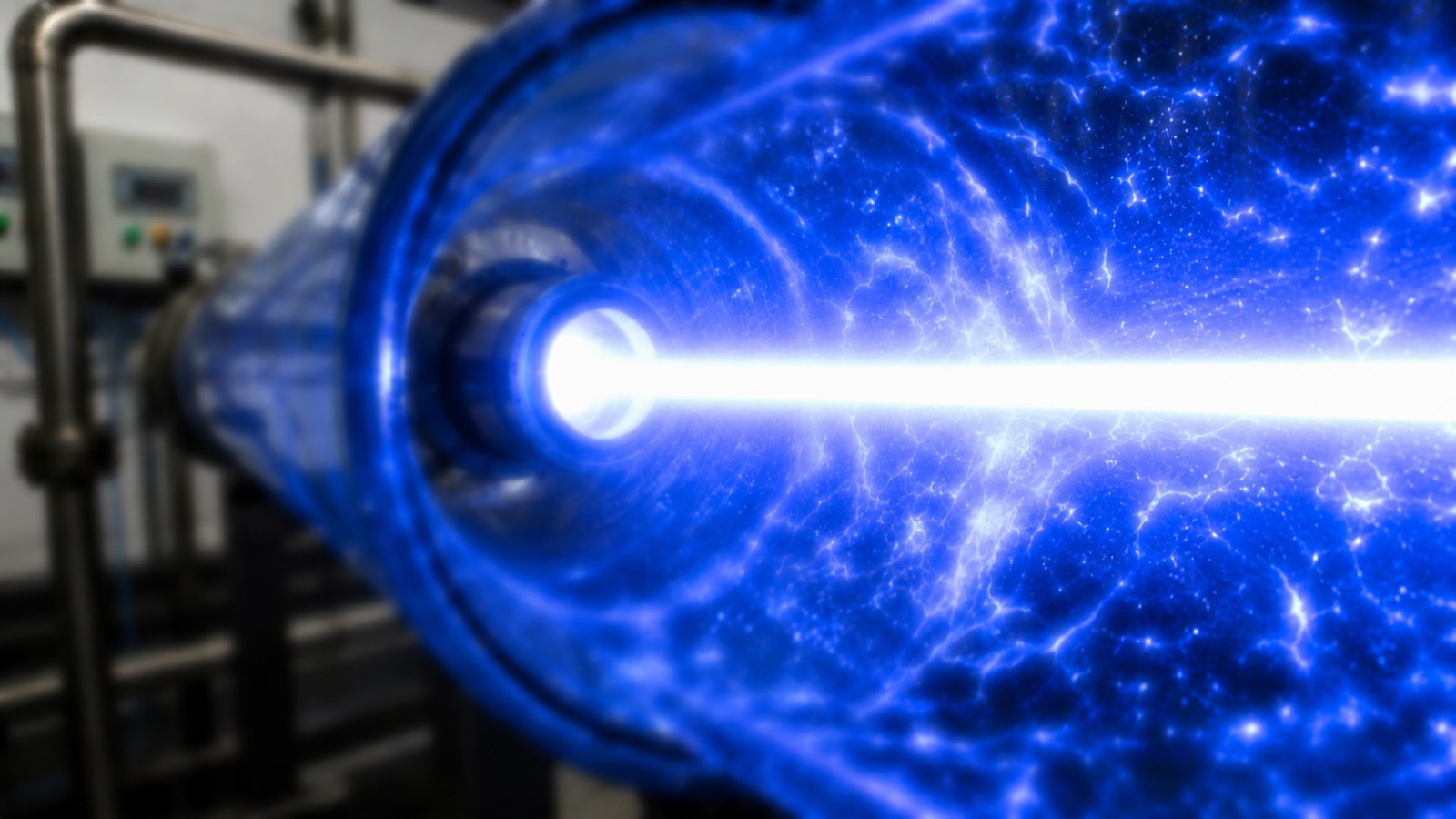
The laser plasma acceleration technology used in the experiment works by firing intense, ultra-short laser pulses into a gas cell, ionizing the gas to form plasma and generating a strong electric-field "wakefield" that accelerates electrons to energy levels of 8 to 15 GeV. According to related materials, reaching such energies previously required particle accelerators hundreds or even thousands of meters long. Simulation results predict that each pulse can produce on the order of tens of thousands of muons.
Currently, Ideon primarily uses cosmic-ray muons as a passive muon source. Due to the limited arrival rate of natural muon flux, imaging experiments can take hours, weeks, or even months, depending on imaging depth and spatial resolution requirements. In contrast, a compact, directed laser-driven muon source can achieve one pulse per minute, potentially delivering equivalent or superior imaging performance in significantly less time, while offering controllability of directionality and beam parameters.
Douglas Schouten, co-founder and CTO of Ideon Technologies, stated that the company has previously relied on naturally occurring muon flux for imaging work, and this collaboration has the potential to change that paradigm. For the first time, a compact accelerator can generate muon beams on demand for high-resolution imaging, with speed and portability that could improve subsurface imaging efficiency by several orders of magnitude.
In addition to the ELI-NP project, Ideon is advancing another active muon source initiative. The company has received funding from the U.S. Department of Energy's Advanced Research Projects Agency-Energy (ARPA-E) under the "Reliable Ore Characterization using Keystone Sensing" (ROCKS) program, led by Lawrence Berkeley National Laboratory. In this project, the BELLA Center at Lawrence Berkeley National Laboratory will develop a multi-stage laser plasma accelerator targeting 20 to 25 GeV electrons and muons, while Ideon provides detector technology and a subsurface intelligence platform for data fusion and three-dimensional density imaging.
These projects will advance the development and commercialization exploration of compact, deployable active muon sources, with a focus on critical mineral resource development, mining operations, and other large-scale industrial and subsurface structure imaging needs.
Disclaimer: Information republished from partner media, institutions or other websites is provided for reference and communication purposes only. It does not imply endorsement of its views or verification of its accuracy. Please contact us if any content infringes rights or requires correction.