
South Korea Raises 2040 Electricity Demand Forecast, Increment Equivalent to 19 Large Nuclear Power Units
 Scan to share
A forum on the formulation of South Korea's 12th Basic Plan for Electricity Supply and Demand was held in Seoul on August 20. The new round of electricity demand forecasts submitted at the meeting showed that by 2040, South Korea's annual maximum electricity demand is expected to reach 158.4 GW to 165.0 GW, an upward revision of 26.6 GW to 26.8 GW compared to the forecast proposed in April this year.
Based on the 1.4 GW single-unit capacity of the AP1400 large nuclear power unit under construction in South Korea, the increment in electricity demand from this upward revision is equivalent to the electricity provided by approximately 19 large nuclear power units operating at full power. The previous April forecast for the 2040 annual maximum electricity demand was 131.8 GW to 138.2 GW.
The new forecast reflects factors such as large-scale electricity consumption projects including semiconductor industry clusters and artificial intelligence data centers, as well as the Korea Development Institute's (KDI) upward revision of next year's economic growth forecast. According to calculations, the average annual economic growth rate forecast for South Korea from 2026 to 2040 has been raised from 0.96% to 1.02% under the baseline scenario, and from 1.29% to 1.36% under the upside scenario.
With demand-side management measures such as the mandatory energy efficiency improvement system in place, the target maximum electricity demand for 2040 is 158.4 GW to 165.0 GW; without these measures, the baseline demand forecast would rise to 179.2 GW to 186.4 GW. The target annual electricity consumption for 2040 is expected to be 847.3 TWh to 885.1 TWh, also higher than the April forecast of 657.6 TWh to 694.1 TWh.
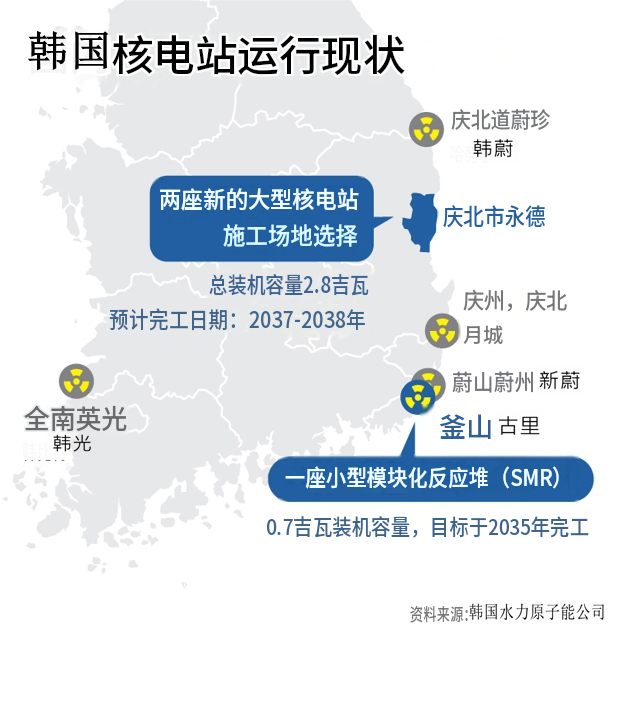
With the significant upward revision in electricity demand, whether South Korea needs to add new nuclear power projects has become a focal point of discussion. The South Korean government plans to discuss in the 12th Basic Plan for Electricity Supply and Demand whether to continue planning new nuclear power projects beyond the two large nuclear power plants and one small modular reactor (SMR) already included in the 11th Basic Plan. Previously, Yeongdeok County in North Gyeongsang Province and Gijang County in Busan have been selected as construction sites for related nuclear power projects.
In the discussions that day, some argued that even if South Korea increases its renewable energy generation capacity to 100 GW by 2030 as targeted, its power generation would still only meet 58% of the electricity demand from large new electricity consumption projects. There were also opinions calling for the addition of a "downside scenario" forecast to reflect the possibility that electricity demand could fall below expectations due to delays in high-tech industry investment.
The head of South Korea's climate, energy, and environment department stated that accurately forecasting electricity demand for 2040 is nearly impossible, but underestimating demand and resulting in insufficient power generation capacity preparation would bring multiple risks. The sixth discussion session of the 12th Basic Plan for Electricity Supply and Demand is scheduled to continue on the 26th. The South Korean government plans to present the government's basic proposal in October after collecting opinions, and complete the final draft within the year.
Disclaimer: Information republished from partner media, institutions or other websites is provided for reference and communication purposes only. It does not imply endorsement of its views or verification of its accuracy. Please contact us if any content infringes rights or requires correction.