
Kyoto Fusioneering Completes 25.72 Billion Yen Series D Funding Round
 Scan to share
Japanese fusion startup Kyoto Fusioneering announced on August 24 that it has completed the first closing of its Series D funding round, with total financing of 25.72 billion yen. Of this amount, equity financing totaled 16.72 billion yen and debt financing totaled 9 billion yen, with the debt portion comprising credit lines and loan facilities. With this, the company's cumulative equity financing has reached 32.98 billion yen.
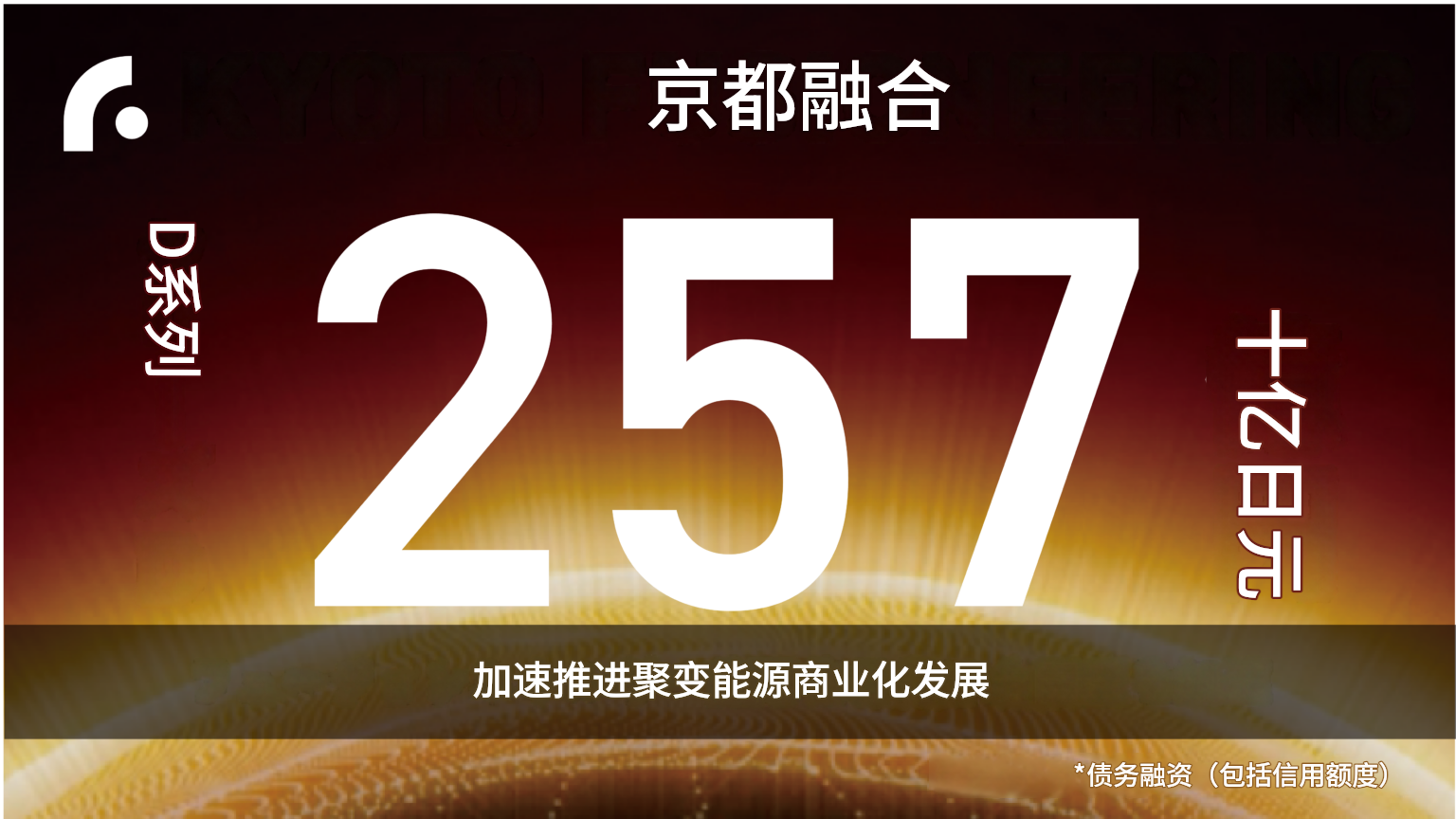
Following this funding round, Kyoto Fusioneering is valued at approximately 120 billion yen, a significant increase from its pre-funding valuation, making it the first startup in Japan's fusion sector to exceed a valuation of 100 billion yen. The company has previously secured contracts exceeding 14 billion yen cumulatively in markets such as North America and Europe, and has set a short-term sales target of approximately 10 billion yen.
Kyoto Fusioneering primarily develops fundamental engineering technologies required for the commercialization of fusion energy, with business operations covering plasma heating, tritium fuel cycling, and tritium breeding blanket thermal cycling. These systems are located outside the core plasma of a fusion reactor but play a critical role in enabling continuous power generation and engineered operation of future fusion power plants.
The funds from this round will be primarily used to advance the "UNITY™ Project." This project consists of three integrated demonstration programs located in Japan, Canada, and the United States. The UNITY-1 integrated power generation test facility in Kumiyama-cho, Kyoto Prefecture, Japan, has completed its construction phase and is currently conducting hydrogen isotope extraction tests, with plans to conduct integrated tests including high-temperature loop power generation and hydrogen production starting this autumn.
The UNITY-2 full-scale tritium fuel system at Chalk River, Ontario, Canada, is being advanced in collaboration with Fusion Fuel Cycles Inc., a joint venture related to Canadian Nuclear Laboratories (CNL). The system is currently undergoing preliminary testing in Japan using fuels such as hydrogen, with plans to commence tritium fuel operations at Chalk River by the end of this year, aiming to validate an integrated tritium fuel cycle system for practical applications.
The UNITY-3 blanket neutron irradiation test facility in Oak Ridge, Tennessee, United States, is being developed in collaboration with Oak Ridge National Laboratory (ORNL) and the U.S. Department of Energy (DOE), and is currently in the detailed design phase with a target completion date of the end of 2028. The project aims to conduct module-level neutron irradiation testing of tritium breeding blankets and validate blanket systems with a tritium breeding ratio greater than 1.
New investors in this equity financing round include funds affiliated with IMM Investment Japan Co., Ltd., SiteGround Capital Ltd., the Organization for Promoting the Transition to a Low-Carbon Growth-Oriented Economic Structure (GX Promotion Organization), Development Bank of Japan, East Japan Railway Company (JR East), and Minerva Growth Partners Inc. Existing investors including SMBC Venture Capital Co., Ltd., Kyoto Capital Partners Co., Ltd., JIC Venture Growth Investments Co., Ltd., Daiwa Corporate Investment Co., Ltd., DBJ Capital Co., Ltd., and MUFG Bank, Ltd. also participated with additional investments. Debt financing was provided by financial institutions including Sumitomo Mitsui Banking Corporation, The Bank of Kyoto, Sumitomo Mitsui Trust Bank, and Mizuho Bank.
Kyoto Fusioneering stated that it will use the new funds to strengthen its global business network and expand production capacity for key equipment such as "gyrotrons," plasma heating systems. The company currently has business bases in Japan, the United States, the United Kingdom, Germany, and Canada, and aims to participate in the construction of the global fusion energy supply chain by supplying key equipment and systems needed for fusion power plants.
According to estimates by relevant Japanese authorities, the global fusion energy market could reach approximately 120 trillion yen by 2040. As the United States, Europe, and multiple Asian countries accelerate the development of fusion demonstration and commercial reactors, tritium fuel supply, securing rare metals such as beryllium, low-level radioactive waste treatment standards, and the development of related regulatory frameworks are becoming issues that need to be addressed in parallel during the commercialization of fusion energy.
Disclaimer: Information republished from partner media, institutions or other websites is provided for reference and communication purposes only. It does not imply endorsement of its views or verification of its accuracy. Please contact us if any content infringes rights or requires correction.