
Digital twins are becoming an important R&D pathway in fusion research
 Scan to share
Recently, a new paper reviewed the progress of digital twin technology in fusion research over the past five years and noted that several key gaps remain before a complete digital twin model of a fusion power plant can be achieved.
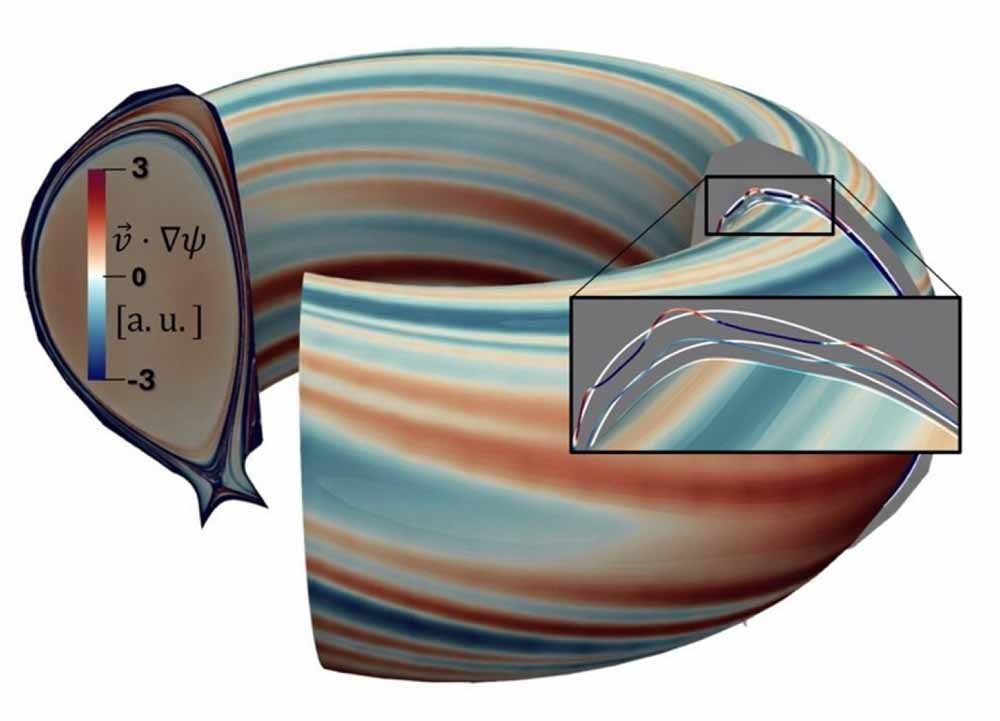
Simulating the movement of tungsten in the plasma core. Copyright: (F. Jenko et al., 2026, *Nuclear Fusion* 66 116014)
Digital twins are a class of virtual models that reflect the structure, environment, and behavior of physical systems, and can be used to predict future system states and inform real-world decision-making. In fusion research, as issues in plasma physics, device engineering, and material interactions grow increasingly complex, digital twins are considered promising tools to help researchers integrate disparate models into systematic simulation frameworks that more closely mirror the operating conditions of real devices.
Frank Jenko, Director of the Max Planck Institute for Plasma Physics and Head of Digital Solutions at the EUROfusion Fusion Office, stated that researchers are already able to simulate many aspects of fusion plasmas with high reliability and predictive capability. The next step is to combine these simulation elements as much as possible, which is why digital twin technology has entered the purview of fusion research.
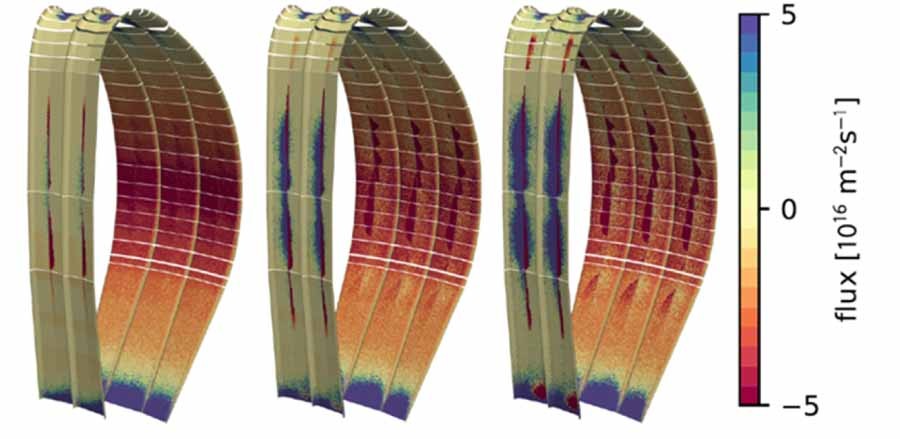
Simulation of tungsten erosion and deposition fluxes in the DEMO main chamber. DEMO is a demonstration fusion power plant. (Copyright: F. Jenko et al., 2026, *Nuclear Fusion* 66 116014)
The digital twin concept has been used in engineering since the early 21st century, and the fusion research community has explored it for many years. In 2021, the EUROfusion consortium launched the E-TASC project to coordinate theory and advanced simulation research across Europe. The paper concludes that over the past five years, related work has gradually shifted from conceptual discussions to concrete R&D plans.
Regarding tokamak plasma simulation, the paper notes that researchers have made notable progress in core plasma simulations, addressing key issues such as turbulence, instabilities that could disrupt magnetic confinement, and the behavior of fast particles produced by fusion reactions. Jenko stated that core plasma research has advanced relatively smoothly, with extensive code validation completed—one of the significant achievements in recent years.
Meanwhile, research that was previously relatively fragmented is gradually moving toward coupled simulations. The paper mentions that researchers have begun conducting coupled simulations of turbulence and fast-particle-driven waves, and are developing codes capable of tracking the evolution of instabilities deep into the nonlinear regime, rather than being limited to initial-stage analysis.
In contrast, the plasma edge region remains a modeling challenge. This region is closer to the reactor wall, where physical processes are more complex and material–plasma interactions are more difficult to describe accurately. Taking tungsten wall material as an example, over the multi-year operation of a future power plant, some tungsten will inevitably enter the plasma. How to simulate the impact of these free particles on the plasma, and how heat and particles reach the wall under turbulent transport, remain key open questions in research.
Statistical simulation results of neutron flux in a tokamak model generated using Bluemira. Bluemira is not a complete digital twin model, but it represents an important step toward one. Copyright: (F. Jenko et al., 2026, *Nuclear Fusion* Vol. 66, p. 116014)
The paper also notes progress in edge-region research. For example, turbulence codes have been able to reproduce the "detachment" phenomenon, in which the plasma cools rapidly before reaching the wall. Researchers have also conducted simulations of erosion and dust formation at reactor scale. However, these models still require further refinement before they can fully and reliably support fusion power plant design.
Beyond tokamaks, stellarator simulations have also advanced. Research results from Germany's Wendelstein 7-X device have drawn increased attention to the stellarator route, while improved simulation capabilities have enabled researchers to design and evaluate stellarator concepts with greater confidence. Jenko noted that stellarator technology is not yet mature enough, primarily due to limited theoretical and experimental data, but the research team hopes to advance stellarator simulation to a level that can support the formation of power plant concepts.
Regarding the tokamak and stellarator routes, Jenko believes they are not in simple competition but can be advanced in parallel; digital twin modeling can help both types of fusion devices mature together.
Looking ahead to the next phase, the paper argues that the focus of fusion digital twins will be on integrating previously independent model components. Researchers are exploring frameworks that can bring together diverse information, such as the Bluemira tool for integrated design of future fusion reactors. This tool comprises multiple modules, some of which depend on other codes, and can carry out a range of conceptual fusion reactor design activities. Although Bluemira is not yet a complete digital twin model, it is regarded as an important step toward a fusion digital twin.
The researchers also point out that before integrated simulations can be applied to devices that have not yet operated, such as ITER or future fusion power plants, simulation results must still be validated against existing devices. Jenko stated that a complete digital twin model of a fusion power plant does not yet exist, but foundational models of the plasma core, edge, wall, and auxiliary systems around the device are closer to practical application than ever before. "Five years ago, this was still a vision. Now it has become an R&D program, and it is progressing rapidly."
Disclaimer: Information republished from partner media, institutions or other websites is provided for reference and communication purposes only. It does not imply endorsement of its views or verification of its accuracy. Please contact us if any content infringes rights or requires correction.