
Two South Korean companies to collaborate on expanding fusion energy projects
 Scan to share
KEPCO Engineering & Construction (KEPCO E&C) signed a Memorandum of Understanding (MOU) with Enable Fusion on September 7 at the Daejeon Science Center to establish a cooperation framework for participation in fusion energy projects, technology sharing, and joint business development. Kim Tae-kyun, President of KEPCO E&C, and Lee Kyung-soo, CEO of Enable Fusion, attended the signing ceremony.
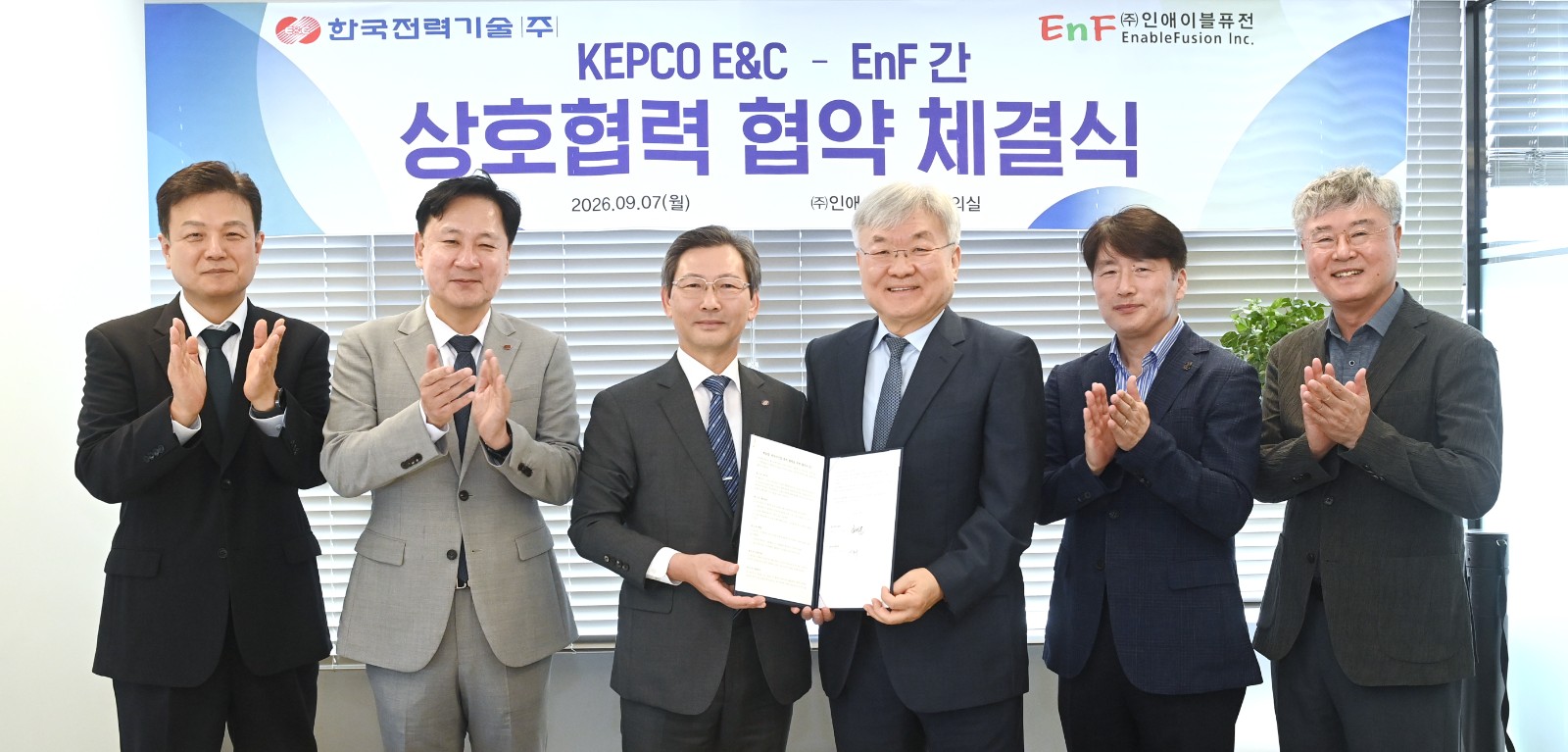
Under the MOU, the two parties will provide each other with technical and commercial information required for participation in the construction of fusion power facilities and jointly develop fusion energy projects both domestically and overseas. KEPCO E&C plans to share relevant project information with Enable Fusion, focusing on identifying potential projects and areas of cooperation, while leveraging its experience in power plant design, engineering management, and project execution to gradually expand its participation opportunities in fusion power facility construction.
Founded in 2023, Enable Fusion is a startup focused on the fusion energy sector. Its founder, Lee Kyung-soo, previously participated in the development and construction of the Korea Superconducting Tokamak Advanced Research (KSTAR) device and the International Thermonuclear Experimental Reactor (ITER) project. The company primarily designs and manufactures core equipment for controlling extreme physical environments, including ultra-high vacuum and cryogenic plasma vessels and high-temperature superconducting magnets, while also offering a "fusion foundry" service that can convert various fusion reactor designs into demonstration reactor solutions, as well as an AI-based engineering platform.
In August of last year, the South Korean government designated nuclear fusion as one of the "seven seed projects for future growth engines," proposing to build a Korean-style innovative fusion reactor by 2035 and achieve fusion power generation in the 2030s. Recently, South Korean companies have made progress in the manufacturing, assembly, and follow-up orders of ITER core facilities, drawing greater attention to the potential for fusion technology to extend from the R&D stage to industrial applications.
Kim Tae-kyun stated that nuclear fusion is regarded as an important direction for future clean energy and, once commercialized, could transform the energy supply paradigm. He said that the deployment of fusion technology requires coordination of industrial capabilities across multiple fields, and that the two parties will combine their respective expertise to progressively refine their cooperation model and strive to build differentiated competitiveness in future fusion energy projects.
Disclaimer: Information republished from partner media, institutions or other websites is provided for reference and communication purposes only. It does not imply endorsement of its views or verification of its accuracy. Please contact us if any content infringes rights or requires correction.