
Progress Reported for Leningrad and MBIR Steam Generators
 Scan to share
Recently, "State Atomic Energy Corporation Rosatom" announced that four steam generators for Unit 3 of "Leningrad II NPP" have been delivered to the site, while the second specially designed "reverse-flow steam generator" for the "Multipurpose Fast-Neutron Research Reactor" (MBIR) has also been shipped, marking key-stage progress in the manufacture and delivery of two large nuclear-grade heat exchange equipment items.
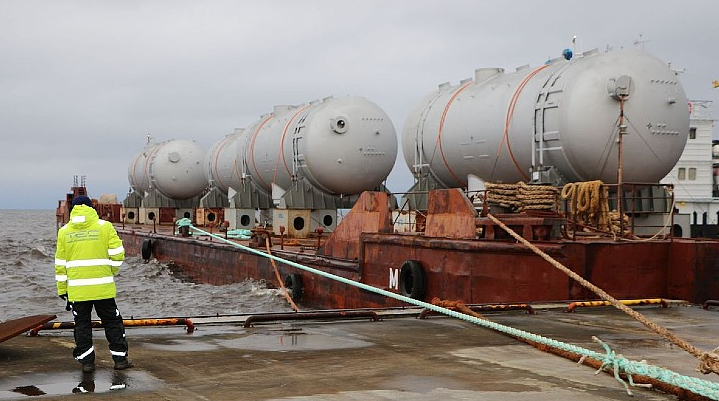
The four cylindrical steam generators delivered to "Leningrad II NPP" are 13 meters long and 4.2 meters in diameter, with a total weight exceeding 1,300 tonnes, and have arrived at the site for incoming inspection before installation next year; Konstantin Khudyakov, Head of the Leningrad NPP Facilities Planning at Titan-2, stated that the necessary structural components are currently being prepared, with plans to build eight dedicated supports inside the reactor building by next spring, two for each steam generator; given the equipment's own weight and the design steam-water volume of the loop, the supports will consume 85 tonnes of rebar and 370 cubic meters of special concrete; Alexey Mochalov, Deputy Chief Engineer for Construction of New Units at Leningrad II NPP, noted that each steam generator contains nearly 11,000 heat exchange tubes with a diameter of 16 millimeters, providing a heat transfer area of 6,000 square meters; the four units together can produce nearly 6,500 tonnes of saturated steam per hour, sufficient to drive a turbine rotor weighing 675 tonnes and maintain a speed of 1,500 revolutions per minute.
In addition to installing the steam generators, the 2027 work plan for Unit 3 of "Leningrad II NPP" also includes installing the "reactor pressure vessel" in the third quarter of that year and continuing construction of the double-layer "containment"; "Leningrad II NPP" adopts the "VVER-1200 reactor" design, with the first two units having entered commercial operation in 2018 and 2021 respectively; the third and fourth new units are currently under construction to gradually replace the four "RBMK-1000 reactor" units built in the 1970s; the third new unit (i.e., the plant's Unit 7) had its first concrete poured in March 2024, and upon completion is expected to have a design service life of 60 years with the potential for a 20-year life extension.
Meanwhile, the second steam generator for the "Multipurpose Fast-Neutron Research Reactor" nuclear research facility has been delivered to the construction site of the "State Scientific Center — Research Institute of Atomic Reactors" (NIIAR) in "Dimitrovgrad", "Ulyanovsk Oblast"; the steam generators for this reactor differ from those of standard nuclear power units such as "VVER reactors", employing a special design called "reverse-flow steam generator", with each generator consisting of three modules, minimizing the equipment's footprint within the building.
It is understood that this design is similar to the steam generators of the "BOR-60 reactor" operating at the site since 1969; Svyatoslav Novikov, Deputy Technical Director and Chief Engineer of the Facilities Construction Management Department at the "State Scientific Center — Research Institute of Atomic Reactors", noted that the "BOR-60 steam generator" has proven itself to be reliable and technologically advanced equipment, with "sodium coolant" flowing inside the heat exchange tubes and feedwater supply and superheated steam extraction taking place in the inter-tube space; the good operating experience was one of the key reasons for choosing a similar design for the new nuclear facility of the "MBIR reactor"; Anton Lebedev, Head of the "ZiО-Podolsk Plant" that manufactured the equipment, stated that the manufacture of the "reverse-flow steam generator" is an important stage in the construction of the innovative "MBIR reactor" and constitutes a core component of the reactor facility.
The "MBIR reactor" has a thermal power of 150 MW and, once completed, will become the world's most powerful research reactor; it is a multi-loop research reactor capable of testing "liquid lead", "lead-bismuth alloy" and gas coolants, and uses "MOX fuel"; the "Research Institute of Atomic Reactors" plans to establish an on-site "closed nuclear fuel cycle" facility at the site, employing its "pyrochemical reprocessing" technology developed at pilot scale; the "MBIR reactor" is planned to start operation in 2027 to replace the "BOR-60 reactor", with a design service life of 50 years; it will expand research on "two-component nuclear energy" technology and closed fuel cycles, and help accelerate the justification for construction of "Generation IV nuclear power plants".
Disclaimer: Information republished from partner media, institutions or other websites is provided for reference and communication purposes only. It does not imply endorsement of its views or verification of its accuracy. Please contact us if any content infringes rights or requires correction.