
Russia's BN-800 starts pilot operation with recycled uranium-plutonium fuel
 Scan to share
Recently, at the "BN-800 fast neutron reactor" of Unit 4 of the "Beloyarsk NPP" in "Russia", pilot industrial operation has begun with "recycled uranium-plutonium fuel"; this so-called "recycled uranium-plutonium fuel" refers to nuclear fuel made from plutonium, and this plutonium is generated and extracted from "spent fuel assemblies" that were irradiated in the same "BN-800 reactor" during the previous stage.
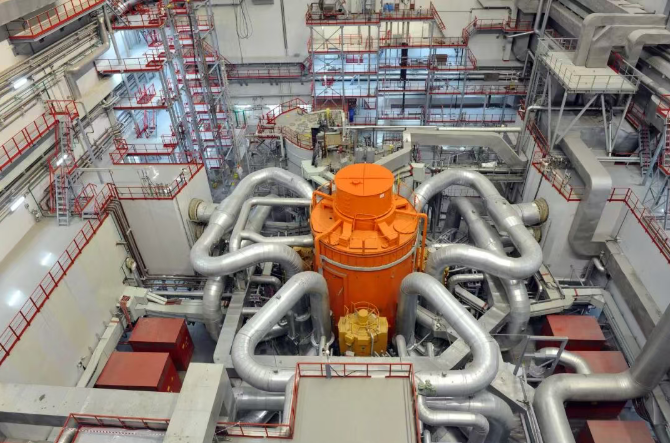
This is the first time globally that a high-power power reactor has been used to demonstrate the feasibility of the "closed nuclear fuel cycle" concept; this concept means that in an operating "fast neutron reactor", nuclear fuel generates plutonium through irradiation, and when the "spent nuclear fuel" leaves the reactor, the plutonium is extracted and used to make new fresh fuel for the same unit. This process can be repeated cyclically. Previously, the industry had already mastered the technology of reprocessing irradiated fuel from conventional "thermal neutron reactors" and loading it as a component of new fuel into "fast neutron reactors" without the need for further reprocessing, but it had not been able to realize all the advantages of multiple cycles, while multiple cycles can remove the constraints of the "uranium resource" base and secure long-term energy supply.
"Director General of Rosatom State Corporation" Alexey Likhachev stated that in the field of the "closed nuclear fuel cycle with fast reactors", the industry has moved from theory to practice, and crossing this technological milestone is proving the vitality of the "renewable" nuclear energy model, enabling it to meet growing electricity demand without proportionally increasing the burden on natural resources and the amount of "radioactive waste". Therefore, the "closed nuclear fuel cycle" is not only an effective use of uranium and plutonium, but also a systematic solution to environmental problems. The successful operation of the unique fuel assemblies in the "BN-800 reactor" is a direct contribution to the readiness of future "Generation IV reactor" technologies, including the series of "BN-1200M units" under construction and scheduled to be commissioned in the next decade.
The new experimental fuel assemblies were manufactured using an optimized plutonium production technology, reducing the total number of process operations and maintaining fuel quality, thereby improving the economic efficiency of reprocessing and reducing the technical complexity of realizing the "closed nuclear fuel cycle"; the loading of all experimental fuel assemblies was coordinated with the "Federal Environmental, Industrial and Nuclear Supervision Service of Russia" (Rostechnadzor) and fully complies with the regulator's licensing documents.
Advancing the "closed nuclear fuel cycle" is of particular significance against the backdrop of growing global uranium demand and resource constraints; one scenario of the "International Atomic Energy Agency" (IAEA) assumes that by 2050 global nuclear power installed capacity will more than double to 890 GW, while analysts of the "Organization for Economic Co-operation and Development" (OECD) estimate that the full potential of proven uranium reserves (about 8 million tonnes) may be exhausted between 2060 and 2090. In the long run, only the "closed nuclear fuel cycle" can provide sustained nuclear fuel for growing nuclear energy demand.
It is understood that the mass production of "MOX fuel" for the "BN-800 reactor" has been organized and implemented at the "Closed Nuclear Fuel Cycle Competence Center" in "Zheleznogorsk" (under the "Environmental Solutions" division), and the enterprise is also building new capacity to manufacture "MOX fuel" for the world's first high-power "fast neutron reactor", the "BN-1200M reactor", while the "MOX fuel" supplier for the "Beloyarsk NPP" is "TVEL JSC" (under the fuel division of "Rosatom").
"Generation IV nuclear energy systems" can fundamentally change the face of nuclear energy through new levels of safety, expanded fuel varieties, and a significant reduction in "radioactive waste". "Russia" is an important participant in the research and development of Generation IV technologies. At present, the "Beloyarsk NPP" has begun preliminary design work for the construction of "BN-1200M units", while in "Tomsk Oblast" the world's first nuclear power plant equipped with a "BREST-OD-300 reactor" and on-site "closed nuclear fuel cycle" facilities at the same site is being advanced.
Disclaimer: Information republished from partner media, institutions or other websites is provided for reference and communication purposes only. It does not imply endorsement of its views or verification of its accuracy. Please contact us if any content infringes rights or requires correction.