
Search Results
Keyword:Lead-cooled fast reactor
New Progress in Research on Microstructural Stability of High-Silicon Austenitic Steels for Lead-Cooled Fast Reactors
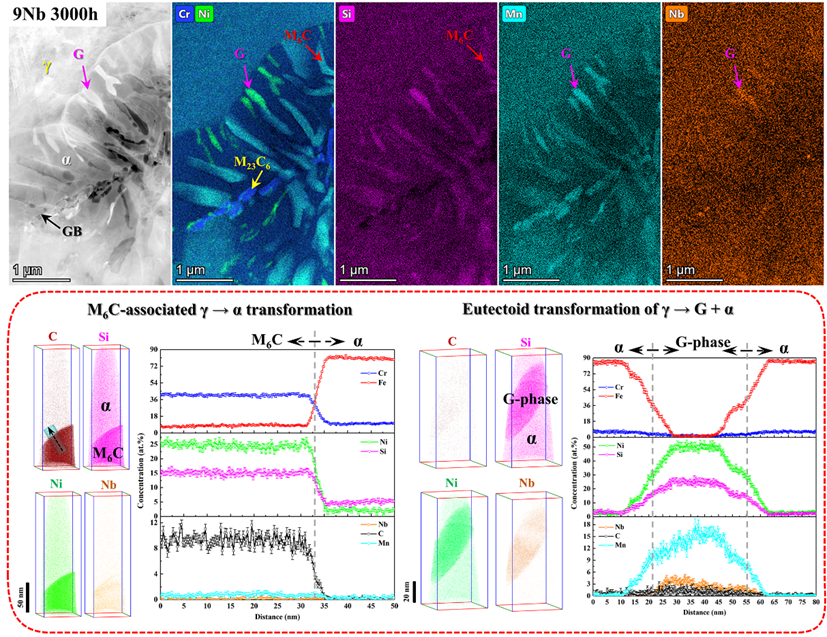
The lead-cooled fast reactor is an important reactor type in the fourth-generation nuclear energy system, and its structural materials need to withstand harsh service environments such as high temperature, irradiation, and liquid lead-bismuth corrosion over the long term. High-silicon austenitic stainless steel possesses excellent lead-bismuth corrosion resistance and is an important candidate structural material for core equipment such as the reactor vessel and internals of lead-cooled fast reactors. However, Si addition significantly alters the phase precipitation mechanism during high-temperature service and induces austenite decomposition, affecting the long-term microstructural stability of the material. Recently, the Special Alloys Research Department of the Institute of Metal Research, Chinese Academy of Sciences, in collaboration with the Department of Mechanical Engineering of The Hong Kong Polytechnic University, building on prior work that revealed Si-induced austenite decomposition behavior in high-silicon austenitic steels and the resulting mechanical...
2026-09-21
Blykalla Establishes Advanced Nuclear Reactor Technology Center in Austin
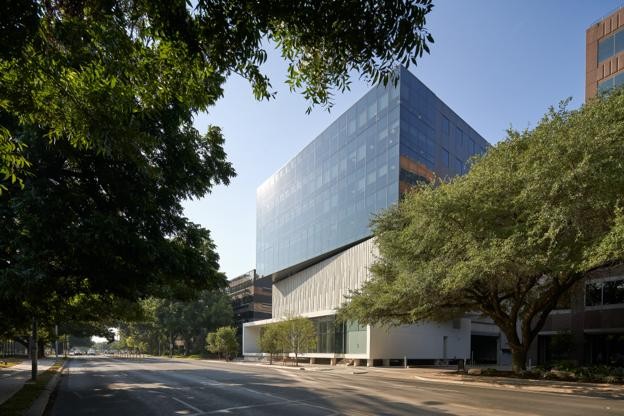
Advanced nuclear technology company Blykalla announced it will establish a new technology center in Austin, Texas, to expand its engineering and reactor R&D operations in the United States. Located at 801 Barton Springs Road in Austin, the center will house engineering and reactor development teams to strengthen the company's local operations and advance collaboration with its U.S. partners, regulators, and stakeholders in the clean energy industry. Blykalla stated that the Austin technology center will serve as its U.S. hub for engineering and advanced nuclear reactor R&D. The company currently operates two complementary business centers in the U.S.—Austin and New York: Austin focuses on technology R&D and engineering...
2026-09-02
France's n-Floating Floating Nuclear Power Project Receives Nearly One Million Euros in Funding
newcleo announced on August 26 that a consortium led by the company has been selected for a call for projects managed by Bpifrance, the French public investment bank, supporting the decarbonization of France's maritime sector. The consortium will advance research on a floating nuclear power solution called n-Floating, with the project receiving nearly one million euros in funding and an expected duration of approximately 18 months. The n-Floating project aims to validate the relevance and technical feasibility of a new floating nuclear power solution. Under the proposed concept, a non-self-propelled floating unit would carry multiple LFR-AS-200 reactors, each with an electrical output of 200 megawatts. LFR-AS-200 is one of the lead-cooled fast reactor technology lines developed by newcleo.
2026-08-27
Newcleo Initiates U.S. Regulatory Pre-Application Engagement for MOX Fuel Facility, Accelerating Advanced Reactor Fuel Supply Chain Development
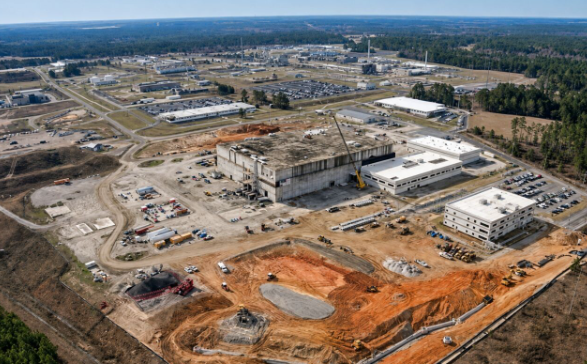
Advanced reactor and nuclear fuel company Newcleo has initiated regulatory pre-application engagement with the U.S. Nuclear Regulatory Commission (NRC) for a mixed oxide (MOX) fuel fabrication facility, with plans to advance construction at the Savannah River Site in South Carolina. This move indicates that the company is not only advancing the licensing of its advanced reactor itself but also seeking to establish supporting fuel supply capabilities in parallel, aiming to mitigate fuel bottlenecks in future commercial deployment. The submitted regulatory engagement plan represents a key step prior to formal license application, with the core objective of communicating with regulators in advance on facility design, safety standards, review scope, and key technical issues. Newcleo previously submitted its regulatory engagement plan for the LFR-AS-200 lead-cooled fast reactor to the NRC in July...
2026-08-07