
Search Results
Keyword:neutron irradiation

Korean Research Team Reveals Mechanism Behind Neutron Irradiation-Induced Reliability Degradation in Ferroelectric AI Semiconductors
Jeonbuk National University announced on the 20th that a research team led by Professor Bae Hak-yeol from the Department of Electronic Engineering at its College of Engineering, in collaboration with Professor Kim Tae-wan's team at Seoul National University and Q-Beam Solution, a startup affiliated with the Korea Atomic Energy Research Institute, conducted a joint study analyzing the causes of performance degradation in next-generation ferroelectric memory and neuromorphic semiconductor devices under neutron irradiation. The findings have been published in the latest issue of ACS Applied Electronic Materials. Ferroelectric semiconductors, which can maintain their polarization state even after power is disconnected, are considered a key candidate for next-generation non-volatile memory and neuromorphic computing devices. Neuromorphic computing aims to simultaneously implement both memory and computation within a single device...
2026-08-20
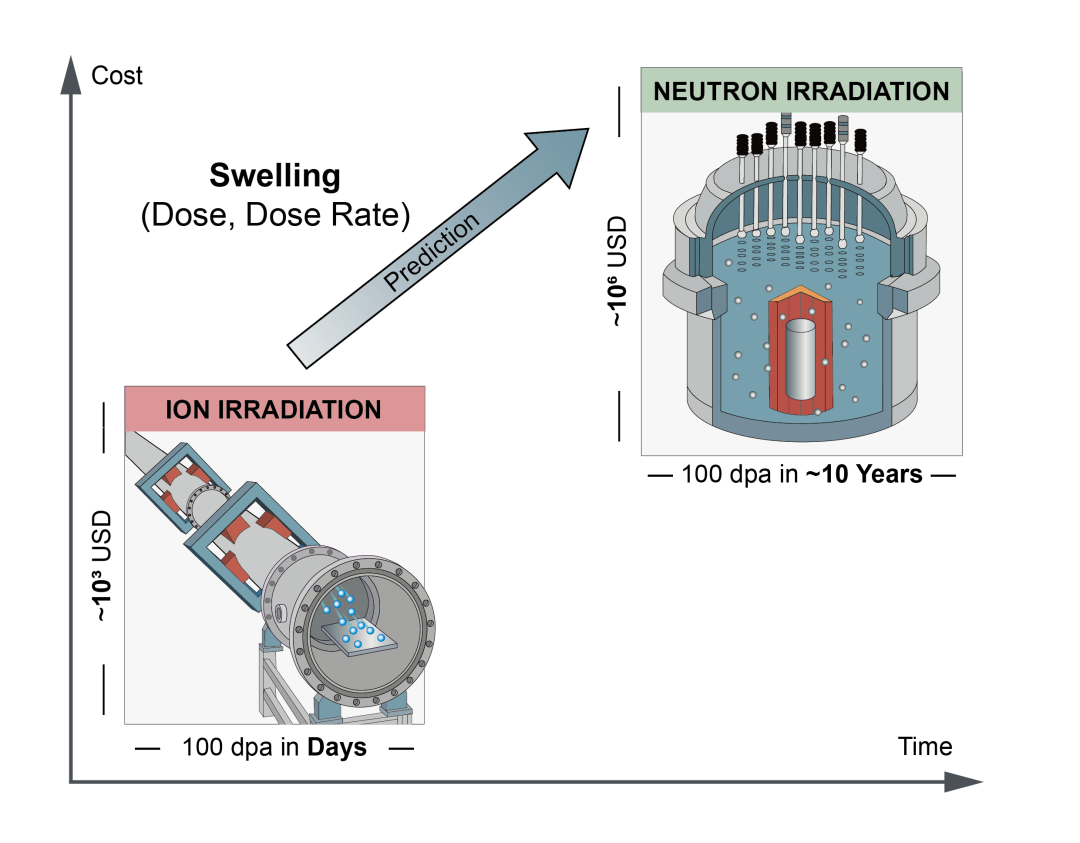
Basic research cracks an application challenge that has persisted for nearly half a century: quantitative prediction of neutron irradiation swelling via ion irradiation
Whether advanced nuclear energy systems can operate safely over the long term depends on the ability of structural materials to resist neutron irradiation damage. Neutrons create numerous atomic-scale defects in materials, which gradually aggregate into nanoscale cavities, ultimately causing material swelling, dimensional instability, and performance degradation. However, obtaining high-dose neutron irradiation data often requires years or even more than a decade, with high costs and post-irradiation sample radioactivity; in contrast, ion irradiation can simulate years of accumulated damage within days and is therefore widely adopted (approximately 95% of irradiation experimental data in existing literature come from ion irradiation). But the dose rate of ion irradiation is typically 3—4 orders of magnitude higher than that of neutron irradiation, making direct conversion between the two results difficult. Recently, the research team of Wang Chenxu and Wang Yugang from the Institute of Heavy Ion Physics, School of Physics, and the State Key Laboratory of Nuclear Physics and Nuclear Technology at Peking University, in collaboration with researchers from the University of Tennessee and other institutions, established a quantitative relationship between material swelling and irradiation dose and dose rate at fixed temperatures based on cluster dynamics simulations, theoretical derivations, and ion irradiation experiments, achieving prediction of neutron irradiation swelling using rapid ion irradiation and providing a new tool for rapid screening and lifetime evaluation of nuclear materials.
2026-08-07

Hefei establishes a new joint laboratory for fusion reactor material irradiation and evaluation, driving the coordinated development of the nuclear fusion industry.
Recently, the Joint Laboratory for Fusion Reactor Material Irradiation and Evaluation—co-established by the Institute of Plasma Physics (Hefei Institutes of Physical Science, Chinese Academy of Sciences) and the Institute of High Energy Physics (Chinese A
2026-07-27