
The Institute of Modern Physics, Chinese Academy of Sciences, has made progress in developing heat-tolerant industrial lactic acid bacteria strains via heavy-ion beam mutagenesis.
 Scan to share
Recently, researchers from the Institute of Modern Physics of the Chinese Academy of Sciences and the National Key Laboratory of Heavy Ion Science and Technology relied on the carbon ion beam provided by the Lanzhou Heavy Ion Research Facility (31111.02.HIRFL) to successfully breed a high-temperature-resistant industrial lactic acid strain and achieve low-cost lactic acid production from non-grain raw material sweet sorghum biomass. Relevant results were published in the American Chemical Society's academic journal "ACS Sustainable Chemistry & Engineering".
The economic feasibility of lactic acid biomanufacturing based on non-grain raw material sweet sorghum biomass still faces major challenges. High-temperature biomanufacturing can effectively reduce pollution and energy consumption, while improving material transfer efficiency and product yield, and has significant production economic advantages. However, the current tolerance temperature of most industrial lactic acid bacteria is only about 50°C. Further increasing the fermentation temperature will lead to a significant decrease in the metabolic activity of the strains.
To address this bottleneck, the research team used heavy ion beam mutagenesis technology to select industrial lactic acid bacteria strains with significantly improved high temperature resistance. Research has found that this strain exhibits excellent survival, growth and fermentation properties under high temperature conditions. Through comparative genomics and transcriptional expression analysis, two key mutated genes were identified, which were closely related to the improvement of temperature tolerance of the strain. On this basis, a matching "two-stage" temperature-raising fermentation strategy was established, which significantly improved the acid production capacity and raw material conversion rate of the high-temperature resistant strain. This study fully demonstrated the advantages of heavy ion beam mutagenesis technology in industrial microbial breeding, achieved rapid breeding of complex industrial traits, and provided a new strategy for high-value utilization of non-food biomass resources and green biomanufacturing.
This work was jointly completed by the Institute of Modern Physics, Gansu Agricultural University, and Baiyin Kejin Heavy Ion Beam Bioindustry Innovation Research Institute. The first author of the paper is doctoral student Shan Wenwen, and the corresponding authors are young researcher Hu Wei and researcher Zhou Libin of the Institute of Modern Physics. This work was supported by the National Natural Science Foundation of China, Longyuan Young Talents, and Lanzhou Science and Technology Planning Project.
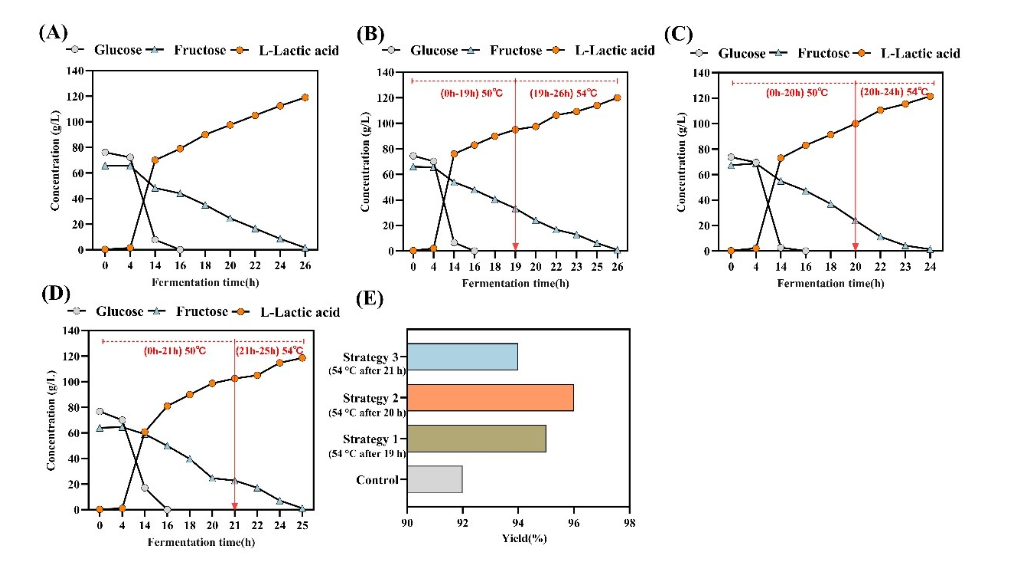
Figure: High-temperature resistant industrial lactic acid bacteria bred based on heavy ion beam mutagenesis technology and its efficacy in converting non-grain sweet sorghum biomass to produce lactic acid.
Disclaimer: Information republished from partner media, institutions or other websites is provided for reference and communication purposes only. It does not imply endorsement of its views or verification of its accuracy. Please contact us if any content infringes rights or requires correction.