
U.S. Brookhaven National Laboratory Achieves Milestones in High-Luminosity Large Hadron Collider Upgrade
 Scan to share
On July 29, the Large Hadron Collider (LHC) at CERN concluded its recent run and entered a four-year shutdown for maintenance. During this shutdown, some LHC components will be dismantled and rebuilt for the High-Luminosity LHC (HiLumi LHC) upgrade project. The U.S. Department of Energy's Brookhaven National Laboratory has recently achieved important production milestones in both accelerator and detector-related work.
The LHC helps scientists study the fundamental structure of matter by accelerating and colliding two beams of protons traveling in opposite directions in a nearly 17-mile circular ring. The core goal of the HiLumi LHC upgrade is to significantly increase the number of particle collisions per unit time, i.e., enhance "luminosity," thereby increasing the chance of recording rare interactions.
In terms of accelerator upgrades, Brookhaven National Laboratory, in collaboration with Lawrence Berkeley National Laboratory and Fermi National Accelerator Laboratory, is developing superconducting beam-focusing magnets for the HiLumi LHC. The new magnets use niobium-tin material, which can carry higher currents and generate stronger magnetic fields, but the material is more brittle, imposing high requirements on coil winding, heat treatment, installation, and testing. Brookhaven National Laboratory is responsible for key steps such as coil fabrication and cryogenic testing, which are conducted in a liquid helium environment near absolute zero, with each magnet test taking approximately two months.
According to reports, the team has completed the fabrication of 24 magnets ahead of schedule and within budget. Some magnets have already been paired and installed in cryostats, undergoing comprehensive testing at CERN, with related tests expected to be completed this summer.
In detector upgrades, Brookhaven National Laboratory, as the U.S. host laboratory for the ATLAS experiment, is involved in the design and fabrication of key components such as the new inner tracker detector. The ATLAS detector captures signals generated after particle collisions, and its innermost tracker, being close to the collision point, must adapt to the higher data rates and radiation levels brought by the HiLumi LHC.
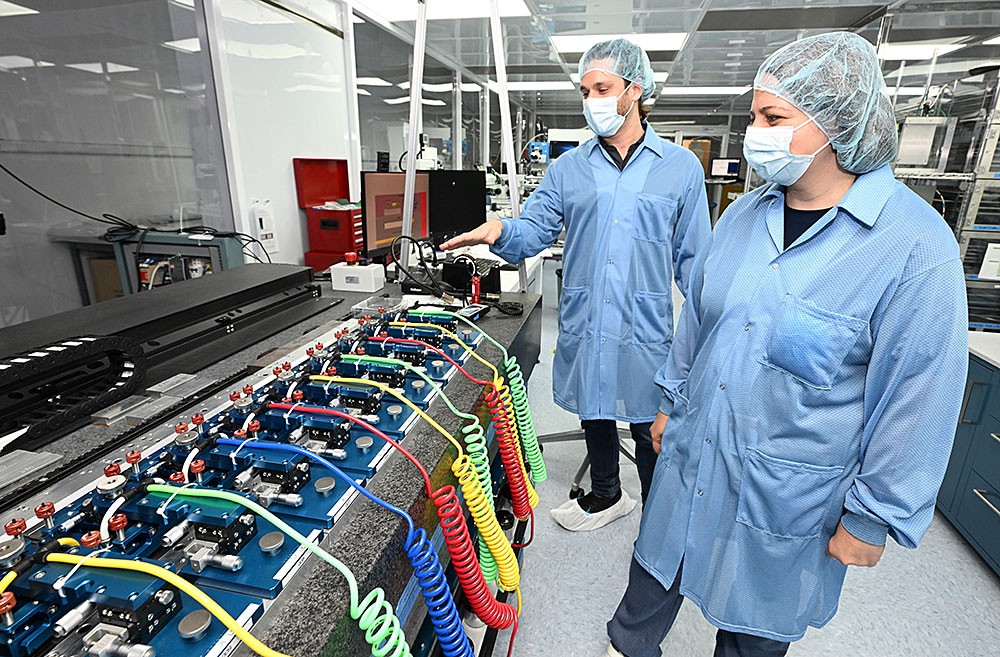
Brookhaven National Laboratory has contributed nearly 650 square feet of silicon area to the inner tracker detector, containing over 20 million sensors. One year after production launch, the team has completed and delivered 10% of the total components required by ATLAS. Project personnel stated that this progress indicates the production process has been validated, and subsequent component production and delivery are expected to accelerate.
Brookhaven National Laboratory believes that the HiLumi LHC upgrade will not only provide higher-sensitivity experimental conditions for particle physics research but also offer training opportunities for students and young researchers in areas ranging from superconducting coil fabrication to detector testing, thereby building technical capacity for future collider projects.
Disclaimer: Information republished from partner media, institutions or other websites is provided for reference and communication purposes only. It does not imply endorsement of its views or verification of its accuracy. Please contact us if any content infringes rights or requires correction.