
Chinese Jinshui River study reveals seasonal variations affect nitrogen removal capacity of forest streams
 Scan to share
A new study shows that the capacity of forest streams to remove excess nitrogen varies with the seasons, influenced by different environmental factors in summer and winter respectively. This finding suggests that water quality management in forest watersheds needs to give greater consideration to seasonal differences.
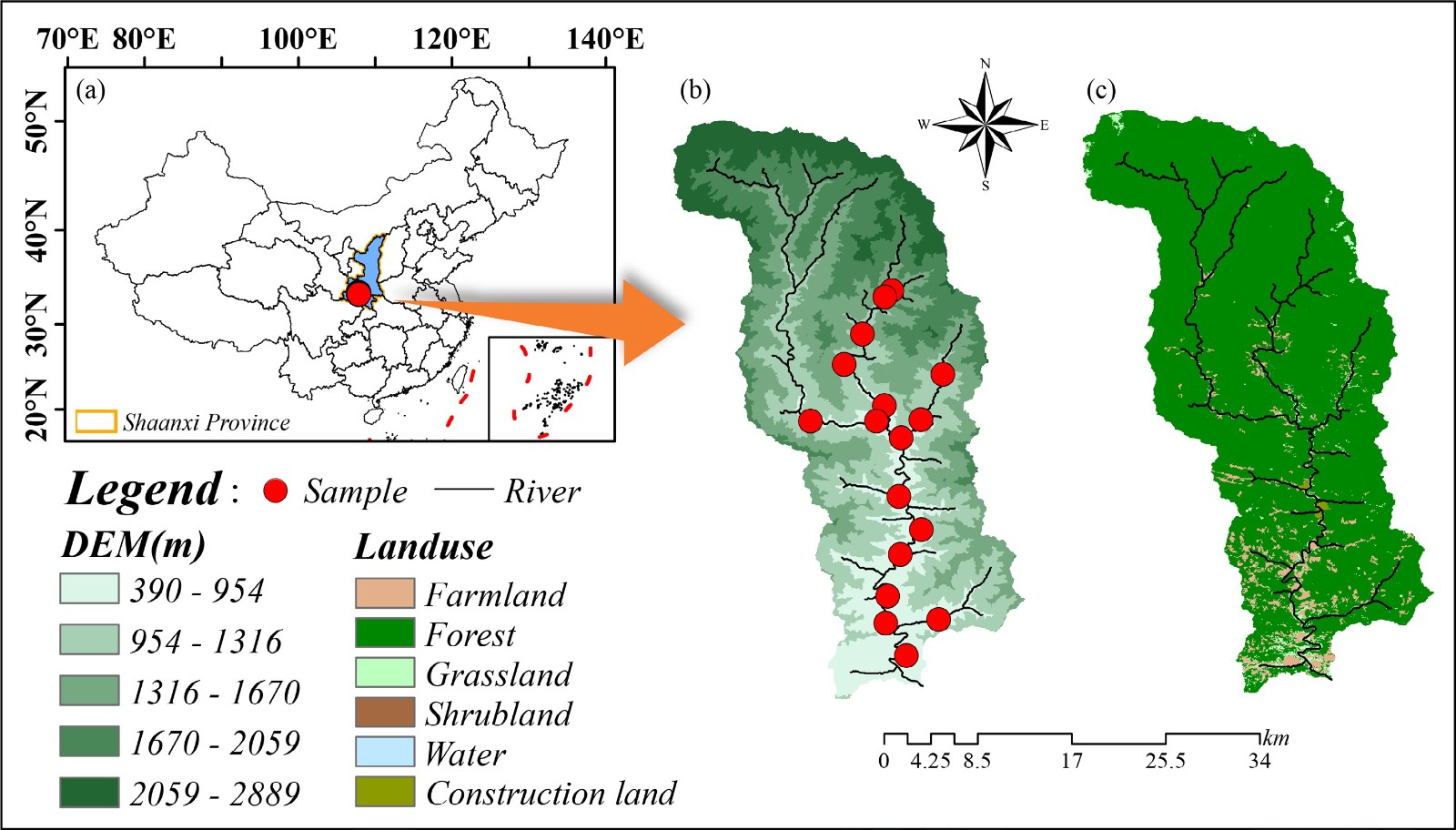
Figure 1. Location of study sites along the Jinshui River. (a) Watershed location; (b) Watershed topography and sampling point distribution; (c) Watershed land use types.
Researchers focused on the Jinshui River in central China, analyzing water and surface sediment samples from 18 sites along forested riparian zones. The study integrated methods including nitrogen-15 isotope tracing, remote sensing monitoring, water and sediment chemical measurements, and microbial gene analysis to track nitrogen cycling and natural denitrification processes in the river.
The results indicate that denitrification is the primary natural nitrogen removal pathway in the river throughout the year, accounting for approximately 90% of total nitrogen removal in summer and about 95% in winter. Denitrification rates were higher during the warmer season; meanwhile, the anammox process also contributed to nitrogen removal in both summer and winter.
The study found that nitrogen removal in summer is primarily driven by microbial activity and sediment characteristics, including organic carbon, nitrogen content, and moisture conditions in the sediment. In winter, the dominant factors shift to water chemistry conditions, with temperature and ammonium-nitrogen and nitrate concentrations having a more pronounced influence on microbial denitrification processes.
Hao Jiang, corresponding author from the Wuhan Botanical Garden of the Chinese Academy of Sciences, stated that river nitrogen removal processes cannot be explained by a single environmental factor, as the dominant factors change with the seasons. Therefore, effective watershed management must consider both large-scale landscape conditions and the microscopic processes occurring in river sediments.
The researchers believe these findings will help improve global nitrogen cycling models and provide a basis for forest watershed management, thereby reducing downstream nutrient pollution and protecting water quality.
Disclaimer: Information republished from partner media, institutions or other websites is provided for reference and communication purposes only. It does not imply endorsement of its views or verification of its accuracy. Please contact us if any content infringes rights or requires correction.