
Fusion for Energy completes full delivery of ITER cryopump distribution system
 Scan to share
The International Thermonuclear Experimental Reactor (ITER) will operate in an ultra-high vacuum environment. To prevent contamination inside the device, a set of cryopumps supplied by Europe will extract gas particles and alternate operation before and after plasma discharges, maintaining the vacuum vessel pressure at approximately one millionth of Earth's atmospheric pressure.
The core of cryopump operation lies in the extremely low-temperature environment. Its internal panels will be cooled to 4 K, approximately minus 269 degrees Celsius, close to absolute zero, to capture gas particles; they are then warmed to release and expel the particles. To precisely control this process, Europe is also supplying ITER with the Front-End Cryopump Distribution System (FECDS), which delivers helium at specific doses and temperatures to the cryopumps.
The FECDS consists of eight toroidal cryostat cold valve boxes, three neutral beam cold valve boxes, one warm regeneration box, a cryogenic piping network, and a control system that coordinates fluid flow. Fusion for Energy (F4E) signed the relevant procurement agreement in 2017, taking responsibility for the system's design and manufacturing. After nine years of progress and through nine contracts with European industry, the entire system has been delivered to the ITER site.
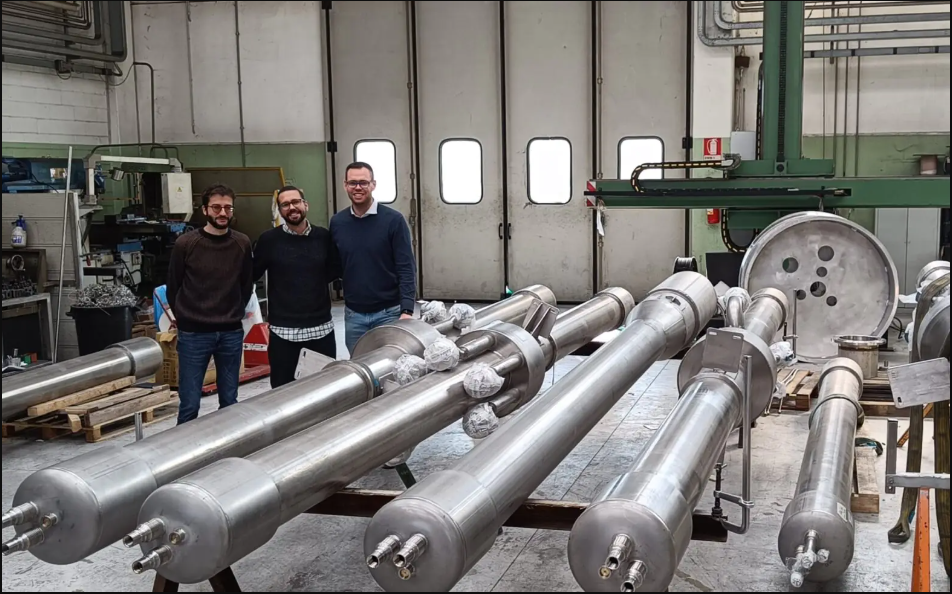
The final batch of equipment arrived this month, mainly comprising the last cryogenic lines needed for the neutral beam cryopumps. This batch came from the Italian SME Criotec, a company specializing in cryogenic and high-vacuum technology that has collaborated with F4E since 2022 on equipment manufacturing and testing.
These cryogenic lines are not ordinary pipes. They must transport extremely low-temperature fluids, withstand significant temperature fluctuations, and maintain vacuum sealing; their structure must also adapt to the complex and compact installation spaces around the tokamak. Some of these lines, known as "cryogenic jumpers," feature flexible designs and detachable connections that enable remote robotic operation.
F4E Project Manager Lluís Mora stated that the team addressed stringent technical requirements and optimized the integration and maintenance schemes for the cryogenic lines within ITER's neutral beam rooms. He said this delivery marks the completion of a demanding engineering effort and is the result of the team's long-term commitment.
Criotec CEO Marco Roveta noted that the company has over a decade of experience in cryogenic lines, and this contract has driven it to further deepen its capabilities, including meeting stringent requirements, developing customized solutions, and strengthening the supply chain. He believes that F4E's support and the dedication of the engineering and production teams enabled the company to overcome multiple challenges during project implementation.
With the delivery of the cryogenic lines complete, F4E and its supply chain have fulfilled Europe's supply commitments in the FECDS project. F4E Project Manager Josep Benet stated that FECDS is a complex system connecting the cryogenic plant, vacuum system, and fuel cycle system, and must operate under demanding conditions. Through the manufacturing and delivery of this equipment, F4E and European industry have accumulated specialized expertise in key ITER technologies, and its suppliers have gained capabilities to continue serving fusion engineering.
Disclaimer: Information republished from partner media, institutions or other websites is provided for reference and communication purposes only. It does not imply endorsement of its views or verification of its accuracy. Please contact us if any content infringes rights or requires correction.