
Progress in Tritium Containment and Radiation Protection Materials Research at the Institute of Plasma Physics, Chinese Academy of Sciences
 Scan to share
Future fusion facilities require comprehensive performance from radiation protection materials in tritium safety containment systems, including airtight sealing, flexibility for easy assembly and disassembly, and radiation shielding capability, for penetration hole sealing, post-maintenance, and high-flux neutron and γ-ray radiation protection. The research team synthesized micron-sized spindle-shaped PbWO₄ (tetragonal bipyramidal crystals) via an aqueous direct precipitation method and combined it with micron-sized B4C as shielding agents. A series of silicone rubber composites were fabricated through hydrosilylation crosslinking casting, and compared against various commercial shielding agents. Due to its stronger polarity, smaller particle size, and more uniform distribution, the spindle-shaped PbWO₄ exhibited good compatibility with the matrix and effectively suppressed chain segment motion, enhancing the thermal stability and mechanical properties of the composites: the thermal decomposition temperature reached 335.4 °C, compressive strength reached 5.32 MPa, and tensile strength was 0.92 MPa, meeting the airtightness and detachability requirements for penetration holes. Furthermore, the composite demonstrated excellent UV resistance, with minimal tensile strength loss after accelerated aging, highlighting outstanding environmental service durability.
Monte Carlo simulations verified the composite's synergistic shielding capability against neutrons and gamma rays, as well as its suppression of secondary gamma rays. At a measured thickness of 15 cm, the shielding rates for ²⁵²Cf neutrons and ¹³⁷Cs gamma rays reached 93.13% and 82.76%, respectively, with neutron protection performance superior to concrete and gamma protection performance comparable to concrete. This work provides a new strategy for the design of tritium containment radiation protection materials for fusion applications.
This research was supported by the Fusion Reactor Materials and Tritium Fuel Key Technology R&D and Experimental Verification Platform, the National Natural Science Foundation of China, the Anhui Provincial Ecological Environment Research Project, the Anhui Provincial University Collaborative Innovation Project, and the Institute of Energy, Hefei Comprehensive National Science Center (Anhui Energy Laboratory), among others.
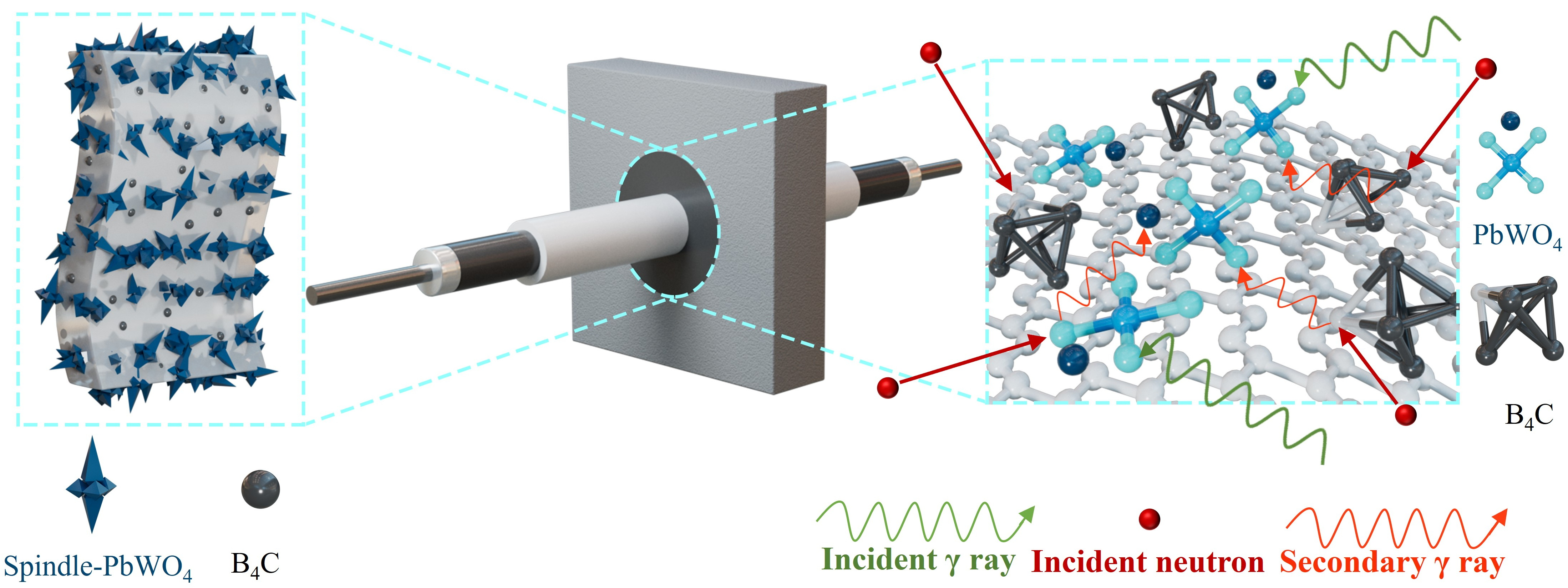
Figure 1. Schematic diagram of the mechanism of micron spindle-shaped PbWO4 filler-reinforced flexible silicone rubber for penetration hole sealing and radiation shielding in fusion facilities
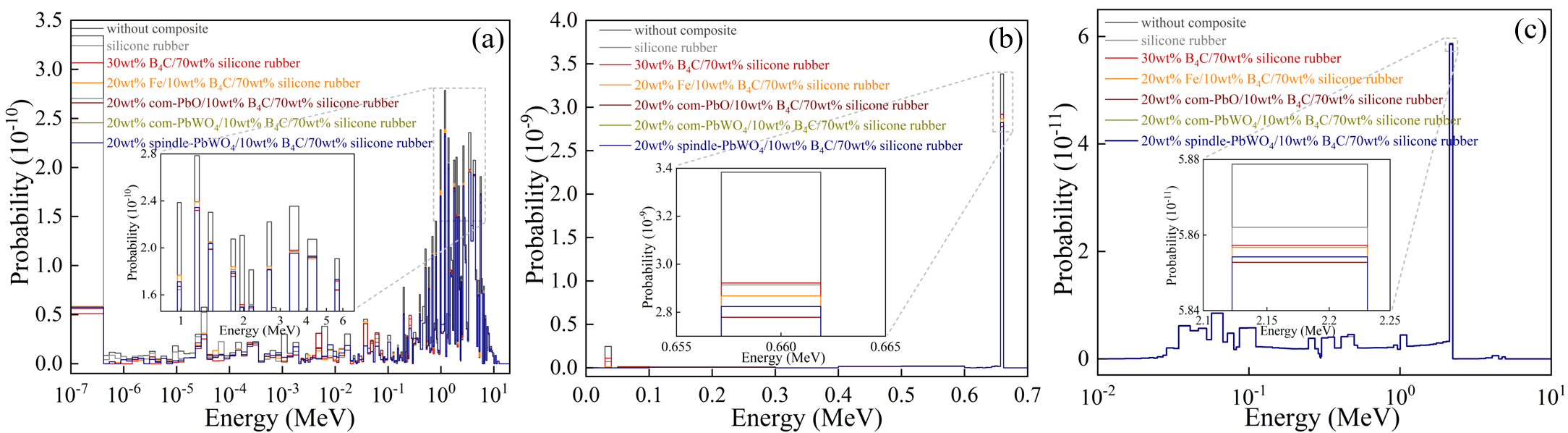
Figure 2. Monte Carlo simulated energy spectra of (a) incident neutrons, (b) gamma rays after shielding by the silicone rubber composite, and (c) secondary gamma rays
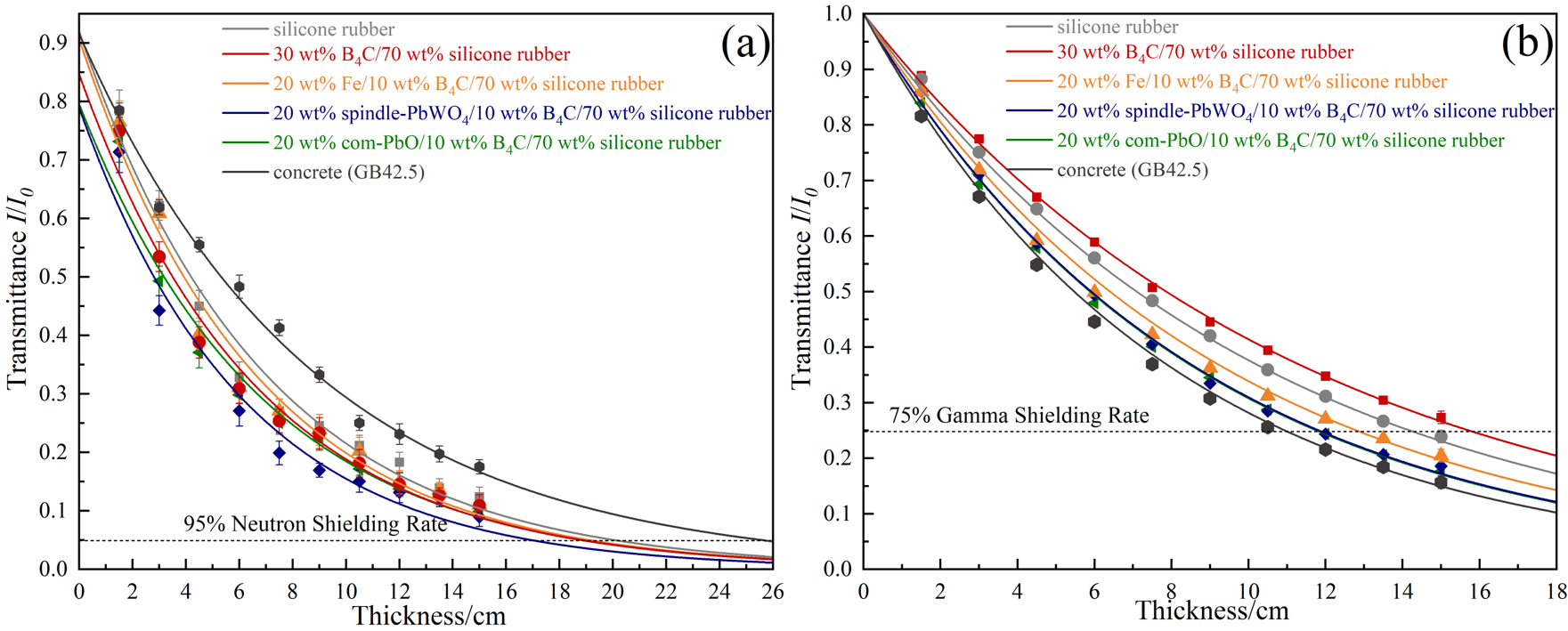
Figure 3. Measured (a) neutron and (b) gamma ray attenuation curves of the silicone rubber composite and building concrete
Disclaimer: Information republished from partner media, institutions or other websites is provided for reference and communication purposes only. It does not imply endorsement of its views or verification of its accuracy. Please contact us if any content infringes rights or requires correction.